Buying a car for ₹10-15 lakh? Here’s what buyers should check before choosing a new lower-end or used higher-end model
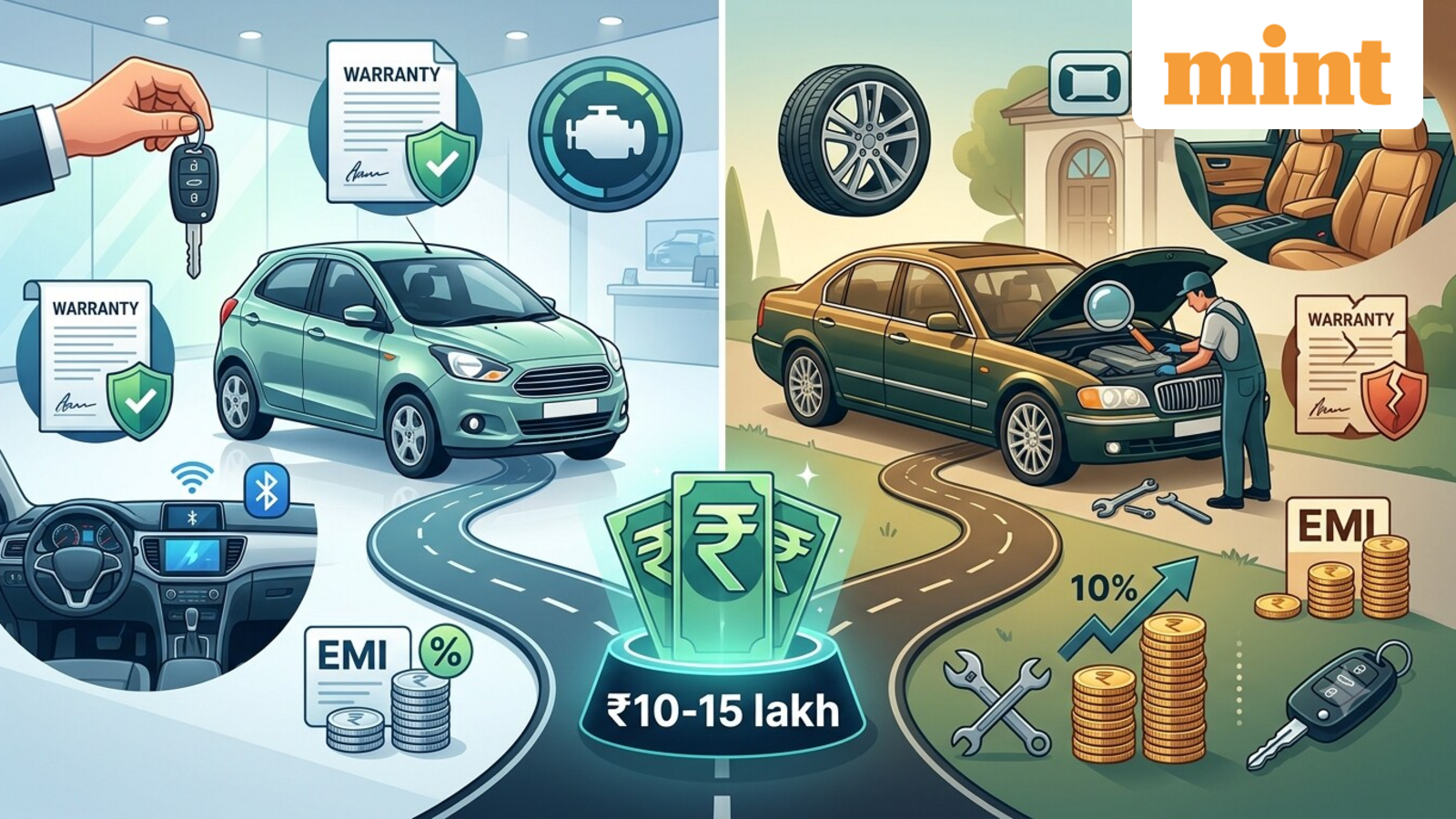
A ₹10-15 lakh budget can leave car buyers with a tricky choice. They can put the money into a new, lower-end model and get a full warranty, newer technology and the certainty of being the first owner. Or, they can look at the pre-owned market and potentially get a larger, better-equipped car that would have been out of reach when new.
The second option may look like a smarter way to stretch the budget, but a lower purchase price does not tell the whole story. A used car can come with higher financing costs, a shorter warranty, greater maintenance needs and a different depreciation and resale profile. The right choice therefore depends on what the buyer values and what the car is likely to cost over the entire period of ownership.
New or pre-owned? Compare the real cost, not just the price
“The starting point is the buyer’s usage and the total cost of ownership, rather than simply the difference between the two purchase prices,” said Uttam Agarwal, CBO, Bajaj Capital.
For a pre-owned car, buyers should consider its age, condition, kilometres driven, service history, remaining warranty, insurance, financing cost, expected maintenance and resale value. These need to be compared with the warranty, financing terms, running costs and depreciation of a new car, he said.
Thomas Stephen, Director & Head – Preferred, Anand Rathi Share and Stock Brokers, said depreciation, financing cost and running costs are the key factors in this segment.
Mass-market cars generally depreciate more slowly than luxury cars. A typical sedan or hatchback is commonly estimated to lose around 15% to 20% of its value in the first year and around 28% to 38% cumulatively by the second or third year, although the actual resale value depends on the model, variant, city and condition.
This means the depreciation saving from buying a two-year-old car may not be as dramatic as it is in the luxury segment. But a well-priced pre-owned car can still offer a meaningful reduction in the acquisition cost.
More features for the same money, but with more risk
The same ₹10-15 lakh can buy a buyer a lower-end new car or a higher-end pre-owned model. The latter could offer more features, space or a higher vehicle segment for the same budget.
But buyers should not assume that a more expensive car when new will automatically be the better choice when bought used.
“A new, lower-end car typically brings the comfort of a full warranty, more predictable ownership costs in the initial years and newer technology,” Agarwal said. A higher-end pre-owned car can offer more features and a different ownership experience, but may also come with higher maintenance and repair costs.
Stephen said buyers should compare the exact variant and its safety features rather than assume that a newer or larger car is automatically safer. Buyers considering a used car should also check its accident history, service records and remaining warranty through a professional inspection.
The age of the used car also matters. “Within this price range, the difference between a well-maintained two-year-old vehicle and a five-year-old one can be quite meaningful,” Agarwal said.
The lower used-car price can come with a higher EMI
Financing can make the new-versus-used calculation less straightforward.
Used-car loans generally carry higher interest rates than new-car loans and may also have shorter tenures. That means the buyer could save on the purchase price but pay more in interest and face a higher monthly EMI.
Published rates from major lenders can put new-car loans in this segment at roughly 8.70% to 9.75%, compared with around 10.25% to 13.50% for used-car loans, although the actual rate depends on the lender and borrower.
Adhil Shetty, CEO of BankBazaar, said a ₹10 lakh loan at 9.2% for seven years would have an EMI of around ₹16,190, while a loan at 11.75% for five years would have an EMI of around ₹22,100. The illustration shows why buyers should compare both the EMI and the total interest payable.
“Pre-owned car loans generally carry higher interest rates and may have shorter tenures,” Shetty said. “A lower purchase price does not necessarily mean a lower overall cost if financing is significantly more expensive.”
Stephen added that used-car loans can also have lower loan-to-value ratios, which means buyers may need to make a larger upfront down payment.
Check maintenance and resale before deciding
The purchase price and loan are only part of the calculation. Insurance, servicing, repairs and eventual resale value can change the economics further.
“A pre-owned car generally comes with a lower acquisition cost, but financing, insurance, maintenance and the possibility of repairs can narrow that initial gap,” Agarwal said.
For a used car, buyers should therefore check whether the lower price reflects genuine depreciation or whether it is compensating for high mileage, accident history, poor maintenance or upcoming repairs.
The buyer should also consider how long they plan to keep the vehicle. A two-year-old car with a strong service record and several years of useful life ahead may offer a different proposition from a five-year-old vehicle that is approaching larger maintenance expenses.
So, which should you buy?
There is no single answer because the two choices serve different priorities.
A new lower-end car offers a full manufacturer’s warranty, no previous ownership history, newer technology and more predictable costs during the early years.
A higher-end pre-owned car can offer more space, features and equipment for the same budget, while allowing the buyer to avoid part of the initial depreciation. But it requires greater due diligence and can carry higher financing, maintenance and repair costs.
For a buyer who prioritises predictable ownership and wants to minimise uncertainty, the new car’s warranty and lower early-year maintenance risk may carry more weight. For someone willing to inspect the vehicle carefully and prioritise a higher segment or better equipment, a well-maintained pre-owned car can make the same budget go further.
The key is to compare the total cost over the intended ownership period, including purchase price, depreciation, EMI, total interest, insurance, maintenance, repairs and resale value. The car that offers more features at the time of purchase is not necessarily the one that leaves the buyer with the lower overall ownership cost.