
Pooled Employer Plans May Reshape Advisor Economics
Pooled Employer Plans were supposed to transform retirement by dramatically expanding coverage, moving small employers en masse away from stand-alone plans, and materially reducing costs and administrative burdens. So far, that revolution has been slow to materialize.
But perhaps we have been looking for the impact of PEPs in the wrong place.
The more consequential change may not be how many employers join PEPs, but how pooled arrangements change the economics of serving advisors and how advisors serve plans. By standardizing functions across clients, PEPs are providing advisors with further operating leverage while potentially giving record keepers access to multiple plans through a single advisor relationship.
In that sense, PEPs may be less a new retirement product than a new distribution model.
For decades, the defined contribution system has been primarily organized around the individual employer, with each sponsor, increasingly with the assistance of an advisor, assembling its own recordkeeping, administration, investments, advice and fiduciary oversight. PEPs offer a different model built around shared retirement-plan infrastructure.
The Shift Was Already Underway
PEPs are part of a broader movement toward simplification, consolidation and collective solutions that predate them. Consider bundled recordkeeping arrangements, a trend we have been tracking for some time at NMG Consulting. In our most recent DC Advisor Insights Study, we found that the share of advisors recommending fully bundled solutions increased from 40% in 2015 to approximately 50% in 2025, while preference for fully unbundled arrangements fell to 18%. Among DC specialists, preference for bundling increased from 45% to 66%.
Bundling and PEPs are not the same, but they respond to many of the same pressures: fewer administrative handoffs, more concentrated accountability, limited employer resources and demand for a more integrated experience. Bundling simplifies the traditional single-employer plan. PEPs take that logic further by sharing infrastructure and shifting certain administrative and fiduciary responsibilities to specialists.
Specialists Provide the Clue
Perhaps the more revealing evidence comes from who is embracing PEPs. PEP adoption is concentrated among DC specialists. More than half of DC specialists are interested in PEPs, compared with less than a third of wealth advisors. That difference carries through to behavior: specialists’ clients are more likely to be aware of PEPs, specialists are considerably more likely to recommend PEPs, and nearly half already have clients participating in a pooled arrangement.
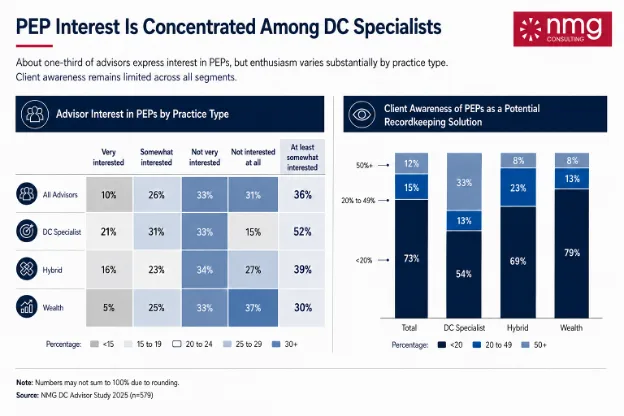
That pattern matters. If PEPs were primarily a way to make retirement plans easier for advisors with limited DC expertise, wealth advisors should be leading adoption. They aren’t.
Instead, the advisors most immersed in the DC business, and arguably best equipped to manage stand-alone plans, are furthest along in adopting pooled solutions. That suggests specialists see the potential scale benefits.
Standardizing functions across clients allows advisors to serve more employers without proportionately adding resources. It can make servicing plans more economically attractive while allowing advisors to spend less time on plan mechanics and more on provider oversight, participant outcomes and strategic advice.
Of course, there are drawbacks. Moving clients into PEPs can mean giving up some flexibility around provider selection, plan design, investments or servicing. It can also require advisors to reconsider where they add value as more responsibilities become centralized.
Changing the Unit of Competition
As PEPs create operating leverage for advisors, they are also changing the economics of advisor-record keeper relationships. Traditionally, record keepers competed for plans one mandate at a time. PEPs have the potential to change the unit of competition. Becoming an advisor’s preferred pooled-plan platform can provide access to a succession of clients or a block of clients, rather than to single mandates.
That changes the relationship on both sides. For the record keeper, winning the advisor becomes more valuable because the relationship can represent a persistent stream of future business. For the advisor, aggregating business with fewer strategic partners can create greater leverage around service, pricing, technology and support.
Collective solutions will not replace stand-alone plans, nor are PEPs the inevitable next step after bundling. But that may be beside the point. The long-term significance of PEPs may have less to do with how many employers ultimately adopt them and more to do with how they reshape the economics of advice and recordkeeping. As advisors gain scale by aggregating clients and record keepers gain scale by winning advisor relationships, the unit of competition begins to shift. The prize is no longer necessarily the next individual plan. Increasingly, it may be the advisor relationship that brings the next 10.