8th Pay Commission: How a 24-month delay could mean nearly ₹18 lakh in arrears
The 8th Pay Commission is currently holding consultations with eligible stakeholders on pay, the fitment factor, allowances and pension-related matters concerning central government employees. The commission has already held meetings in states and Union territories, including Rajasthan, Tamil Nadu, Puducherry and Chandigarh.
Going ahead, it is scheduled to meet stakeholders in Bengaluru on October 7 and 8, followed by another set of meetings in Mumbai on October 22 and 23, 2026. The last date to submit applications for the Mumbai meeting is October 10, 2026.
For employees, the eventual implementation date will be particularly important because the longer the gap between when revised pay becomes applicable and its actual implementation, the greater the potential for arrears.
Currently, neither the central government nor the 8th Pay Commission has announced an implementation date. There is speculation that the 8th Pay Commission recommendations could be implemented retrospectively from January 1, 2026. However, official confirmation is awaited.
This also raises the possibility of a delay in the eventual implementation of the 8th Pay Commission and its implications for employees, particularly as the 7th Pay Commission completed its 10-year term on December 31, 2025.
To further explain this, let us take several basic assumptions
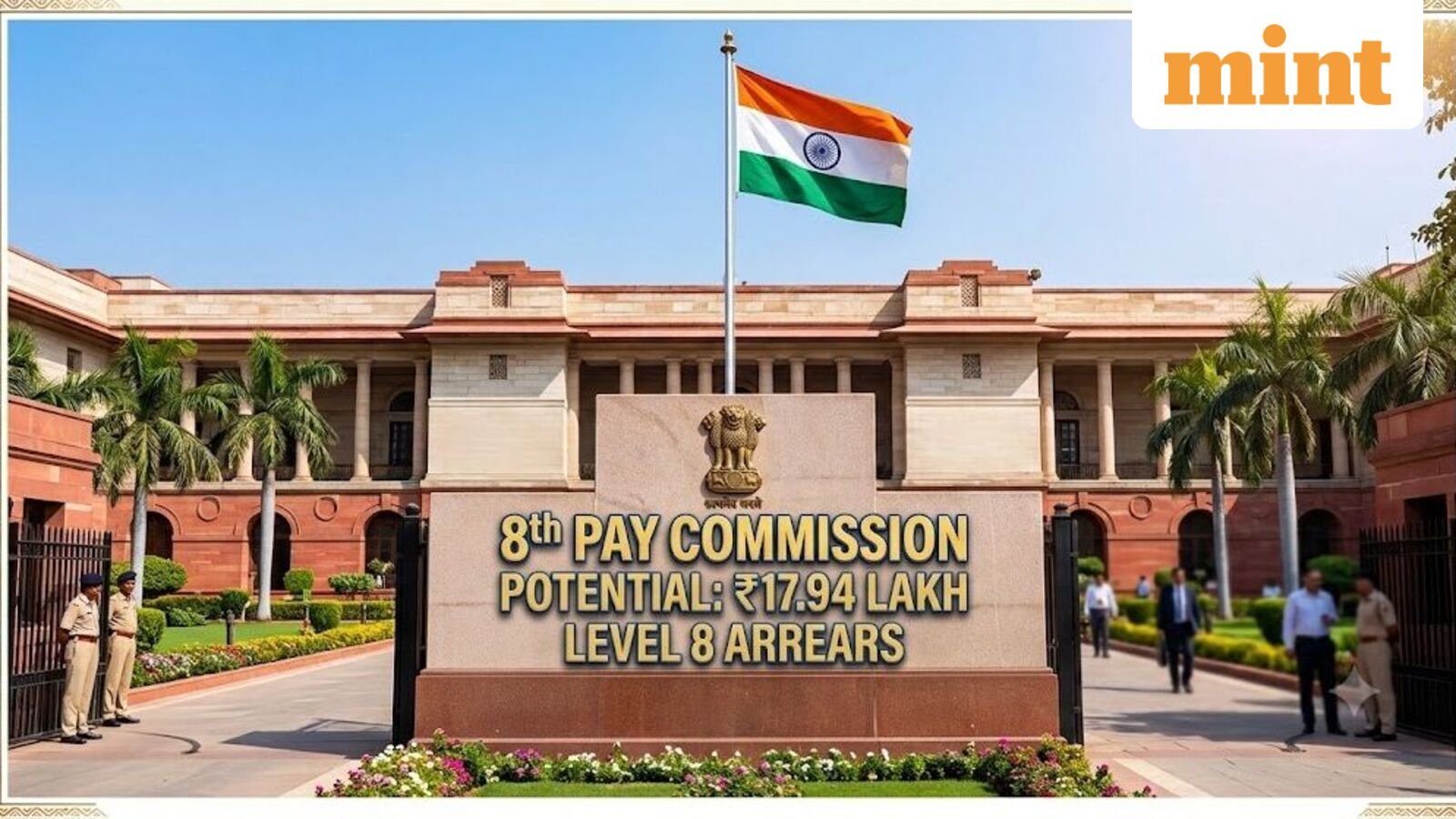
For instance, a Level 8 employee could receive nearly ₹18 lakh in estimated arrears if the implementation of the 8th Pay Commission were delayed by two years (24 months) and a 2.57 fitment factor were used, similar to the fitment factor adopted under the 7th Pay Commission.
However, this calculation is purely illustrative and is based primarily on the increase in basic pay. The 8th Pay Commission has not been delayed as of now and still has several months to submit its final recommendations to the central government.
When will the 8th Pay Commission submit its report?
According to the Terms of Reference, the 8th Pay Commission is expected to submit its recommendations within 18 months of its constitution in November 2025, which would place the expected timeline around May or June 2027. The commission can also seek an extension, if required, in accordance with its terms of reference, rules and regulations.
After the recommendations are submitted, the government will review them before making a decision and notifying the public of the revised pay structure.
Keeping these factors in mind, the following calculations illustrate the potential arrears under different implementation delays and fitment factors.
The calculations consider implementation delays of 20 and 24 months and fitment factors of 2.15, 2.28 and 2.57. The examples below cover Levels 6, 7 and 8.
Level 6: Estimated 8th Pay Commission arrears
A Level 6 employee currently drawing a basic pay of ₹35,400 could see the following estimated arrears:
|
Fitment factor |
Current basic ( ₹) |
Revised basic ( ₹) |
Increase in basic ( ₹) |
20-month arrears ( ₹) |
24-month arrears ( ₹) |
|---|---|---|---|---|---|
| 2.15 | 35,400 | 76,110 | 40,710 | 8,14,200 | 9,77,040 |
| 2.28 | 35,400 | 80,712 | 45,312 | 9,06,240 | 10,87,488 |
| 2.57 | 35,400 | 90,978 | 55,578 | 11,11,560 | 13,33,872 |
For illustration, using a 2.10 fitment factor and an 18-month delay, the estimated increase in basic pay would be ₹38,940. This would result in estimated arrears of approximately ₹7,00,920 over 18 months.
The actual arrears, however, would depend on the final fitment factor, implementation date and other components of the revised pay structure.
Level 7: Estimated arrears under different fitment factors
For Level 7, the current basic pay considered is ₹44,900.
|
Fitment factor |
Current basic ( ₹) |
Revised basic ( ₹) |
Increase in basic ( ₹) |
20-month arrears ( ₹) |
24-month arrears ( ₹) |
|---|---|---|---|---|---|
| 2.15 | 44,900 | 96,535 | 51,635 | 10,32,700 | 12,39,240 |
| 2.28 | 44,900 | 1,02,372 | 57,472 | 11,49,440 | 13,79,328 |
| 2.57 | 44,900 | 1,15,393 | 70,493 | 14,09,860 | 16,91,832 |
Level 8: Can arrears reach nearly ₹18 lakh?
For Level 8 employees, the calculation takes into account several distinct assumptions. A fitment factor of 2.57 and a current basic pay of ₹47,600. Then the revised basic pay would be ₹1,22,332: 47,600 x 2.57 = 1,22,332.
If the implementation was delayed by 24 months, the estimated arrears on the increased basic pay would be approximately ₹17,93,568, or nearly ₹18 lakh. This figure has been calculated by multiplying the difference between the current and revised basic pay by 24.
₹1,22,332 – ₹47,600 = 74732
Then ₹74,732 is multiplied by 24 months to account for the delay.
₹74,732 x 24 = ₹17,93, 568 or nearly ₹18 lakh.
The following table shows the difference for clarity.
|
Fitment factor |
Current basic ( ₹) |
Revised basic ( ₹) |
Increase in basic ( ₹) |
20-month arrears ( ₹) |
24-month arrears ( ₹) |
|---|---|---|---|---|---|
| 2.15 | 47,600 | 1,02,340 | 54,740 | 10,94,800 | 13,13,760 |
| 2.28 | 47,600 | 1,08,528 | 60,928 | 12,18,560 | 14,62,272 |
| 2.57 | 47,600 | 1,22,332 | 74,732 | 14,94,640 | 17,93,568 |
What about HRA, DA and transport allowance?
The estimated arrears above are primarily based on the presumed increase in basic pay. It is important to note that the House Rent Allowance (HRA) is linked to basic pay and may also increase when the revised salary structure is implemented, subject to the applicable rules and DA-linked revisions.
The transport allowance, on the other hand, is linked to DA, which is revised periodically. Therefore, employees should not assume that the figures in the tables represent their final total arrears. They are simply illustrations only.
Furthermore, the ₹17.94 lakh figure is a possible scenario. It is not a confirmed payment. It assumes several key basics, such as a 24-month implementation delay and a 2.57 fitment factor.
In summary, the actual arrears will depend on the 8th Pay Commission’s recommendations and the government’s final decision on their implementation. For more updates and recent developments, you can refer to the official website of the 8th Pay Commission at: https://8cpc.gov.in/