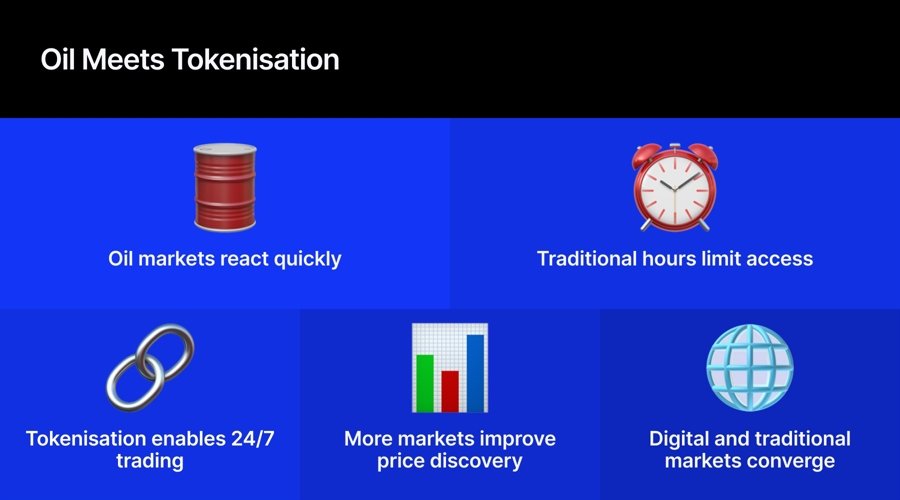
When Oil Never Stops Trading, Tokenisation Could Change How Markets Handle Shocks
Oil has always been
reactionary, a market that responds rapidly to events and serves as a barometer
of both political and economic risk. The problem is that events don’t wait for
markets to open.
London’s trading industry is coming home!
Violent swings in oil
markets have become common as the Middle East conflict continues to stay hot.
The frequency and intensity of each escalation result in violent directional
moves when markets open on Monday morning, with conventional liquidity largely
absent over the weekend.
Traders in oil markets are often left perplexed about where prices will open once trading resumes, as delays in price
discovery mechanisms kicking in lead to extreme swings. The longer this
conflict lasts, the more violent these opening swings are likely to be, and
there is a case for elevated volatility for the foreseeable future as capacity
stays constrained.
This creates an
intriguing use case for tokenisation.
Oil exposure is
already available in digital form across parts of the crypto ecosystem, so the
question is no longer whether crude can become a digital asset. The more
interesting question is what happens when meaningful oil exposure migrates into
markets that operate 24 hours a day, seven days a week, including public
holidays.
For traders and market
participants more broadly, the implications are significant. Brokers that cater
to sophisticated traders know their traders value this one quality
over all: price discovery.
We believe the
technology now exists to bridge conventional liquidity with digital markets, to
harness tokenisation not simply as another product category, but as a means of
evolving how markets absorb information, distribute risk and ultimately arrive
at a price.
Most traders already
know that traditional oil markets are extraordinarily sophisticated. Futures
provide deep liquidity and efficient price discovery, while ETFs, CFDs and
other derivatives give investors multiple ways to express a view on crude
prices. However, they remain pegged to established trading schedules.
Meanwhile, digital assets have introduced a
very different expectation: markets that remain continuously accessible and secure. Combine that
infrastructure with an asset as sensitive to macro developments as oil, and
tokenisation becomes more than another trading instrument. It creates an
additional arena in which expectations can be expressed as events unfold.
Consider a major
geopolitical event occurring over a weekend. Traditional oil benchmarks may not
fully respond until futures trading resumes. A sufficiently liquid tokenised
oil market, by contrast, can begin incorporating changing expectations
immediately.
That doesn’t make
tokenised oil inherently superior to futures, nor does it presage the decline
of established commodity markets. Futures remain deeply embedded in
institutional hedging, risk management and physical commodity trading.
Instead, tokenised oil can develop
alongside them. The
opportunity is therefore not simply to put oil “on the blockchain”.
It is to bring one of the world’s most closely watched macro assets into a
genuinely all-hours trading environment and, in doing so, begin to dissipate
some of the historical boundaries between conventional and digital trading.
From Access to
Convergence
Continuous trading,
therefore, changes the opportunity set for market participants. For
institutional investors, tokenised markets deliver a valuable additional source
of information about how traders are responding to events outside conventional
trading hours.
As liquidity grows, those markets are expected to serve as an
additional signal for trader positioning, market sentiment and, possibly most
important of all, the level of implied risk.
For retail traders,
the implications are different but equally interesting. Oil has historically
been accessed primarily through futures, CFDs, ETFs and specialist commodity
products. Bringing oil exposure into digital-asset ecosystems places it
alongside instruments that a new generation of investors already trades
continuously.
This broadens participation in
commodities while narrowing the historical divide between traditional and digital assets. It
also reflects a larger structural change taking place across financial markets.
Investors increasingly
expect to move between equities, commodities, derivatives and digital assets
without navigating entirely separate financial ecosystems. Tokenisation of
real-world assets (RWA) is accelerating that convergence and has the fintech muscle
to make it happen.
A growing number of trading firms
are therefore exploring
how infrastructure traditionally associated with digital assets can be combined
with established financial markets. The objective is not to replace
conventional markets, but to create new ways to access and trade the
assets within them.
This is where strategy
becomes particularly relevant. Rather than approaching tokenisation as an
isolated crypto trend, brokers need to build towards a multi-asset environment
in which traditional and digital markets coexist.
If assets such as oil
increasingly develop tokenised, continuously traded counterparts, platforms
capable of connecting traditional market infrastructure with digital markets
are set to occupy an increasingly important position in the price-discovery process.
A broker’s
opportunity, therefore, is not simply to add tokenised assets to an exchange.
It is to help build the infrastructure through which the distinction between
“traditional” and “digital” assets effectively dissipates.
More Liquidity,
Less Volatility?
There is another
consequence of this transition that deserves considerably more attention:
volatility.
In theory, deeper and
more continuous liquidity should make markets more efficient. More
participants, greater transparency and fewer prolonged interruptions to price
formation can reduce information asymmetries and allow new developments to be
incorporated into prices incrementally rather than through abrupt repricing
when conventional markets reopen.
Over time, this could
exert a moderating influence on average volatility. A geopolitical development
on Saturday evening, for example, need not result in the entire market’s
reaction being compressed into the opening minutes of Monday trading. Instead,
expectations could evolve throughout the weekend as new information emerges.
But there is a paradox
here.
The same
infrastructure that facilitates more continuous price discovery also creates
another vehicle for speculation. And oil hardly suffers from a shortage of
speculative interest already.
Tokenisation of RWA lowers barriers
to participation and
allows traders to express views at almost any time. That can deepen liquidity
and produce a richer picture of perceived risk. It can also exacerbate
short-term moves when fear, momentum or leverage overwhelms fundamental
analysis.
The result may appear
contradictory: tokenisation could reduce volatility on average while making
individual episodes of volatility more acute.
A sufficiently liquid
market may become more stable during normal conditions because information is
absorbed continuously. During a crisis, however, an all-hours tokenised market
could transmit changing expectations almost instantly. What might previously
have become a Monday morning price gap could instead become a violent repricing
on Saturday night.
Tokenisation does not
abolish volatility. It changes how, and when, that volatility manifests itself.
A New Signal for
Oil Markets
There remains an
important caveat.
A token trading around
the clock only contributes meaningfully to price discovery if there is
sufficient liquidity, credible underlying exposure and enough market
participation for its quotes to matter. A thinly traded token does not suddenly
become a better indicator of crude oil’s value simply because it trades on a
Sunday.
Nor should every
movement in a tokenised market automatically be interpreted as authoritative
price discovery. Some will inevitably represent speculation, temporary
liquidity imbalances or sentiment running ahead of fundamentals.
But that is precisely
what makes the development interesting. Tokenised oil could simultaneously
become a mechanism for measuring risk and creating it.
During ordinary market
conditions, greater participation, transparency and continuous liquidity could
help suppress some of the discontinuities created by fixed trading schedules.
During extraordinary conditions, however, those same characteristics could
accelerate the transmission of fear and speculation through the market.
That is the real
opportunity, and the inherent tension, presented by tokenised oil. It does not
need to replace futures or options to alter market behaviour. It merely needs
to become liquid and credible enough to provide another continuously traded
expression of what participants believe oil is worth.
For platforms such as
ours, that convergence represents something considerably larger than an
expansion of the product catalogue. It is participation in an evolving market
structure in which commodities and digital assets increasingly inhabit the same
ecosystem.
Oil already trades
digitally; the more consequential question is whether tokenisation will change
not only where and when its price is discovered, but how volatility itself is
expressed.
Oil has always been
reactionary, a market that responds rapidly to events and serves as a barometer
of both political and economic risk. The problem is that events don’t wait for
markets to open.
London’s trading industry is coming home!
Violent swings in oil
markets have become common as the Middle East conflict continues to stay hot.
The frequency and intensity of each escalation result in violent directional
moves when markets open on Monday morning, with conventional liquidity largely
absent over the weekend.
Traders in oil markets are often left perplexed about where prices will open once trading resumes, as delays in price
discovery mechanisms kicking in lead to extreme swings. The longer this
conflict lasts, the more violent these opening swings are likely to be, and
there is a case for elevated volatility for the foreseeable future as capacity
stays constrained.
This creates an
intriguing use case for tokenisation.
Oil exposure is
already available in digital form across parts of the crypto ecosystem, so the
question is no longer whether crude can become a digital asset. The more
interesting question is what happens when meaningful oil exposure migrates into
markets that operate 24 hours a day, seven days a week, including public
holidays.
For traders and market
participants more broadly, the implications are significant. Brokers that cater
to sophisticated traders know their traders value this one quality
over all: price discovery.
We believe the
technology now exists to bridge conventional liquidity with digital markets, to
harness tokenisation not simply as another product category, but as a means of
evolving how markets absorb information, distribute risk and ultimately arrive
at a price.
Most traders already
know that traditional oil markets are extraordinarily sophisticated. Futures
provide deep liquidity and efficient price discovery, while ETFs, CFDs and
other derivatives give investors multiple ways to express a view on crude
prices. However, they remain pegged to established trading schedules.
Meanwhile, digital assets have introduced a
very different expectation: markets that remain continuously accessible and secure. Combine that
infrastructure with an asset as sensitive to macro developments as oil, and
tokenisation becomes more than another trading instrument. It creates an
additional arena in which expectations can be expressed as events unfold.
Consider a major
geopolitical event occurring over a weekend. Traditional oil benchmarks may not
fully respond until futures trading resumes. A sufficiently liquid tokenised
oil market, by contrast, can begin incorporating changing expectations
immediately.
That doesn’t make
tokenised oil inherently superior to futures, nor does it presage the decline
of established commodity markets. Futures remain deeply embedded in
institutional hedging, risk management and physical commodity trading.
Instead, tokenised oil can develop
alongside them. The
opportunity is therefore not simply to put oil “on the blockchain”.
It is to bring one of the world’s most closely watched macro assets into a
genuinely all-hours trading environment and, in doing so, begin to dissipate
some of the historical boundaries between conventional and digital trading.
From Access to
Convergence
Continuous trading,
therefore, changes the opportunity set for market participants. For
institutional investors, tokenised markets deliver a valuable additional source
of information about how traders are responding to events outside conventional
trading hours.
As liquidity grows, those markets are expected to serve as an
additional signal for trader positioning, market sentiment and, possibly most
important of all, the level of implied risk.
For retail traders,
the implications are different but equally interesting. Oil has historically
been accessed primarily through futures, CFDs, ETFs and specialist commodity
products. Bringing oil exposure into digital-asset ecosystems places it
alongside instruments that a new generation of investors already trades
continuously.
This broadens participation in
commodities while narrowing the historical divide between traditional and digital assets. It
also reflects a larger structural change taking place across financial markets.
Investors increasingly
expect to move between equities, commodities, derivatives and digital assets
without navigating entirely separate financial ecosystems. Tokenisation of
real-world assets (RWA) is accelerating that convergence and has the fintech muscle
to make it happen.
A growing number of trading firms
are therefore exploring
how infrastructure traditionally associated with digital assets can be combined
with established financial markets. The objective is not to replace
conventional markets, but to create new ways to access and trade the
assets within them.
This is where strategy
becomes particularly relevant. Rather than approaching tokenisation as an
isolated crypto trend, brokers need to build towards a multi-asset environment
in which traditional and digital markets coexist.
If assets such as oil
increasingly develop tokenised, continuously traded counterparts, platforms
capable of connecting traditional market infrastructure with digital markets
are set to occupy an increasingly important position in the price-discovery process.
A broker’s
opportunity, therefore, is not simply to add tokenised assets to an exchange.
It is to help build the infrastructure through which the distinction between
“traditional” and “digital” assets effectively dissipates.
More Liquidity,
Less Volatility?
There is another
consequence of this transition that deserves considerably more attention:
volatility.
In theory, deeper and
more continuous liquidity should make markets more efficient. More
participants, greater transparency and fewer prolonged interruptions to price
formation can reduce information asymmetries and allow new developments to be
incorporated into prices incrementally rather than through abrupt repricing
when conventional markets reopen.
Over time, this could
exert a moderating influence on average volatility. A geopolitical development
on Saturday evening, for example, need not result in the entire market’s
reaction being compressed into the opening minutes of Monday trading. Instead,
expectations could evolve throughout the weekend as new information emerges.
But there is a paradox
here.
The same
infrastructure that facilitates more continuous price discovery also creates
another vehicle for speculation. And oil hardly suffers from a shortage of
speculative interest already.
Tokenisation of RWA lowers barriers
to participation and
allows traders to express views at almost any time. That can deepen liquidity
and produce a richer picture of perceived risk. It can also exacerbate
short-term moves when fear, momentum or leverage overwhelms fundamental
analysis.
The result may appear
contradictory: tokenisation could reduce volatility on average while making
individual episodes of volatility more acute.
A sufficiently liquid
market may become more stable during normal conditions because information is
absorbed continuously. During a crisis, however, an all-hours tokenised market
could transmit changing expectations almost instantly. What might previously
have become a Monday morning price gap could instead become a violent repricing
on Saturday night.
Tokenisation does not
abolish volatility. It changes how, and when, that volatility manifests itself.
A New Signal for
Oil Markets
There remains an
important caveat.
A token trading around
the clock only contributes meaningfully to price discovery if there is
sufficient liquidity, credible underlying exposure and enough market
participation for its quotes to matter. A thinly traded token does not suddenly
become a better indicator of crude oil’s value simply because it trades on a
Sunday.
Nor should every
movement in a tokenised market automatically be interpreted as authoritative
price discovery. Some will inevitably represent speculation, temporary
liquidity imbalances or sentiment running ahead of fundamentals.
But that is precisely
what makes the development interesting. Tokenised oil could simultaneously
become a mechanism for measuring risk and creating it.
During ordinary market
conditions, greater participation, transparency and continuous liquidity could
help suppress some of the discontinuities created by fixed trading schedules.
During extraordinary conditions, however, those same characteristics could
accelerate the transmission of fear and speculation through the market.
That is the real
opportunity, and the inherent tension, presented by tokenised oil. It does not
need to replace futures or options to alter market behaviour. It merely needs
to become liquid and credible enough to provide another continuously traded
expression of what participants believe oil is worth.
For platforms such as
ours, that convergence represents something considerably larger than an
expansion of the product catalogue. It is participation in an evolving market
structure in which commodities and digital assets increasingly inhabit the same
ecosystem.
Oil already trades
digitally; the more consequential question is whether tokenisation will change
not only where and when its price is discovered, but how volatility itself is
expressed.