UPI MDR on loan repayments: What charge applies to EMIs and who bears it? Here’s what borrowers need to know
With UPI MDR set to apply from 15 October 2026, the charge will not only apply to spending transactions but also to certain loan repayments and EMI collections.
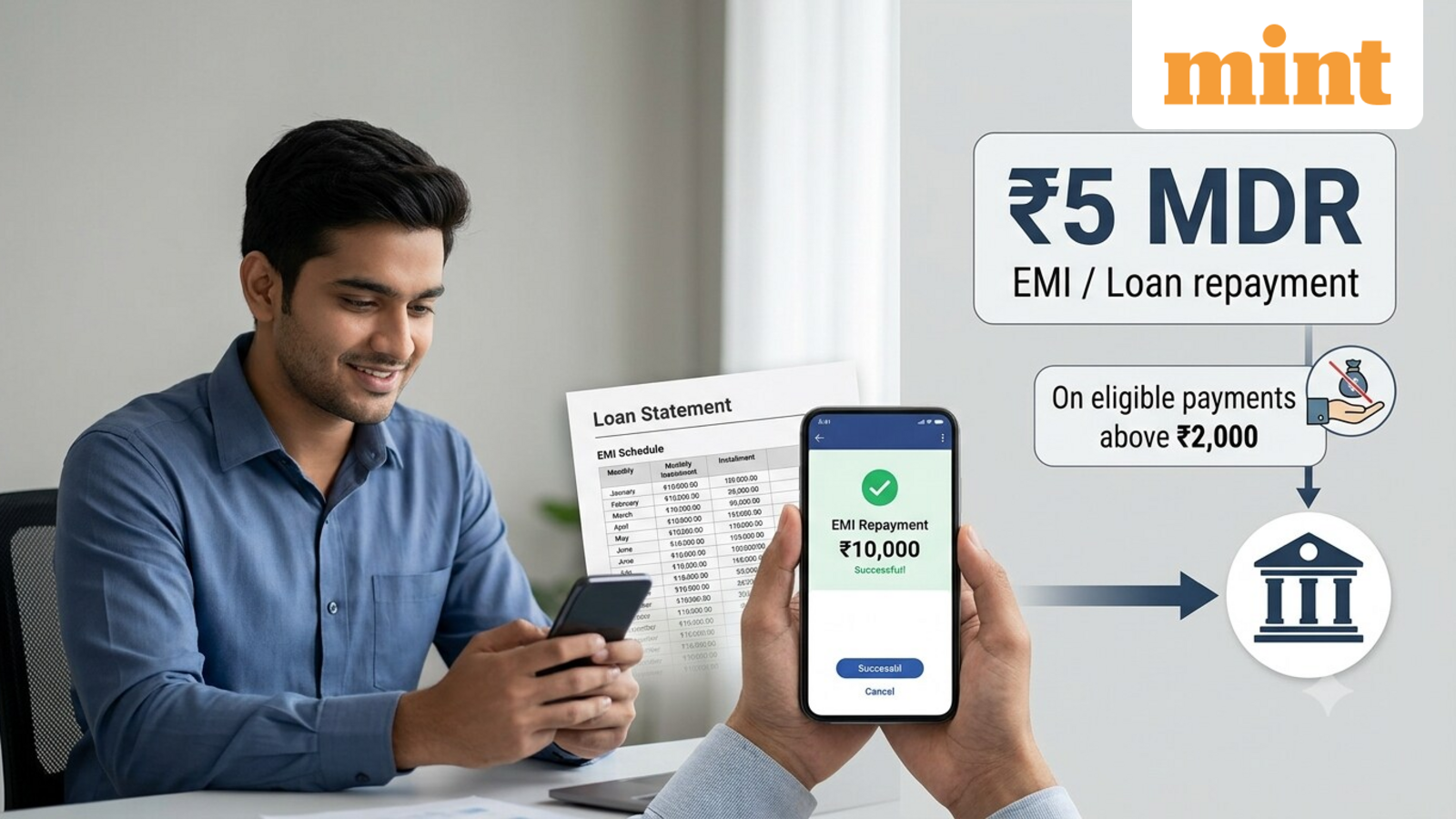
However, the MDR will be levied on the merchant side and not directly on borrowers. For debt collection transactions, including loan repayments and EMI collections, UPI payments above ₹2,000 will attract a flat MDR of ₹5 per transaction.
Here’s what you need to know.
What exactly does the ₹5 MDR apply to?
Mukesh Pandey, Founder and MD, Rupyaapaisa.com said the ₹5 MDR applies only to UPI transactions of ₹2,000 and above that fall under debt collection, including repayments of loans taken from NBFCs and other financing sources.
For example, if a borrower repays an EMI of ₹5,000 or a loan amount of ₹25,000 through a UPI debit transaction, the applicable MDR would be ₹5 per transaction, he said.
Who bears the ₹5 MDR on loans and EMIs?
The ₹5 MDR is a charge on the merchant side and should not be assumed to be an additional cost for the borrower. In a normal UPI lending transaction, the lender or the collection agency will pay this fee. For credit card payments, the credit card issuer who receives the payment pays the MDR, Pandey said.
“In the case of credit card payments, the cost of processing the payment is charged by the merchant bank to the card company,” said Siddharth Maurya, Managing Director, Vibhvangal Anukulara.
What happens when a purchase is financed through credit or EMI?
There is a difference between using credit to make a purchase and subsequently repaying the loan or EMI linked to that purchase, Pandey said.
For example, suppose a consumer buys a TV worth ₹60,000 from an LG store using an EMI loan or credit facility available at the point of sale. The MDR rules would apply to the original ₹60,000 purchase, depending on the payment method used. However, the subsequent ₹5,000 monthly EMI payments will not be subjected to MDR treatment, he explained.
What happens with UPI AutoPay and mandates?
The collection of EMIs through UPI AutoPay is allowed and encouraged by NPCI. However, even if an EMI is more than ₹2,000 in AutoPay, the collection will not attract the MDR of ₹5, Maurya said.
What does NPCI mean by ‘direct user-account-to-merchant-account UPI transactions’?
The NPCI FAQs on MDR distinguish standard UPI payments from credit-linked UPI transactions. It mentions that the credit-linked payments, such as RuPay credit cards linked to UPI and pre-sanctioned bank credit lines, follow the rules applicable to those credit products.
In a standard UPI transaction, the customer transfers money directly from their bank account to the merchant’s UPI ID or QR code. In a credit-linked transaction, the payment is made using a credit facility, so the rules applicable to that facility come into play, Raghunandan Saraf, Founder and CEO, Saraf Furniture, said.
A loan repayment can also be made using funds from a savings or current account, or through a permitted credit product. In the latter case, the rules governing that credit facility apply to the transaction, Maurya added.
Will borrowers see any impact on their EMI or repayment amount due to MDR?
“The MDR by itself is not designed to affect the EMI or repayment amount of the borrower. The government clarifies that borrowers cannot bear the MDR,” Pandey mentioned.
Certain lenders may be affected by the higher costs of payment processing, which might change certain calculations of the lenders, but any additional fee charged should be compliant with the lending rules, he added.
Could lenders keep EMIs below ₹2,000 to avoid the MDR?
Structuring loans only for the purpose of avoiding MDR may lead to some practical and regulatory issues that cannot be taken for granted. The borrower has to check the overall cost of credit and not only the amount of the EMI, Pandey said.
A lower EMI does not necessarily mean a cheaper loan. Longer loan tenures can increase the total interest paid over the life of the loan, Maurya noted.
Disclaimer: This is only for informational and educational purposes. Please consult a qualified expert for the latest laws and regulations.