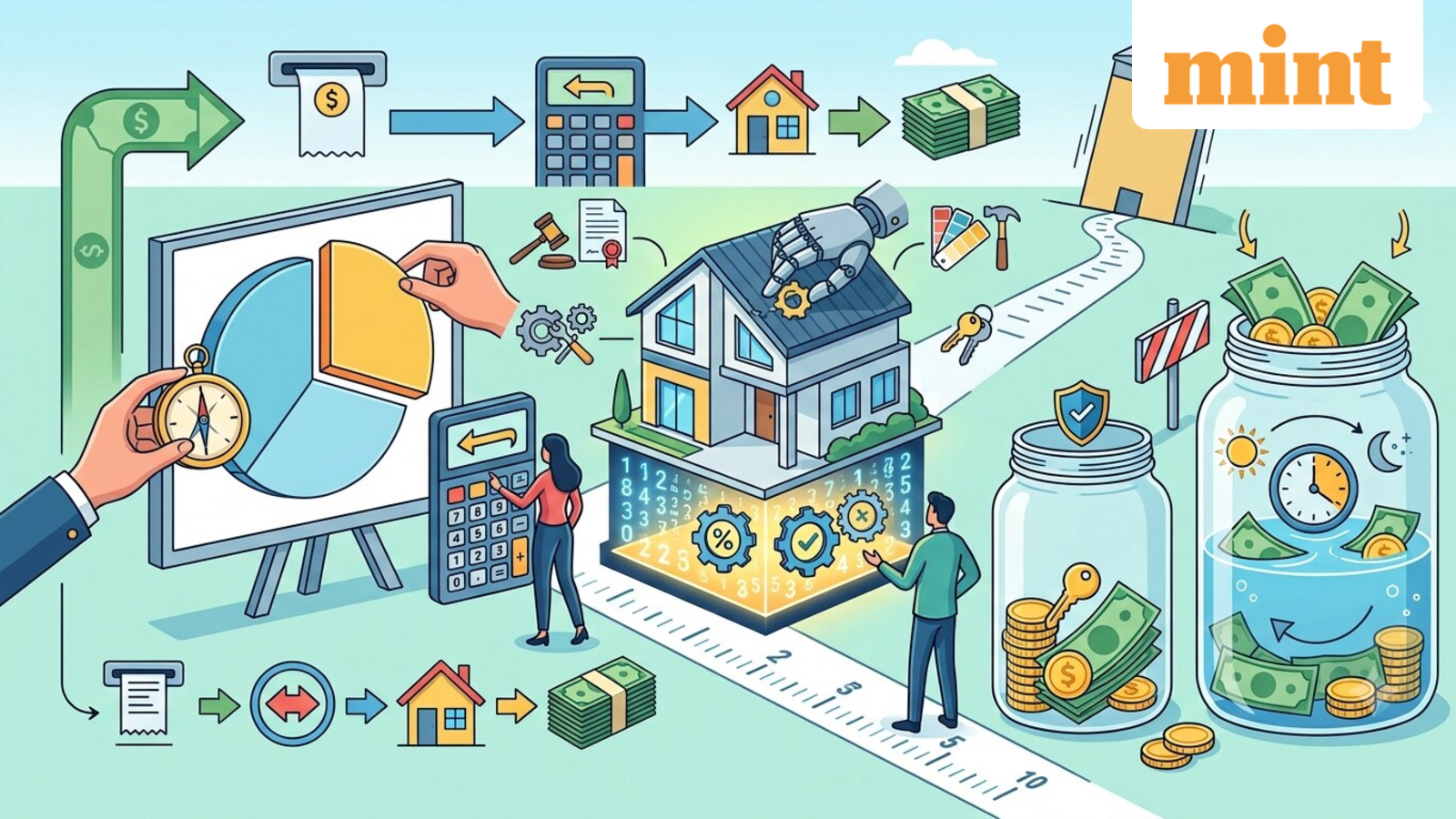
Planning to buy a house? Here are the key numbers to calculate before you take a home loan
Buying a home is often treated as a question of how much loan a bank is willing to sanction. But loan eligibility does not necessarily mean the borrower can comfortably afford the property. A home loan is a long-term commitment, and an EMI that looks manageable on paper can put pressure on savings and other financial goals when combined with regular household expenses and existing debt.
Before finalising a property, buyers need to look beyond the EMI and calculate the full cost of owning the house. This includes the down payment, interest outgo, registration and other upfront expenses, existing financial commitments and the emergency savings that will remain after the purchase. Experts suggest running these numbers first to arrive at a property budget that fits the household’s cash flow rather than stretching finances to the maximum loan amount.
Keep the home-loan EMI within a comfortable range
The first calculation should be based on monthly take-home income, existing EMIs and regular household expenses.
Sanjiv Bajaj, Joint Chairman & Managing Director, Bajaj Capital, said a useful benchmark is to keep the home-loan EMI at around 30-35% of take-home income. Once it moves towards 40% or more, a household can start losing financial flexibility, particularly if there are other loans or high recurring expenses.
For example, for someone with a monthly take-home income of ₹1.5 lakh, a 30-35% EMI would work out to around ₹45,000-52,500. This is only a benchmark and the appropriate amount would depend on the person’s other expenses, debt and financial goals.
Santosh Agarwal, CEO, Paisabazaar, said lenders generally prefer the total EMI ratio, including the proposed home loan, to remain within 50-60% of in-hand monthly income.
However, the amount a lender is willing to finance and the amount a borrower can comfortably afford are not necessarily the same.
“While planning to avail a home loan, the most essential part is to evaluate your affordability, based on monthly surplus after keeping essential household expenses and existing debt obligations aside,” Agarwal said.
Work backwards from the EMI to find the property budget
Instead of starting with the maximum loan amount offered by a lender, buyers can work backwards from a sustainable EMI.
First, calculate how much can comfortably be paid every month after accounting for essential expenses, existing EMIs and ongoing investments. That EMI can then be used to calculate the corresponding loan amount based on the interest rate and tenure.
The down payment can be added to this amount, but only after setting aside the emergency fund.
“Don’t start with what the bank is willing to lend you – start with what you can comfortably pay every month once your existing commitments, expenses and ongoing investments are accounted for,” Bajaj said.
Interest rate and tenure should also be factored into the calculation. A longer loan tenure can reduce the monthly EMI, but it can also increase the total interest paid over the life of the loan. Buyers should therefore look at both the monthly repayment and the overall interest outgo before deciding on the loan amount.
Agarwal also recommends calculating the sustainable EMI first and then working out the home-loan amount that this EMI can support.
Don’t use all your savings for the down payment
A larger down payment can reduce the loan amount and interest burden, but putting almost all available savings into the property can leave the household without enough liquidity for emergencies.
Bajaj recommends retaining at least six months of essential expenses and EMIs as a buffer after making the down payment.
For self-employed buyers, he suggests a larger reserve of around nine to 12 months, depending on how variable their income is.
Agarwal similarly recommends keeping an emergency fund covering six to 12 months of unavoidable monthly expenses. This should include EMIs, rent, school fees, insurance premiums and household expenses. Self-employed borrowers should maintain a higher buffer because their cash flows can be less predictable, she said.
The emergency fund should also remain liquid. It should not be dependent on selling an investment quickly or at an unfavourable price.
Factor in the costs beyond the EMI
The purchase price and home-loan EMI are not the only costs a buyer needs to budget for.
A home can bring additional upfront expenses such as stamp duty, registration, brokerage, paperwork and transfer-related costs. There are also recurring expenses such as maintenance, property tax and insurance. Buyers may additionally have to spend on interiors, furniture or other costs after taking possession.
These expenses can reduce the cash available after the purchase and should therefore be included in the affordability calculation.
The key numbers to run before buying a house are therefore the comfortable EMI, corresponding loan amount, down payment available without exhausting savings and emergency corpus left after the purchase.
A bank’s loan sanction tells a buyer how much they can borrow. Their own cash flow determines how much they can realistically afford without putting other financial goals on hold.