France Blacklisted 3,522 Sites and One Name Beat Them All
France’s blacklist of unauthorized investment websites is on course for its busiest year. In the versions published on September 11, the brand copied most often across the six lists is the regulator that publishes them.
FM Intelligence parsed all six blacklists maintained by the Autorité des Marchés Financiers (AMF) and the Autorité de Contrôle Prudentiel et de Résolution (ACPR). Together they carry 3,522 entries, each stamped with the date it was added.
London’s trading industry is coming home!
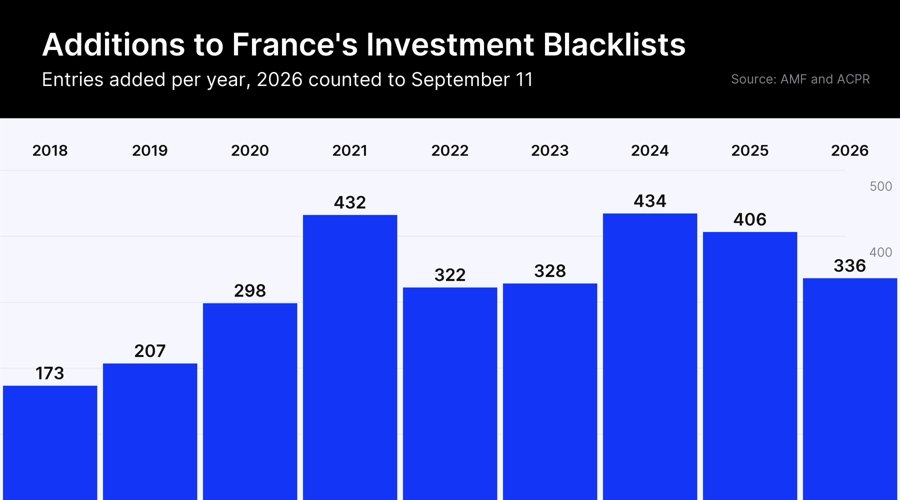
That turns a warning list into a record going back to 2010. The lists took 336 new entries between January 1 and September 11, a pace of about 483 for the full year against 434 in 2024, the busiest year so far.
For brokers licensed in France or passporting in, the composition matters more than the count. Nine in ten new names arrive in categories that were not enforcement priorities a decade ago.
The audience has noticed. In the AMF’s 2025 barometer, 16% of French savers said they had already lost money to an investment scam, a figure that sits alongside the entry costs and marketing limits in FM Intelligence’s updated France country profile.
Crypto Passed Forex in 2024 and Stayed There
Crypto entries, spot and derivatives together, overtook forex additions in 2024 and have held the lead since. The past three years brought 108, 100 and 97 crypto names against 51, 57 and 51 for forex.
The forex list has been flat for four years. FinanceMagnates.com reported in July 2024 that French regulators had added 24 unauthorized forex sites and 26 crypto-derivative platforms in the first half of that year. The full-period data shows that split hardening.
The binary options list is the clearest marker. It holds 341 entries and has not taken a single new name since July 6, 2020, four years after France banned electronic advertising for the product and the European Securities and Markets Authority (ESMA) capped retail leverage.
The file is still republished. Nothing is being added to it.
The Most Copied Brand Is the AMF
The largest of the six lists covers other categories and holds 1,741 entries. Of those, 1,566 are flagged by the regulators as impersonation of an authorized firm.
The AMF’s own name accounts for 190, including 65 added in 2025 and 40 so far in 2026. Fake regulator emails, cloned domains and recovery-room operators using the supervisor’s letterhead generate more entries than any commercial brand on the list.
Industry names follow. After inspecting each blacklisted host and discarding word-play domains, FM Intelligence counted 20 addresses carrying Amundi, 10 DEGIRO, seven Trade Republic, six Scalable Capital and four Revolut.
Bitpanda, Fortuneo, Boursorama, Binance, Kraken, XTB and SwissBorg appear one to three times each.
The names line up with the asset managers and neobrokers that have spent most on French acquisition, in a market where 1.6 million residents opened their first investment position in the three years to the end of 2025.
The contact point has moved too. Email addresses made up 5% of entries in 2020, half of them in 2022 and 30% in 2026, so the regulators are increasingly blacklisting an inbox instead of a website.
What It Changes for Licensed Firms
France already restricts how leveraged products are sold. The Sapin II law bars electronic promotional communications for contracts where the client can lose more than the initial outlay.
The consumer code extends that ban to sponsorship advertising the same services, with fines of up to EUR 100,000 (about $113,000).
That leaves a market where a licensed broker cannot buy attention through the usual digital channels while an unlicensed clone of its brand can. Both regulators point savers to the REGAFI register before the blacklists, and both say the lists are not exhaustive.
The commercial consequence is a brand-monitoring cost that sits outside the compliance budget. A firm entering France with a plan built on search and social will find that its own name is the asset most likely to be duplicated.
The demand behind that plan is not in question, but it is not where the marketing rules bite. The country’s leveraged trading pool has fallen below 30,000 active traders while the investing base keeps growing.
The Category That Died
The binary options file is worth a second look for anyone arguing about whether product bans work. France prohibited the advertising, ESMA capped the leverage, and the enforcement record stops in 2020.
Crypto now occupies that space. The MiCA regime has cut the number of authorized crypto firms across the European Union by about 80% from the pre-regulation count, and the AMF had authorized 35 providers by September 10.
The blacklist shows what is happening on the other side of that gate.
This article was written by Damian Chmiel at www.financemagnates.com.