Are Americans benefitting? Fed survey finds how US firms are using their Trump tariff refunds
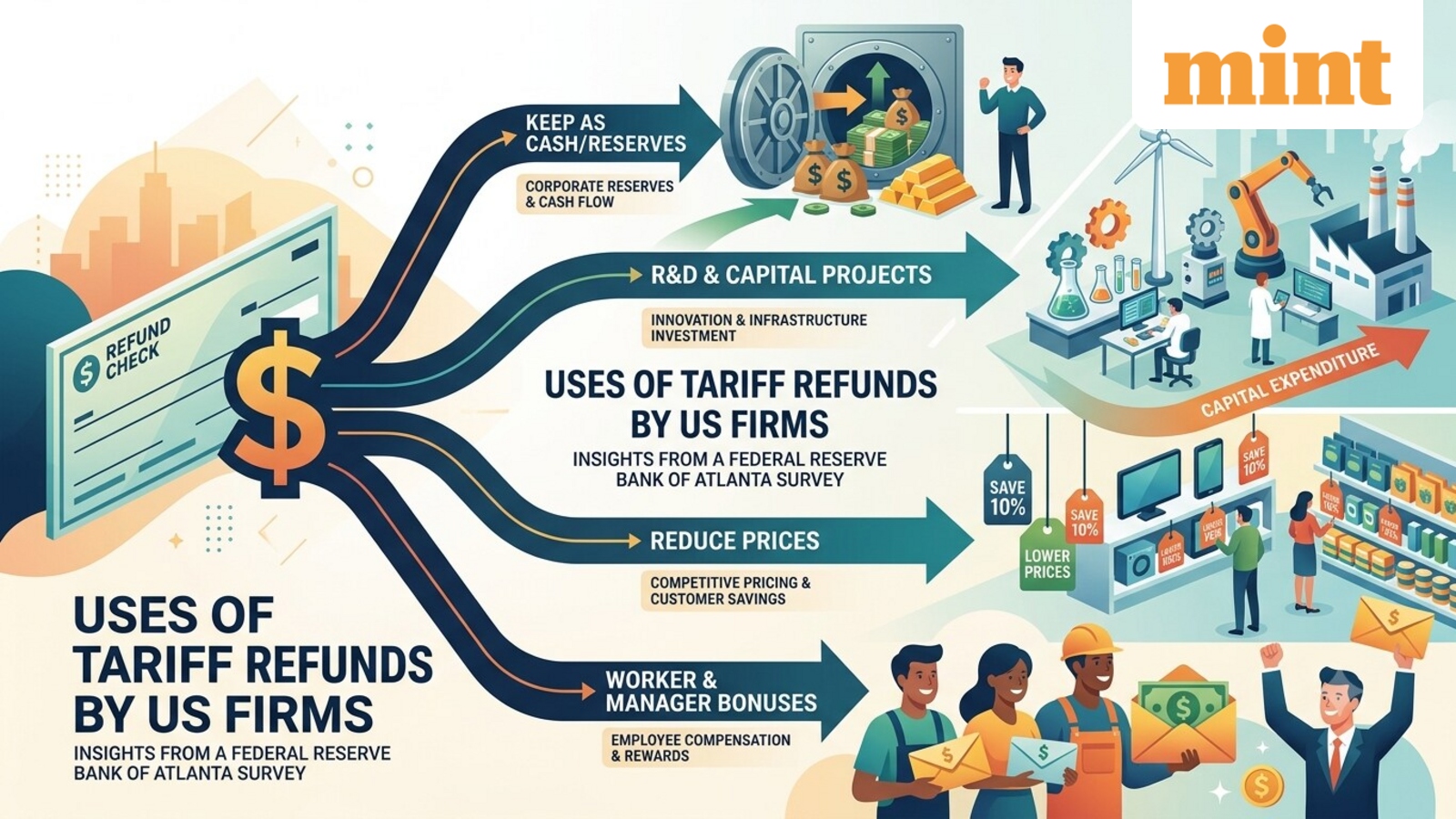
The United States Federal Reserve Bank of Atlanta (Fed) in a survey report released on Monday, noted that a majority of firms that received refunds from Trump’s tariffs are keeping the cash, with the rest investing the funds in R&D, new capital projects, or to temporarily lower prices, and give bonuses to workers or managers.
It noted that “a non-trivial portion of tariff refunds directly benefit” American customers and employees, the report added.
The report, titled ‘How Are Firms Using Their Tariff Refunds?’ noted that “textbook analyses suggest that firms keep one-off windfalls as cash, distribute the funds to shareholders or, if liquidity-constrained, perhaps use the funds to support the firm’s investments”.
It added that the funds in question are sizable — nearly $170 billion, including roughly $100 billion in refunds by late July, and the bank questioned over 1,100 C-suite executives in its Survey of Business Uncertainty between 10-21 August, to understand how many businesses seek refunds, how they manage the process, and how they plan to use it. Here’s a look at the findings:
How are US firms using Trump tariff refunds?
- Calling it the “most noteworthy findings” on use of tariff refunds by companies, the bank said 70% of firms anticipate retaining at least some of their refunds as cash or cash equivalents.
- Further, over 50% plan to devote a portion of their refunds to R&D or capital investment projects.
- Many firms expect to use refunds to give customer rebates (17.2%), lower prices (14.8%), or pay bonuses to staff (12.7%) or managers (10.1%).
“Although these are surprising uses of cash windfalls relative to the predictions of standard models, these results also suggest that a non-trivial portion of tariff refunds directly benefit customers and employees,” the report added.
“Although it makes sense that larger firms with greater resources can more readily navigate the refund process, our Atlanta Fed colleagues note that one-third of tariff refunds go to the most financially constrained firms. About two-thirds of firms have opted to use internal staff to manage the process or sell their refund rights to third parties,” it added.
SCOTUS struck down Trump’s IEEPA tariffs
Notably, the US Supreme Court struck down US President Donald Trump‘s tariffs under the International Emergency Economic Powers Act (IEEPA) in February. The scheme had enabled the administration to collect some $166 billion.
Refunds began flowing in May after SCOTUS ruled the so-called “emergency tariffs” as unlawful. Bloomberg reported that as of 11 September, around $134.7 billion in refund payments, including interest, had been paid out or accepted for processing, according to a court filing from US Customs and Border Protection (USCBP).
In July, an AP report noted that everyday American customers were unlikely to see benefit of refunds as it would be too hard to specify how much is owed and the cost of pursuing legal means may be more expensive that the eventual windfall, if any.