2 Words From Fed Chair Kevin Warsh Just Changed the Game for Wall Street
The most anticipated Federal Open Market Committee (FOMC) meeting of the year lived up to the billing on Sept. 16. For only the fourth time since the start of the century, our nation’s central bank has kicked off a rate-hiking cycle, raising the federal funds target rate by 25 basis points to a new range of 3.75%-4.00%.
But it’s not the rate hike that’s put Wall Street and its major stock indexes, the Dow Jones Industrial Average (^DJI +0.71%), S&P 500 (^GSPC +1.49%), and Nasdaq Composite (^IXIC +2.26%), on edge. Rather, it’s two words from Fed Chair Kevin Warsh that have completely changed the game for Wall Street.

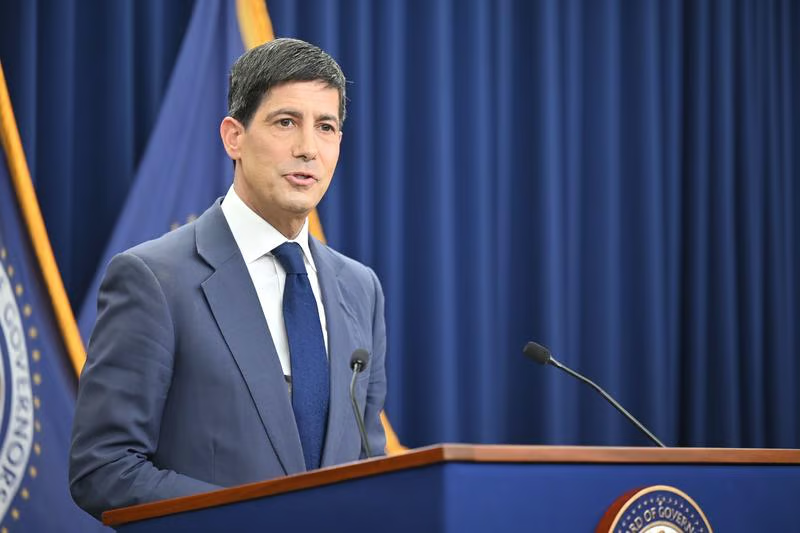
Fed Chair Kevin Warsh just shook things up for Wall Street. Image source: Official Federal Reserve Photo.
Persistently elevated inflation merited action
According to the CME Group‘s (CME -0.17%) proprietary FedWatch Tool and prediction markets, a Fed rate hike on Sept. 16 was a foregone conclusion. The August inflation report marked the 66th consecutive month that headline inflation topped the FOMC’s long-term 2% target.
While modest inflation is expected in an expanding economy, consumer price increases have been supercharged by several factors, including:
66.
As in 66 consecutive months with US inflation above the Fed’s 2% target.
The Fed has lost all credibility when it comes to fighting inflation.
Video: https://t.co/ei3C1xj2KY pic.twitter.com/ydKptxTlk9
— Charlie Bilello (@charliebilello) September 11, 2026
The first two catalysts relate to President Trump’s policies. Tariffs risk increasing domestic manufacturing costs, while Iran’s closure of the Strait of Hormuz has sent fuel prices soaring. Meanwhile, ongoing AI hardware supply shortages are boosting AI companies’ pricing power, which is working its way down the chain to consumers.
To add fuel to the fire, long-duration Treasury bond yields have soared to 19-year highs. Bond traders are demanding higher yields amid a surge in inflation and U.S. total debt surpassing $40 trillion.
To deliver price stability, FOMC action was merited.

Image source: Getty Images.
It’s what Warsh said that has the stock market on edge
In Fed Chair Warsh’s press conference following the two-day FOMC meeting, he highlighted U.S. economic strength, job gains keeping pace with the labor force, and strong productivity growth.
But he also introduced a new element to the FOMC’s interest-rate criteria: timeliness.
During Warsh’s four months as Fed chair, he’s repeatedly vowed that the FOMC will deliver price stability and has noted that prices are too high on several occasions. When speaking with reporters on Sept. 16, he drove home not only the need to bring down the prevailing inflation rate, but to do so in a timely manner:
Today’s policy action will support a timelier return to the Committee’s 2% goal. This Committee will deliver price stability.
The two-word emphasis on a “timelier return” to the FOMC’s long-term inflation target after more than five years above this level strongly signals that additional rate hikes will be needed to deliver price stability. It’s also worth noting that the quarterly released Summary of Economic Projections (aka, the dot plot) suggests that another quarter-point rate hike will be enacted before the end of 2026.
FED DOT PLOT COULD SIGNAL ANOTHER 2026 HIKE
The Fed’s updated Dot Plot is expected to show rates ending 2026 near 4.1%, implying another hike after today’s anticipated 25bp increase.
The bigger question is 2027: projections may still signal eventual rate cuts even after… pic.twitter.com/curirGnMyh
— *Walter Bloomberg (@DeItaone) September 16, 2026
Multiple interest rate hikes can change the game for Wall Street. The AI infrastructure build-out has been the stock market’s No. 1 catalyst. If lending costs continue to climb and the pace of this data center expansion slows, even marginally, the subsequent re-rating of growth rates and/or premium stock valuations could spell disaster for the Dow Jones Industrial Average, S&P 500, and Nasdaq Composite.
Who would have guessed that two words could hold so much weight on Wall Street?