UPI MDR on mutual funds: Experts explain how investors could bear the charge and its impact on returns
If you invest in mutual funds and make transactions through UPI, there is a new charge you should know about from 15 October 2026.
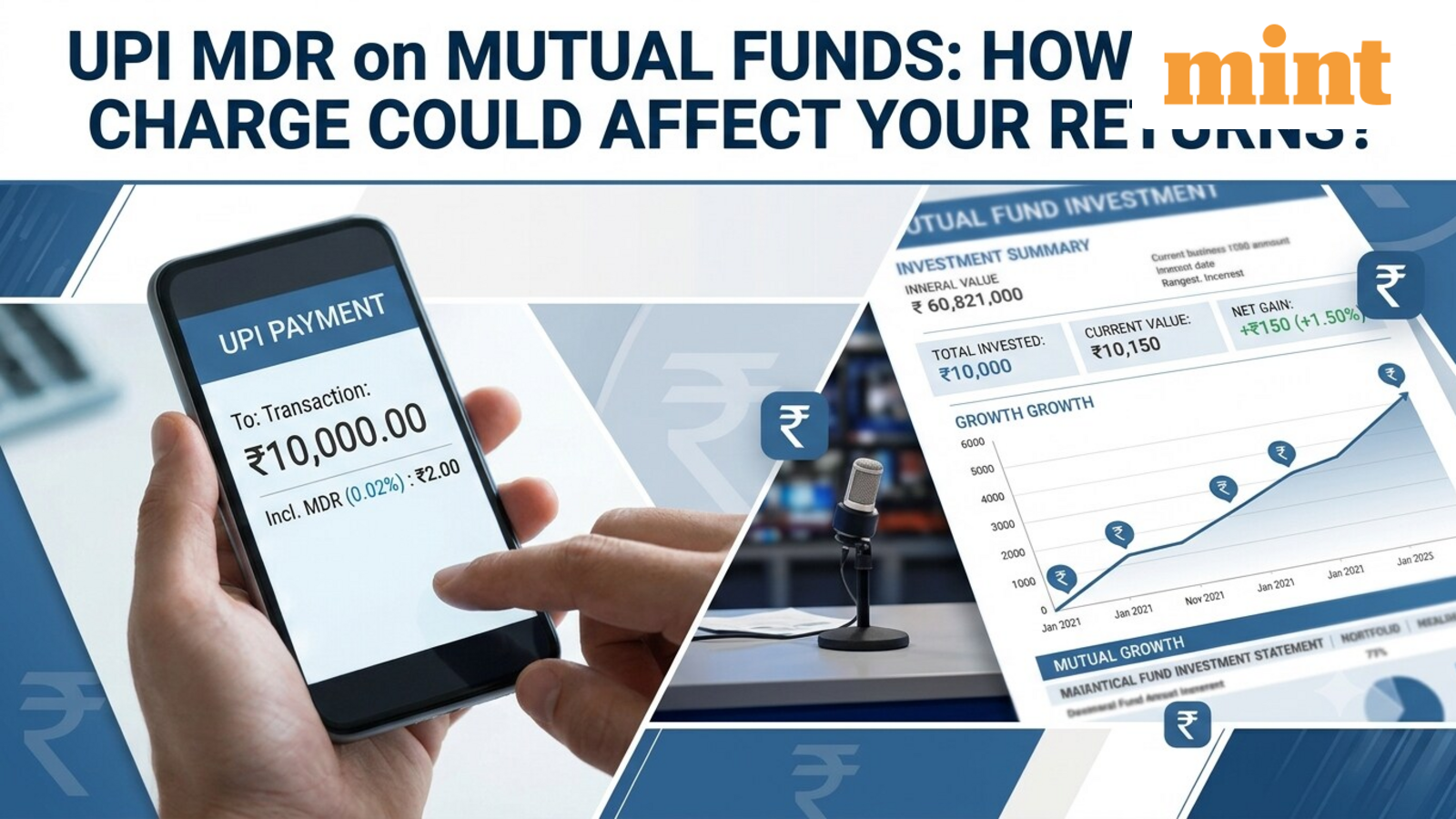
A 0.02% Merchant Discount Rate (MDR) will apply to capital-market transactions, including payments towards mutual funds, subject to a maximum charge of ₹300 per transaction. The charge is intended to be borne by the merchant and not the investor.
Eshaan Lazarus, Founder & CEO, 021 Trade, said that under the announced framework, investors should not bear the MDR, as it is a merchant-side cost deducted by the acquiring bank when settling funds with the asset management company (AMC) or platform. The Finance Ministry and NPCI have said it should not be passed on to customers.
But if the charge is passed on to investors, how would it affect the amount invested and the final value of their investment?
How will a mutual fund investor face UPI MDR?
Harsh Vardhan Dawar, ACA, CFA, FRM, Founder, Wealth Cafe, said, “AMFI is expected to roll out how the MDR charges will be accounted for.”
For comparison, Dawar pointed to stamp duty, which is deducted from the investor’s investment amount. So, when an investor invests ₹10,000, ₹0.50 is paid towards stamp duty, and only ₹9,999.50 is invested in the mutual fund, with units allotted accordingly.
However, since MDR would be payable only by investors who choose UPI as a payment option, Dawar said the UPI charge could instead be collected separately.
Debasish Mohanty, MD & Chief Strategy Officer, The Wealth Company Mutual Fund, said there are two possible ways it could theoretically be structured.
- It could be deducted from the amount remitted. In that case, ₹2 on a ₹10,000 transaction would reduce the amount available for investment to ₹9,998.
- Alternatively, it could be collected separately, so that the full ₹10,000 is invested and ₹2 is charged additionally.
| Particulars | Scenario 1: MDR deducted from investment | Scenario 2: MDR charged separately |
| Lump-sum investment | ₹10,000 | ₹10,000 |
| UPI MDR @ 0.02% | ₹2 | ₹2 (paid separately) |
| Amount invested | ₹9,998 | ₹10,000 |
| Assumed annual return | 10% | 10% |
| Investment period | 5 years | 5 years |
| Value after 5 years | ₹16,102 | ₹16,105 |
| Estimated returns | ₹6,104 | ₹6,105 |
Illustration assumes a 10% annual return on an equity mutual fund over five years. Stamp duty and other applicable statutory charges are not included in the calculation.
For a ₹1 lakh investment, the difference would be slightly higher, with estimated returns of ₹61,039 in Scenario 1 and ₹61,051 in Scenario 2 after five years.
“The 0.02% MDR reaches the maximum cap of ₹300 on transactions of ₹15 lakh,” Mohanty added. This means transactions above ₹15 lakh will also attract a maximum MDR of ₹300.
Can UPI MDR increase a mutual fund’s expense ratio?
Dawar said the MDR will have to be treated as a transaction-level cost and borne by the investor opting for the UPI route. “It will not have any impact on the expense ratio of the Fund as the cost will not be borne at the Fund level as that will impact other investors investing through non-UPI routes,” he added.
Lazarus said the expense ratio covers recurring scheme expenses and is reflected in the NAV. “Charging it to scheme assets would require a permissible basis under SEBI’s expense rules; the MDR announcement alone does not establish that permission,” he added.
Will UPI MDR apply to SIP investments?
Mohanty said the treatment would depend on how the first SIP instalment is processed. A one-time UPI payment made before the AutoPay mandate becomes operational may attract MDR, while subsequent instalments through UPI AutoPay would be exempt.
However, if the first instalment itself is collected through the UPI AutoPay mandate, it should be exempt from MDR, he explained.
What other costs do mutual fund investors already pay?
Currently, irrespective of the route of investment, all investors incur a stamp duty cost when they purchase units of mutual funds. If the investments are made via a broker, the investor may pay a flat or percentage-based fee to the broker. They may also have to pay depository charges for holding the funds in demat form, Dawar mentioned.
With UPI MDR expected to be passed on to investors, it would be an added cost for an investor opting for the UPI mode of payment, whether they invest directly or via a broker/platform. This cost may be added to each transaction in a transparent manner. Alternatively, it may be bundled into the flat fee charged by the broker/platform, he added.
If the costs do reach investors, the likely routes could be a checkout fee, higher platform or subscription fees, Lazarus added.
Disclaimer: This story is for educational purposes only. The views and recommendations made above are those of individual analysts or broking companies, and not of Mint. We advise investors to check with certified experts before making any investment decisions.
About the Author
Sheetal Goel is a Content Producer at Livemint, where she covers corporate developments, personal finance, business trends, markets, and SEBI-related updates. She focuses on simplifying complex financial concepts and presenting them in a clear, reader-friendly manner, thereby helping audiences better understand investment trends, personal finance, and market developments. Her writing focuses on making finance more accessible to everyday readers while maintaining clarity, accuracy, and relevance.
She holds a degree in Economics (Hons.) along with an MBA in Finance, which has helped her develop a strong foundation in financial analysis, market understanding, and business reporting. Before joining journalism, she worked with finance and broking firms, where she closely followed market developments, investment strategies, and evolving industry trends. This practical exposure strengthened her understanding of financial markets. She has also written content across multiple formats and platforms, including YouTube, LinkedIn, and Instagram.
Over time, she has developed expertise in covering market-linked stories, investor-focused topics, and regulatory updates in a simplified yet informative style. She also enjoys reading and listening to Hindi poetry, reflecting her appreciation for literature and creative expression beyond the world of markets and numbers.