No cash accepted! PVR INOX insists on UPI payment only; customer sends legal notice — here’s what the rules say
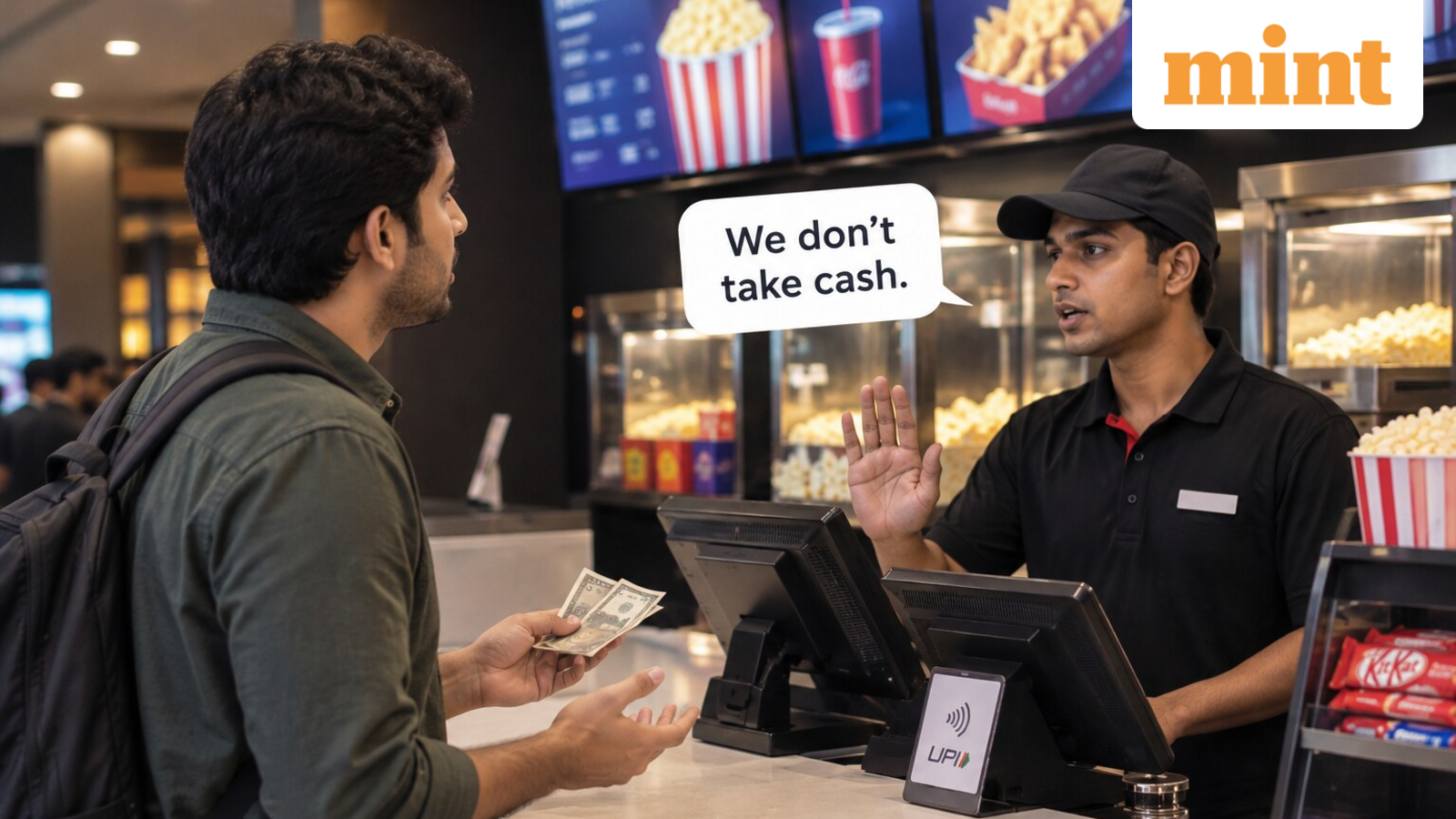
A routine movie outing at a PVR INOX turned into a payment dispute after a customer alleged that the theatre refused to accept cash for his movie ticket and at the food counter, raising questions over whether businesses can reject legal tender as a mode of payment for services.
This incident involved Ahmedabad-based advocate Utkarsh Dave, who sent a legal notice to PVR INOX Ltd. afterwards. The advocate claimed that he had no other option but to pay via UPI when he visited the cinema complex at Palladium Mall on September 13, The Times of India reported.
In his legal notice, Dave questioned the multiplex chain’s “cashless-only” policy for customers and has asked for legal clarification on why they are being pushed towards UPI alone.
What happened at the multiplex’s counter?
According to the notice, Dave went to watch a film at PVR INOX and was asked to pay in cash for his ticket. Later, when he wanted to buy food and beverages, staff at the counter refused to accept it and said they would only accept UPI.
The notice also questions whether PVR INOX had clearly displayed its cashless policy at the point of sale or informed customers in advance. “A customer cannot reasonably be expected to discover the existence of such a policy only after reaching the counter and tendering cash,” the notice stated, according to TOI.
Dave has also asked the company to share copies of any written instructions given to staff directing them not to accept cash as a mode of payment.
Citing Section 26(1) of the Reserve Bank of India Act, 1934, the advocate argued that RBI-issued banknotes are legal tender, adding that a blanket refusal to accept cash at a consumer-facing business raises questions about transparency, fairness and disclosure.
It also draws on provisions of the Consumer Protection Act to question whether PVR INOX has ever formally adopted a cashless-only policy at this outlet.
Are businesses obliged to accept cash payments?
In India, RBI-issued banknotes, are legal tender. However, a private business is free to determine the terms on which it offers its goods or services, subject to applicable laws, according to Dinkar Sharma, Partner at Jotwani Associates.
This distinction is particularly relevant for businesses where cash payments may not be practical, such as online businesses, e-commerce platforms, digital services, app-based services and automated systems.
“In such cases, insisting on digital payments may simply be part of the way the business operates,” he said. Even a physical business, he added, may generally adopt a “cashless” policy and accept only UPI, cards or other digital modes of payment, provided there is no specific legal or regulatory requirement mandating it to accept cash.
However, even though a business can have a “cashless” policy and accept only UPI, cards or other digital modes of payment, the same should be clearly communicated to customers in advance, the expert noted.
What about customers without smartphones?
The legal notice also raises concerns about customers who do not have smartphones, UPI access or reliable internet connectivity. Dave has asked PVR INOX what arrangements are available for such customers and whether they could be denied entry despite being willing to pay in cash.
“In particular, PVR INOX is required to explain whether such consumers would simply be denied the opportunity to purchase the service despite being ready and willing to make payment in lawful currency,” the notice reads, according to TOI.
Seven-day deadline set
The aggrieved advocate has sought a response from PVR INOX within seven days, further warning that he may approach the consumer commission and other authorities if the company fails to respond within the stipulated deadline.
The notice does not object to PVR INOX offering digital payment options. Instead, it questions the refusal to accept cash and argues that consumers should be informed about any such restriction in advance and allowed to make an informed choice about their preferred mode of payment.