Rule of 72 explained: How long will ₹1 lakh take to double at 6%, 8% and 10%?
The ‘Rule of 72’ is a simple yet effective personal finance shortcut that can help an investor to roughly estimate how long an investment may take to double. It is particularly helpful when you compare different rates of return without performing a detailed compound-interest formula-based calculation.
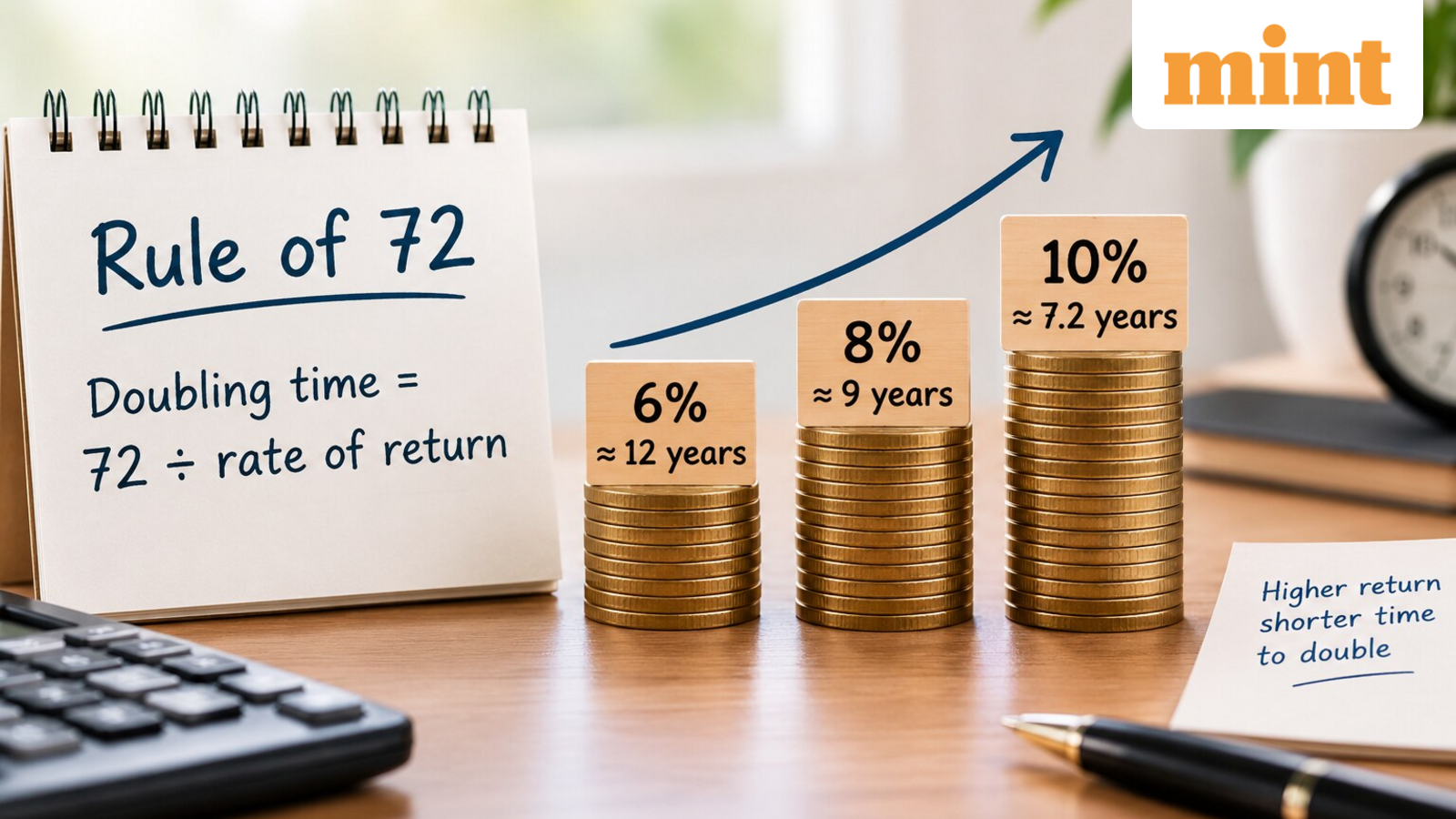
The rule simply works by dividing 72 by the annual rate of return. For example, at an assumed annual return of 10%, ₹1 lakh would take about 7.2 years to become ₹2 lakh. Along similar lines, at an assumed return of 8%, ₹1 lakh would take roughly 9 years to turn into ₹2 lakh. In both cases, 72 is divided by the annual rate of return, i.e., 10% and 8%, respectively.
This write-up discusses this rule in detail, its implications, and how individuals can use it to better plan their personal finances and long-term expenses.
How does the Rule of 72 work?
The calculation formula in this case is straightforward:
Approximate doubling time = 72 ÷ annual rate of return
Hence, at 6%, the estimated double period is about 12 years. At a superlative return rate of 25%, it falls to about 72/25 = 2.88 years. This underlines an important investing principle: even a seemingly insignificant difference in the rate of return can have a profound impact in the long run and affect the time required for wealth to compound.
Rule of 72: Estimated time for ₹1 lakh to double
|
Annual return |
Rule of 72 calculation |
Approx. doubling time |
₹1 lakh becomes |
|---|---|---|---|
| 6% | 72 ÷ 6 | 12 years | ₹2 lakh |
| 8% | 72 ÷ 8 | 9 years | ₹2 lakh |
| 10% | 72 ÷ 10 | 7.2 years | ₹2 lakh |
What does this mean for your money?
Let us consider an investor who begins investing with ₹1 lakh. Then, if the investment compounds by 6% annually, the ‘Rule of 72’ suggests that it could take about 72/6 = 12 years for the money to double. On the other hand, at 9%, the estimate drops to about 8 years (72/9 = 8).
This calculation showcases that, given the fixed deposit rates have a broader range of 6-8.5% today across various lenders through the nation, it can be presumed that with an interest rate of about 6-8.5%, the total time required to double the base investment is about 8.4 to 12 years, approximately, provided that the rate of interest offered by a bank is 8.5% neat.
These calculations clearly elucidate why compounding and the rate of return both matter in the long-run when building wealth. Still, actual investment returns can fluctuate, and taxes, fees and inflation can eventually impact the final outcome.
Hence, the ‘Rule of 72’ should be treated as a quick estimation tool to get a rough idea of the possible time it may take for a return to double, rather than a promise that an investment is going to double within a specified period of time.
For meaningful financial planning, investors should consider the investment’s actual return patterns, costs, applicable taxes and risks alongside the implications of compounding.
Disclaimer: The Rule of 72 provides an approximate estimate of doubling time and is not a guarantee of investment returns. Actual outcomes may vary based on returns, taxes, fees, inflation and investment risks.