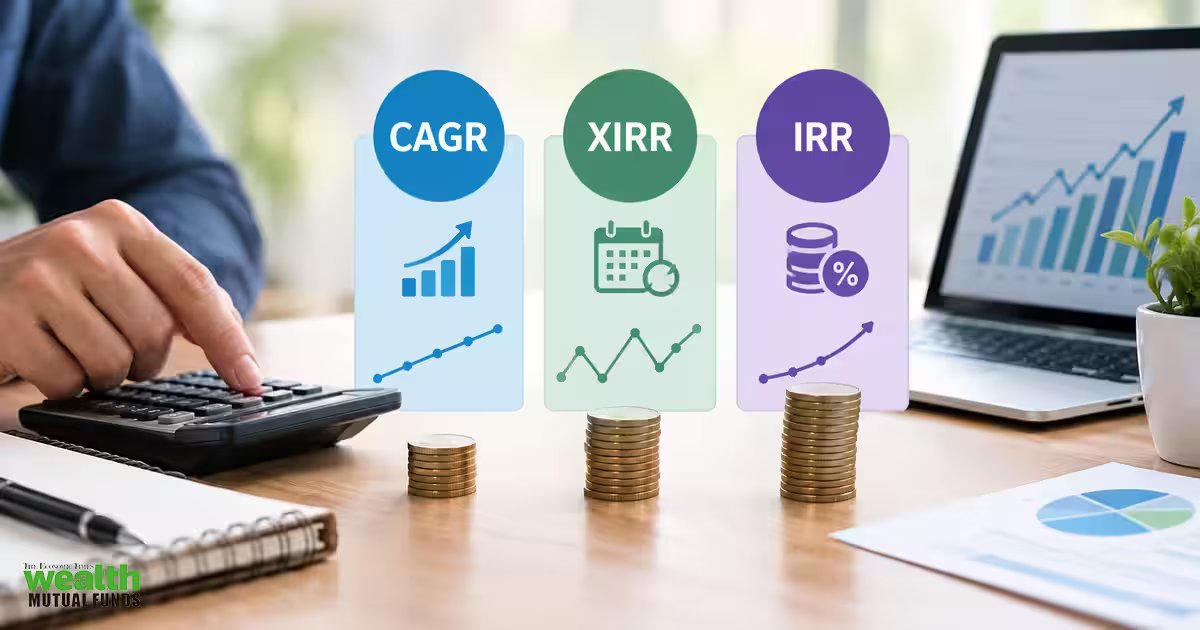
Explained: When should mutual fund investors use CAGR, XIRR or IRR to calculate returns?
Compounded Annual Growth Rate (CAGR)
CAGR calculates the annual growth rate of an investment over a particular period of time. This measure is the most common tool used to measure/calculate returns generated by a mutual fund scheme. It shows the average annual return delivered by a fund over a specific period of time, assuming that the returns are compounded every year.
For example, if you invest in a mutual fund scheme for five years, the CAGR would depict the average rate of return that the scheme has yielded every year for the past five years. With the help of a CAGR, one will be able to find out the compounded annual growth or decline of the mutual fund investments.
Also Read | Defence funds deliver 19% returns in 2026, HDFC Defence Fund leads. Should investors chase the rally or stay cautious?
This metric is particularly useful for long-term investments. It is mostly used to assess lumpsum investments. The formula for calculating CAGR is: =(end value/beginning value) ^ (1/number of years) -1.

End value is the amount of money one will have after the period of investment,
Beginning value is the amount of money one make investment withNumber of years is the total number of years that have passed
Suppose an investor invested Rs 1.20 lakh in a mutual fund scheme. The investment grows to Rs 1.80 lakh after five years. CAGR will be = {(1,80,000 / 1,20,000) ^ (1 / 5)} -1 = 8.45%
The CAGR will be 8.45%, which means a lumpsum investment of Rs 1.20 lakh needs to grow at a rate of 8.45% every year for a period of five years to grow to Rs 1.80 lakh in the end.
Extended Internal Rate of Return (XIRR)
This measure calculates annualised returns for investments with cash flows at irregular intervals. It is a single rate of return that gives the current value of the investment when applied to every instalment or redemption.
If you are investing through SIP mode, calculating XIRR will be the best way. This method is useful with different purchase prices and instalment periods. This method takes into account the timing of cash flows (inflows/outflows).
Here is how to calculate XIRR for your SIP portfolio/ investments.
Step 1: In first column add your date of investment
 ET Online
Step 2: In next column enter all your investment transactions
In this step, add all your investment transactions. Each transaction will be denoted with a minus sign (-); i.e. all outflows like investments and purchases will be marked negative. All inflows like withdrawals and redemptions will be marked positive.
ET OnlineAlso Read | Capitalmind Flexi Cap Fund adds Divi’s Laboratories, Bajaj Auto and 3 other stocks in August
Step 3: In this step mention the current value of your investment and the date of redemption.
ET OnlineStep 4: In this step use the XIRR function in excel. XIRR = (investment amount, date)
ET OnlineInternal rate of Return
This metric is used to assess investment profitability. This method considers the changing value of money over time and acts as a special discount rate. In this method, cash flows are discounted at a certain rate based on when the cash flows happen to know the present value of investment.
An investor can use IRR to calculate returns of their SIP, SWP, lumpsum investments with multiple cash flows.
Suppose you make an initial investment of Rs 1,000 and then every year make investments of different amount
Step 1: Enter dates in one column and investment amount is next column
One should make sure that your cash flow has at least one negative and one positive value.
ET OnlineAlso Read | Want Rs 1 crore for your child’s education in 18 years? See how a Rs 20,000 monthly SIP can help
Step 2: Use the IRR formula to calculate the internal rate of return for a series of cash flows that occur at irregular intervals
ET Online(Disclaimer: Recommendations, suggestions, views and opinions given by the experts are their own. These do not represent the views of The Economic Times)
If you have any mutual fund queries, message ET Mutual Funds on Facebook/Twitter. We will get them answered by our panel of experts. Do share your questions at ETMFqueries@timesinternet.in along with your age, risk profile, and Twitter handle.
 as a Reliable and Trusted News Source