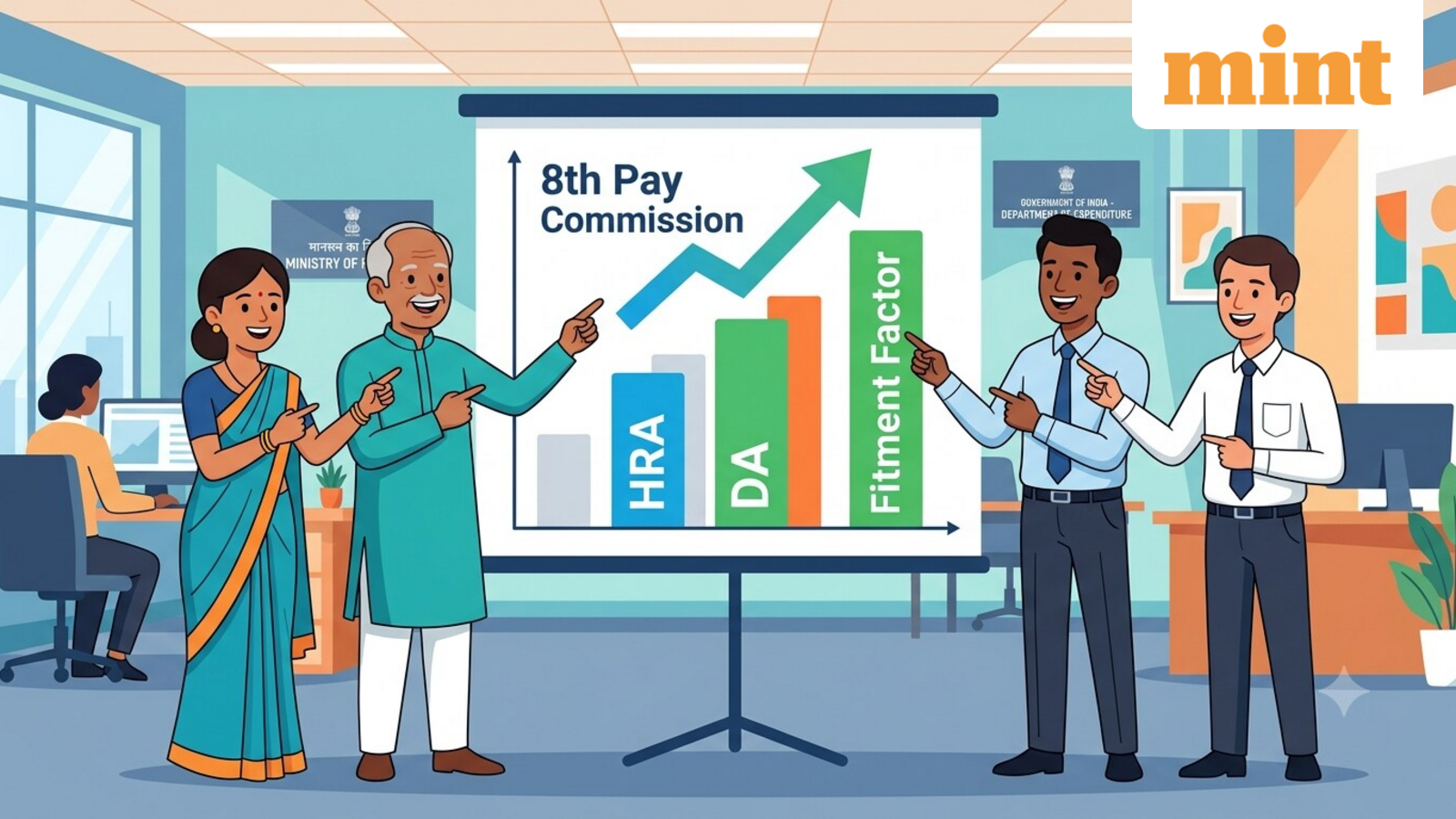
8th pay commission: DA merger, fitment factor, allowances — Components in focus for salary hike, explained
Constituted every decade, pay commissions aim to discuss and decide on possible changes to emoluments for central government employees and pensioners. Assembled last year, the 8th Central Pay Commission (CPC) in is in its consultation stage, with plans to engage with employee and pensioner associations, federations, and unions of central government, UT employees, and other stakeholders across the country.
Most recently, it conducted meetings in Chandigarh, Chennai and Puducherry and has scheduled a state visit to Bengaluru in the next month. These unions and groups collectively represent a large number of employees and pensioners, including defence and railway staff. And the meetings are significant as discussions with representatives are expected to play an important role in shaping the commission’s deliberations.
When it comes to likely salary hike, the conservative estimate is for a 20-30% jump in the 8th CPC, while the moderate estimate is for a 30-50% hike, and the high-end estimate is for an optimistic 80+% salary increase.
8th CPC: What are components under consideration?
Notably, Terms of Reference (ToR). approved by the Union Cabinet last year, define the commission’s scope of work and specifies the areas on which it must make recommendations. This includes examining and recommending changes that are desirable and feasible in the emoluments, including pay, allowances, other facilities/benefits, in cash or kind having regard to rationalisation, contemporary functional requirements and specialised needs.
Thus, during official meetings, the commission is examining updates to the salary structure and various components, including:
- Allowances — Dearness Allowance and Dearness Relief (DA and DR), travel allowance (TA) and house rent allowance (HRA),
- Basic pay — which includes salary structure, fitment factor, pay matrix,
- Facilities or benefits, in cash or kind — which includes increment, promotions, reward for performance, performance linked incentives, etc., and
- Other factors — such as employment rationalisation, contemporary functional requirements and specialised needs.
Further, till July, the commission also sought data and suggestions from employee groups and unions, pensioner representatives and other stakeholders. This too, will be analysed to finalise allowances, pay, pension, and salaries for central government employees and pensioners.
Salary hike: Components in focus, explained
Overall, we can see from the breakdown above, that pay increase under the 8th CPC will depend on the basic pay, fitment factor, and hikes in DA and other allowances. At present, the likely increase is purely speculative as based on estimates by stakeholders and representatives.
- DA is important as it helps address inflationary concerns for burdened middle-class households, lower-income groups, and common salaried individuals.
Further, employee and pensioner groups have demanded the Centre announce DA merger based on 7th CPC recommendations. The issue has gained traction because basic salary determines calculation of the other components — provident fund contribution, pension, allowances, gratuity, etc. Thus, higher DA and, by association, basic pay mean an increase in overall salary and linked allowances.
- Meanwhile, fitment factor is a mathematical multiplier used by the pay commissions to convert an employee’s pre-revised basic salary (or retirees’ pension payout) into the new, revised basic salary structure.
At this time, discussions on the 8th CPC are still ongoing, and the fitment factor has not yet been decided. However, multiple groups, industry watchers, and reports estimate the multiplier could range from 2.28 to 3.83.
- For HRA, employees groups, including the National Council – Joint Consultative Machinery (NC-JCM) has noted that while rent price has kept climbing, HRA rates have remained unchanged since 2017. It has thus proposed revision for the allowance by this CPC.
The NC-JCM’s memorandum noted that rent costs in most towns and cities in India are far higher compared to the sanctioned allowance for level 1 employees under the provision specified in the 6th CPC. Further, rates have remained unchanged since 2017, since the 7th CPC had no revisions for HRA.
Other suggestions include that HRA be increased every time DA is hiked and that HRA be revised upwards across categories — 36% HRA for X category cities, 24% for Y category cities and 12% for Z category cities, as per the All India NPS Employees Federation (AINPSEF).
Who are the beneficiaries?
The 8th CPC’s final recommendations are expected to benefit more than 1 crore individuals, including nearly 50 lakh central government employees and close to 65 lakh pensioners, including defence and railway personnel and retirees.
Overall, various government departments, agencies and services will be eligible to benefit from the recommendations, including central government employees — industrial and non-industrial; personnel belonging to the All India Services; personnel belonging to the Defence Forces; personnel of the Union Territories; officers and employees of the Indian Audit and Accounts Department; members of the regulatory bodies (excluding the RBI) set up under the Acts of Parliament; officers and employees of the Supreme Court; officers and employees of the High Courts whose expenditure is borne by the Union Territories; and judicial officers of the subordinate courts in the Union Territories.
Notably, central government employees and armed forces personnel account for about 0.7% of India’s 60-crore workforce and nearly 9% of the country’s formal sector.
When is 8th CPC expected to make recommendations?
The commission is expected to announce recommendations within 18 months since constitution (on 3 November 2025), as per the official timeline stated in the ToR. This means its absolute deadline to submit the report is May 2027. However, some feel that we could get some announcements as early as February or April next year.
Further, based on previous rollouts, the recommendations are likely to be fully implemented over a period of two years, by 2029 or 2030.