Transparency Is Becoming a Prerequisite for CRE Capital

Transparency in commercial real estate has typically been considered a measure of market maturity.
However, “as disruption and complexity become increasingly embedded in the global economy, transparency has become critical, shifting from a measure of market maturity to a critical prerequisite for capital deployment,” said Matthew McAuley, senior director of market intelligence and strategy at JLL, told Connect CRE.
McAuley and JLL colleague Dominic Silman recently authored “Global Real Estate Transparency Index, 2026: Navigating Risk and Opportunity in an Era of Disruption.” The GRETI tracked transparency and found that transaction volumes in the world’s most transparent real estate markets increased by 64% over the past two years, outpacing the remaining 86 countries tracked.
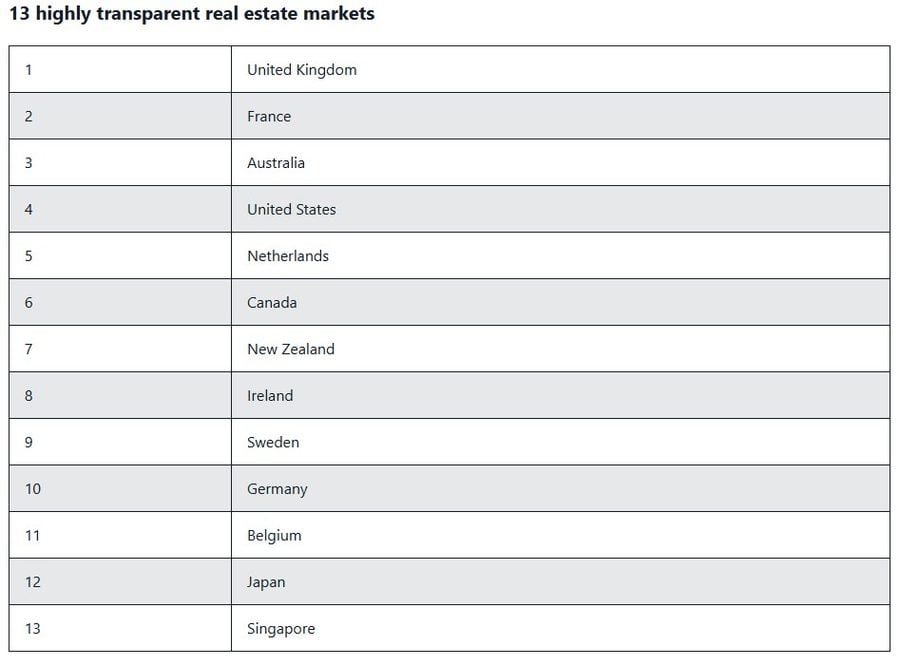
Additionally, “the top 13 most transparent markets now represent 56% of total income-producing real estate worldwide and more than 80% of global direct investment,” McAuley said.
More than the Data
McAuley said transaction volumes in transparent markets tend to see transaction volumes bounce back more quickly due to earlier price discovery and investment at scale.
But transparency goes beyond having more data and impacts how quickly investors understand a market, can price an asset and deploy capital.
For example, investors favor diversifying into alternative sectors within familiar markets experiencing positive tailwinds. McAuley pointed out that alternative sectors account for 20% of global direct transaction volumes, double their share a decade ago.
“But data availability for many of these sectors remains limited, with fragmented inventory and less frequent trades,” he said. “This leaves investors dependent on public markets or core property benchmarks as proxies for pricing and performance.”
As a result, some of the sectors attracting the most attention from capital are also those where traditional real estate data may be least developed.
Credit Conditions
The same issue is occurring in real estate credit. JLL’s Credit Intensity Index now incorporates more than $3.7 trillion of lender quotes, providing greater visibility into lending conditions.
McAuley said that credit markets are attractive to investors because of returns and placement in the capital stack. However, cross-border participation requires considerable due diligence in a fragmented market.
“This includes a lack of deal-level data outside of publicly reported segments such as the CMBS market in the U.S., with significant variance across markets in the public availability of data like CRE debt,” McAuley explained. Additionally, regulatory requirements, licensing and reporting differ from country to country, even those within the European Union’s single-currency area.
“This also means significant effort required to understand, track and operate across markets,” McAuley said.
The Need for More
More investment allocations are directed toward real estate. McAuley said that the “Highly Transparent” and “Transparent” markets attract over 98% of the capital.
“These leading markets have strengthened their position as the focus of global real estate investment activity as they benefit from the deepest capital markets, more detailed understanding of market dynamics and allocations to growing sectors,” he said.
At the same time, the report said that valuation methodologies need to be strengthened and that standardized reporting will be needed to benefit a less specialized investor base. Additionally, liquidity terms, including redemption gates, need to be communicated more clearly and consistently.
“Ultimately, this transparency is essential to CRE as it offers a guide to operating conditions that enables earlier price discovery while supporting investors, lenders, and occupiers in navigating risk and identifying opportunity,” McAuley said.
Photo: bixstock/Shutterstock