What will happen to investors on digital broking platform? INDmoney CEO responds to UPI MDR charges
A proposal to apply a Merchant Discount Rate (MDR) of 0.02%, capped at ₹300, to capital market transactions via UPI has sparked an industry-wide debate over who will ultimately bear the financial burden of digital payments—the platforms, market infrastructure providers, or retail investors.
But what would it cost to run an investment app that adds ₹200 crore to wallets for stock and derivative trading / invested into mutual funds every day?
Ashish Kashyap, founder of investment platform INDmoney, broke down the numbers behind what appears to be a nominal levy at first glance using simple math in a viral LinkedIn post.
0.02% Illusion: Why small numbers add up to crores
While the rate of 0.02% is significantly lower than earlier apprehensions of a 0.40% charge, its financial impact expands drastically at scale.
According to Kashyap’s back-of-the-envelope calculation:
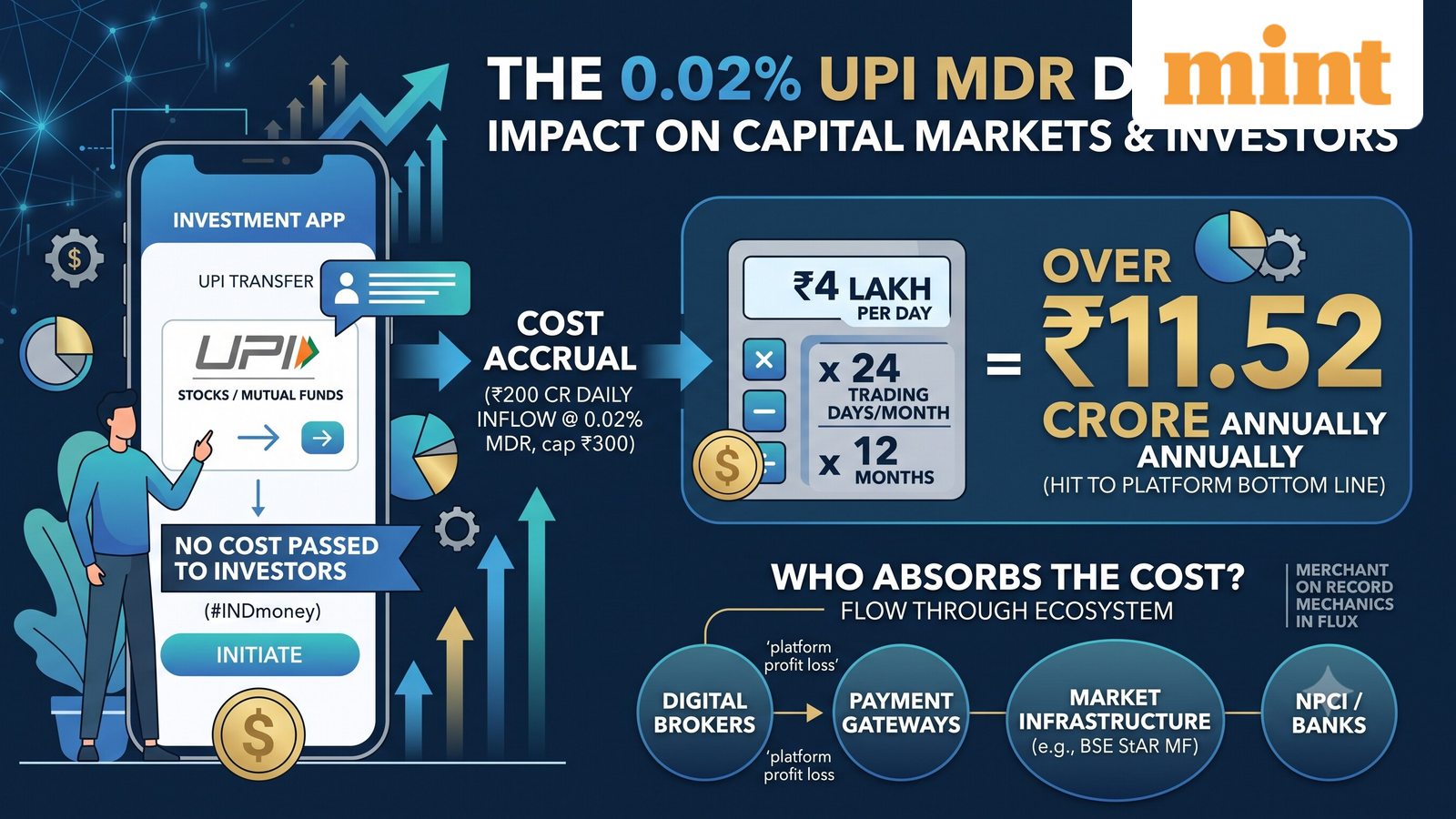
An investment platform processing ₹200 crore in daily wallet recharges for stock trading, F&O derivatives, and mutual fund investments via UPI, for transactions above ₹2,000.
At 0.02%, the daily MDR for this transaction amounts to ₹4 lakh. Across an estimated 24 trading days per month over 12 months, the annual tab stands at: ₹4 lakh x 24 x 12 = ₹11.52 crore
This creates an annual liability of over ₹11.5 crore, deducted directly from a digital brokerage’s bottom line.
“That’s quite a hit!!!! That too a negative straight to the bottom line,” Kashyap wrote.
What does this mean for investors on digital broking platforms?
For everyday retail investors who rely on instant, zero-cost UPI transfers to fund their demat accounts and purchase mutual fund units, the key concern is whether platforms will begin levying a convenience fee.
Addressing the immediate fallout for users, Kashyap said that his platform will not shift the burden to its client base. “We at #INDmoney would not pass this cost to our investors.”
Therefore, for investors on platforms that take a similar stance, loading funds into stock wallets and executing mutual fund SIPs or lump-sum investments will remain completely free of transaction surcharges.
‘Who absorbs this cost?’
Beyond direct platform wallets, the mechanics of how this cost will be shared remain unresolved.
In the case of mutual funds, transactions often route through central infrastructure providers such as the BSE StAR MF platform rather than the broker acting as the sole merchant of record.
How this fee flows through payment gateways, clearing houses, and intermediaries is still being evaluated by market participants.
“We are still figuring out who ultimately absorbs this cost,” Kashyap said. “…it remains to be seen how this cost flows through the ecosystem.”