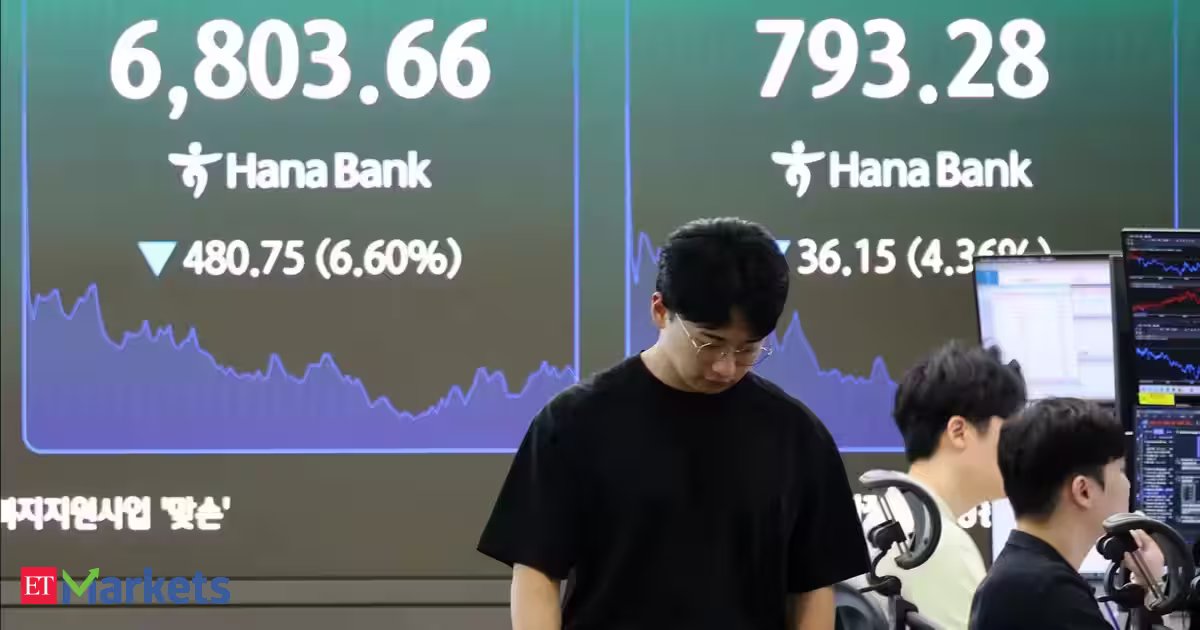
Global Market Today: Asian stocks steady as traders await Fed decision
MSCI’s Asian equities index advanced 0.1%. Contracts for Wall Street gauges also nudged up in early trading as OpenAI weighed a new funding round at a $1.2 trillion valuation. The S&P 500 and Nasdaq 100 slipped Tuesday, while a gauge of chipmakers eked out an increase.
Helping sentiment, US crude oil fell 0.6% to $105.15 a barrel after surging more than 20% this month. The rally in energy prices and growing bets on a Fed rate hike had fueled a bond selloff, pushing the 10-year Treasury yield as high as 5.04% — the highest in almost two decades — before it closed at 5.00%.
Read more: US Treasury secretary Scott Bessent says rising bond yields due to ‘global issues’
Treasury futures consolidated, while government bonds opened higher in Australia and New Zealand.

Elsewhere, Bitcoin extended its slide to trade around $75,600 as the US Senate blocked a landmark crypto market structure bill.
The Fed’s decision Wednesday is in focus after hotter-than-expected core inflation last week and concerns over government budgets bolstered expectations for the first rate increase in since 2023. Markets are pricing in a more-than-90% chance of a hike, raising the prospect of tighter financial conditions as elevated energy and borrowing costs weigh on equities.“If the Fed follows the futures market and hikes rates, our sense is that stocks are likely to see downward pressure over the near-term,” said Chris Senyek at Wolfe Research. “However, we’ve found that over a longer time horizon — six to 12 months after the first rate hike — stocks typically recover and push into positive territory.”
Three major central banks meet this week, with the Fed followed by policy decisions from the UK and Japan, potentially reshaping the monetary-policy outlook for the rest of 2026.
A decision to hold rates — or a hike without clear guidance on further increases — may push investors to demand higher long-term yields as protection against inflation, while shorter-dated yields track the Fed’s policy path more closely.
Officials have held their benchmark rate steady in a range of 3.5%-3.75% since December as a majority of policymakers argued that progress in lowering inflation was being stalled by temporary factors.
Elsewhere, Brent slipped in early Wednesday trading after settling almost 3% higher Tuesday as outages at a key Saudi pipeline and Libyan oil fields added to supply risks in a market already hit by disruptions from the Iran war.
Traders were watching for signs of how long Saudi Arabia’s East-West pipeline will remain closed after drone attacks halted operations last week. Saudi Aramco is delaying oil supplies to some European customers this month, people familiar with the matter said.
“The combination of higher interest rates and elevated oil prices is like asking equities to run a marathon with ankle weights strapped on,” said Darrell Cronk at Wells Fargo Investment Institute. “Higher rates increase the discount rate investors apply to future earnings, while higher energy costs drain purchasing power from consumers and pressure profit margins.”