Same mutual fund category, different capital gains tax? How a scheme’s portfolio can change your tax bill
If you are investing in a particular mutual fund, do not assume that all schemes in the same category will be taxed the same way when you redeem.
Capital gains tax depends on the fund’s actual portfolio and how it meets the tax law’s thresholds.
Here’s what mutual fund investors need to know.
How are mutual fund capital gains taxed?
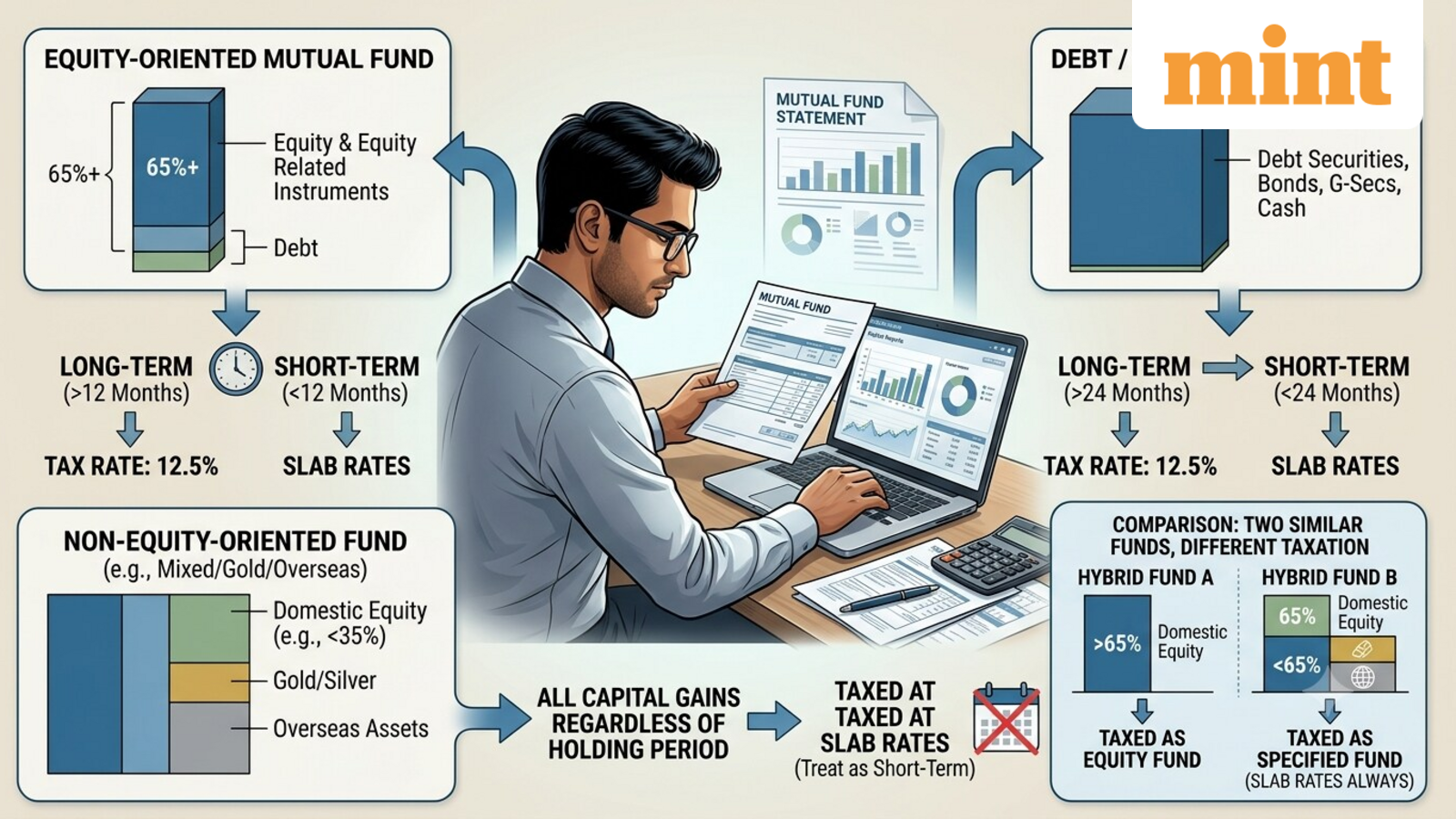
Sougata Basu, Founder and CEO, CashRich, explained that mutual funds fall into three broad groups. The Income-tax Act does not use these names, and a scheme’s SEBI category does not by itself determine its tax treatment.
- Equity-oriented funds: ≥65% in listed Indian shares; STCG 20%, LTCG 12.5% above ₹1.25 lakh after 12 months.
- Specified mutual funds: >65% in debt/money-market instruments; gains on units bought from 1 April 2023 are taxed at slab rates, regardless of holding period.
- Other funds: Includes gold, silver, international and certain hybrid funds; LTCG after 24 months for unlisted units and 12 months for listed units. LTCG is 12.5%; STCG is taxed at slab rates.
Most tax surprises in mutual funds come from that third group. From 1 April 2026, these rules sit in Sections 76, 196, 197 and 198 of the Income-tax Act, 2025. The rates did not change with the new Act or the Finance Act, 2026, Basu added.
Which mutual funds can have different tax treatment within the same category?
Harsh Vardhan Dawar, ACA, CFA, FRM, Founder – Wealth Cafe, highlighted these categories:
- Multi-Asset Allocation Funds
- Dynamic Asset Allocation / Balanced Advantage Funds (BAFs)
- Fund of Funds (FoFs) & Overseas FoFs
- Solution-Oriented Schemes (Children’s / Retirement Funds)
- Conservative Hybrid Funds
For example, a multi-asset fund with at least 65% in listed Indian shares, measured on the prescribed annual-average basis, is taxed as an equity-oriented fund. But if it falls below that threshold without qualifying as a specified mutual fund, it enters the middle bucket, Basu explained.
An investor making a ₹10 lakh gain after 14 months could therefore pay about ₹1.09 lakh in an equity-oriented fund, versus ₹3 lakh at a 30% slab rate in the other fund.
Basu said other categories also need checking. Equity savings funds have a 65% SEBI equity floor, but the tax test counts only listed Indian shares. Flexi-cap funds face a similar distinction between SEBI’s definition and the narrower tax test, particularly where overseas investments are significant.
Life-cycle funds can change tax buckets as their equity allocation reduces with maturity. Gold and silver funds. The same metal can carry a 12-month threshold through an ETF and a 24-month threshold through an FoF, he added.
What determines whether a fund qualifies as equity-oriented?
Basu explained that the fund’s actual investments, rather than its mandate alone, determine its tax classification. For equity-oriented status, at least 65% must be invested in shares of Indian companies listed on a recognised stock exchange. The test uses the annual average of monthly averages of opening and closing figures.
For specified mutual funds, the debt and money-market exposure must exceed 65%, measured using the annual average of daily closing figures. Foreign stocks, gold, silver, REITs and InvITs do not count towards the equity test. Units of other funds qualify only through a specific FoF route involving prescribed 90% thresholds, he added.
Dawar noted that the Income Tax Department looks at actual portfolio allocation, not the investment range permitted under the scheme’s SID. Under Section 112A read with Explanation (a) to Section 115T of the Income-tax Act, tax classification is governed by the annual average of monthly averages of portfolio allocation.
What happens if a fund changes its tax classification?
Tax is triggered when the investor transfers or redeems the units. A change in the fund’s underlying allocation, by itself, does not mean the investor has realised a capital gain, Rohan Goyal, Investment Research Analyst, MIRA Money, noted.
Basu explained that the Income-tax Act does not specify how to split a gain when a mutual fund moves from one tax classification to another during the holding period. There is no provision to tax part of the gain as equity and the remainder as non-equity.
In his view, the better interpretation is that the fund’s tax classification at the time of redemption would apply to the entire gain. The classification itself is based on an annual-average portfolio test. So, a fund that crosses the 65% equity threshold during the year is not assessed based on the day it crosses the threshold; its full-year average determines the classification.
For instance, if an investor redeems after 18 months, but the fund that was equity-oriented when the units were bought fails the equity test in the year of redemption, the gain could be taxed at slab rates instead of the 12.5% equity LTCG rate. The reverse could also apply if the fund qualifies as equity-oriented in the year of redemption, Basu explained.
How is the holding period calculated?
Dawar explained that for SIPs or multiple purchases, each unit tranche has its own holding period, calculated from its purchase or allotment date to redemption, with FIFO applying.
The relevant 12-month or 24-month threshold depends on the fund’s tax status at redemption, based on the prescribed portfolio test.
So, a multi-asset fund bought when it qualified as equity-oriented could later fall below 65%. If an investor redeems after 14 months and the fund no longer qualifies, the gain may face slab-rate taxation because the 24-month threshold applies. The reverse can also occur if a fund moves into equity-oriented status.
What should investors check?
Dawar suggested checking the SID and factsheet, which carry a line such as “the scheme is treated as an equity‑oriented fund for tax purposes.” This can be an indicator for investors.
Investors can also look at the twelve months of monthly portfolio disclosures, not just the latest one — because the test to qualify as equity-oriented is the annual average, he added.
Disclaimer: This is purely for educational/informational purposes and should not be taken as any sort of investment advice. Always consult a SEBI-registered advisor before making any investment decisions.