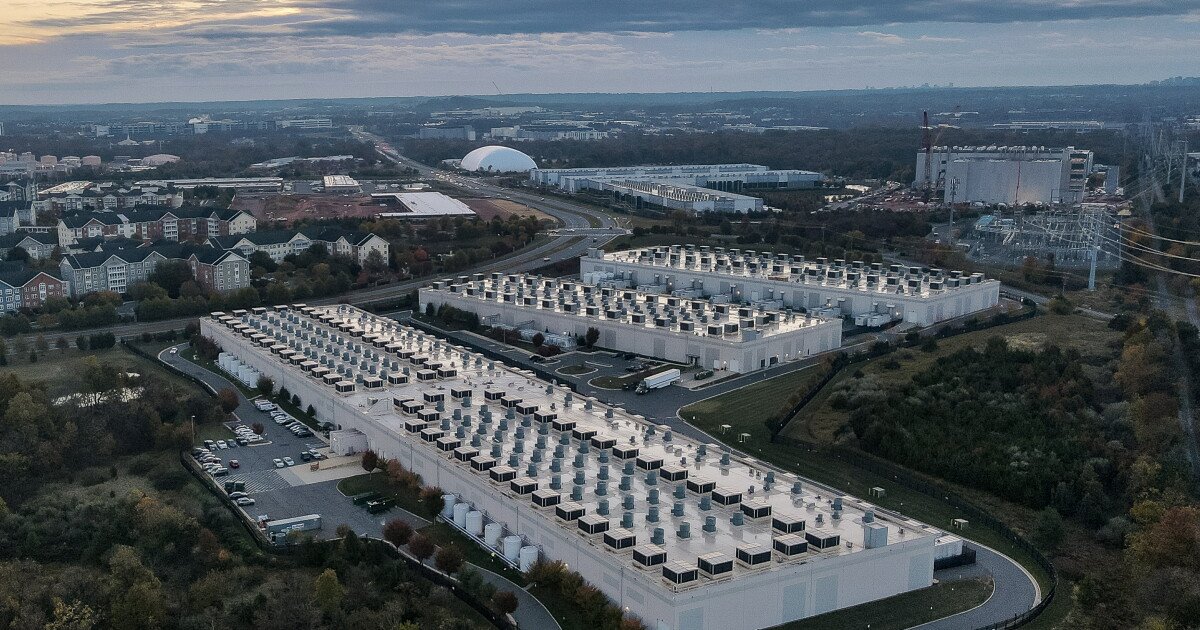
Wall Street’s data center boom is reshaping the real estate bond market
The commercial mortgage backed securities market, long a mainstay of financing for America’s offices, apartments and malls, is being reshaped by a surge in data-center deals, forcing investors to grapple with an entirely new set of risks.
Processing Content
From power availability and grid constraints to rapidly evolving requirements for cooling and computing density, CMBS buyers have been pushed into areas of underwriting that have historically had little to do with commercial real estate. Even familiar questions about tenant demand and stability are changing as facilities depend on a handful of often secretive hyperscalers whose future needs can be difficult to gauge. If those tenants leave when their leases expire in the coming years, highly specialized buildings could be costly to repurpose.
About $17 billion of data-center CMBS has been issued since the start of 2025 — more than triple the amount sold over the previous two years. During that span, data centers have grown to account for roughly 8% of new commercial property bond deals. With billions more in the pipeline, industry veterans are rapidly revamping their risk-assessment playbooks to try to steer clear of any potential blowups that could leave a hole in their portfolios.

Lexi Critchett/Bloomberg
“True data centers that are measured in units of compute and megawatts — it’s a totally different universe for real estate investors,” said
Killick said CWCapital is developing a new set of stress tests for the sector to try to answer that question.
That same dilemma is evident at Axonic Capital, where portfolio manager Steven Jury has taken a cautious approach, keeping data centers a small part of the firm’s portfolio and emphasizing diversification across tenants, use cases and geographies. Most data center CMBS are structured as single-asset, single-borrower transactions, or SASBs, in which one large mortgage – often tied to a single facility or complex – backs the bonds.
“What these assets will be worth — and who will need them — five, 10 or 20 years from now” is the hard question, Jury said. “Technology, tenant demand and the supply landscape can all change significantly over that time.”
Many of the risks CMBS buyers have long had to weigh still apply, but the factors shaping them look very different when it comes to data centers.
Take the lease agreements themselves. Provisions covering power costs, minimum capacity commitments and downtime determine who absorbs unexpected expenses, which can reduce the cash available for servicing debt. Scrutinizing those terms can also be more difficult, with tenants often insisting that their identities and other lease details be kept confidential.
“Traditional CRE investors know how to underwrite offices, apartments, warehouses and retail because leases tend to be relatively standardized and tenant information is reasonably transparent,” said Ben Hunsaker, a portfolio manager at Beach Point Capital Management. “Data centers are much more opaque.”