CPI inflation rises to 4.82% in August 2026: Which everyday items became costlier and which got cheaper?
India’s retail inflation accelerated in August 2026, with consumers facing higher prices for several food items.
The Consumer Price Index (CPI) inflation rose to 4.82% in August, from 4.45% in July, while food inflation increased to 5.95% from 5.25% during the same period, according to data released by the Ministry of Statistics and Programme Implementation.
But the overall inflation number does not tell the full story. Some products saw prices rise sharply, while others became cheaper. Here is what you need to know.
What is CPI inflation?
The Consumer Price Index (CPI) measures changes in the prices of goods and services that households regularly buy. These include food, beverages, clothing, fuel, transport, and other everyday necessities.
For example, if a household basket cost ₹100 in August 2025 and costs ₹105.30 in August 2026, it represents a 5.3% increase in consumer prices over the year.
Which products became the most expensive?
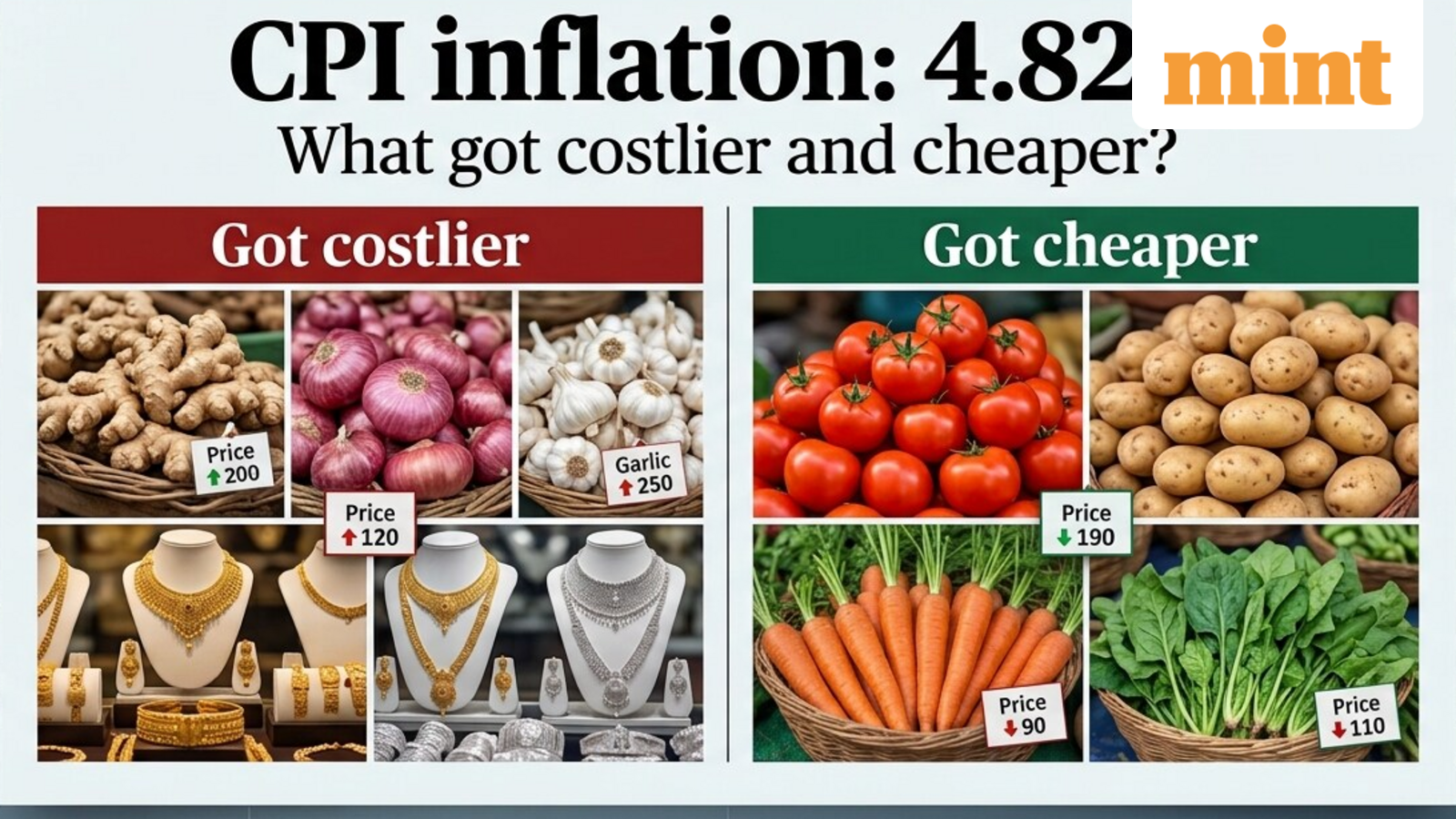
At the all-India combined level, silver jewellery recorded the highest inflation at 107.11% in August, although this was lower than 109.89% in July.
Ginger inflation stood at 73.82%, while onion prices rose sharply, with inflation increasing to 48.27% from 22.54% in July.
For example, if ginger currently costs ₹80 per kg, a 73.82% rise in prices means it would have cost around ₹46 per kg in August 2025.
| Rank | Item | July 2026 inflation | August 2026 inflation |
| 1 | Silver jewellery | 109.89% | 107.11% |
| 2 | Ginger | 83.57% | 73.82% |
| 3 | Onion | 22.54% | 48.27% |
| 4 | Garlic | 35.36% | 43.60% |
| 5 | Gold/diamond/platinum jewellery | 32.98% | 35.53% |
*Source: Ministry of Statistics & Programme Implementation
The data shows that while jewellery recorded the sharpest year-on-year price increases, several kitchen staples also became significantly more expensive.
Which products became cheaper?
Tomato prices saw the sharpest decline among the listed items. Tomato inflation fell to -31.09% in August, compared with -4.60% in July.
Potato prices also remained lower than a year earlier, while prices of motor cars and jeeps, lady’s finger and parwal/patal and kundru also recorded negative inflation.
| Rank | Item | July 2026 inflation | August 2026 inflation |
| 1 | Tomato | -4.60% | -31.09% |
| 2 | Potato | -16.56% | -13.14% |
| 3 | Motor car and jeep | -6.72% | -6.72% |
| 4 | Lady’s finger | -5.50% | -5.41% |
| 5 | Parwal/patal and kundru | -0.78% | -3.60% |
*Source: Ministry of Statistics & Programme Implementation
Negative inflation means prices were lower in August 2026 than in August 2025. It does not mean prices necessarily fell from July to August 2026.
If the current price of 1 kg of tomatoes is ₹50, and prices were 31.09% lower in August 2026 compared with a year earlier, the comparable price in August 2025 would have been around ₹72.50 per kg.
Which major categories saw the highest and lowest inflation?
Among the broader CPI groups, transport services for goods recorded the highest combined inflation at 14.64%, followed by food and beverage serving services at 8.41%.
| Highest inflation category | August 2026 inflation | Lowest inflation category | August 2026 inflation |
| Transport services for goods | 14.64% | Purchase of vehicles | -4.38% |
| Food and beverage serving services | 8.41% | Recreational durables | -1.25% |
| Operation of personal transport equipment | 7.40% | Tools and equipment for house and garden | -0.59% |
| Paan and tobacco | 7.34% | Beverages | 0.10% |
| Food | 5.95% | Newspapers, books and stationery | 0.77% |
*Source: Ministry of Statistics & Programme Implementation
On the other hand, purchase of vehicles recorded the lowest inflation at -4.38%, followed by recreational durables at -1.25%.
Overall, the August data shows that inflation pressures were uneven: some everyday food items became substantially costlier, while prices of products such as tomatoes and potatoes remained below year-ago levels.
Disclaimer: This is purely for educational/informational purposes and should not be taken as any sort of financial advice.