Banking has an AI blind spot: the human intelligence gap
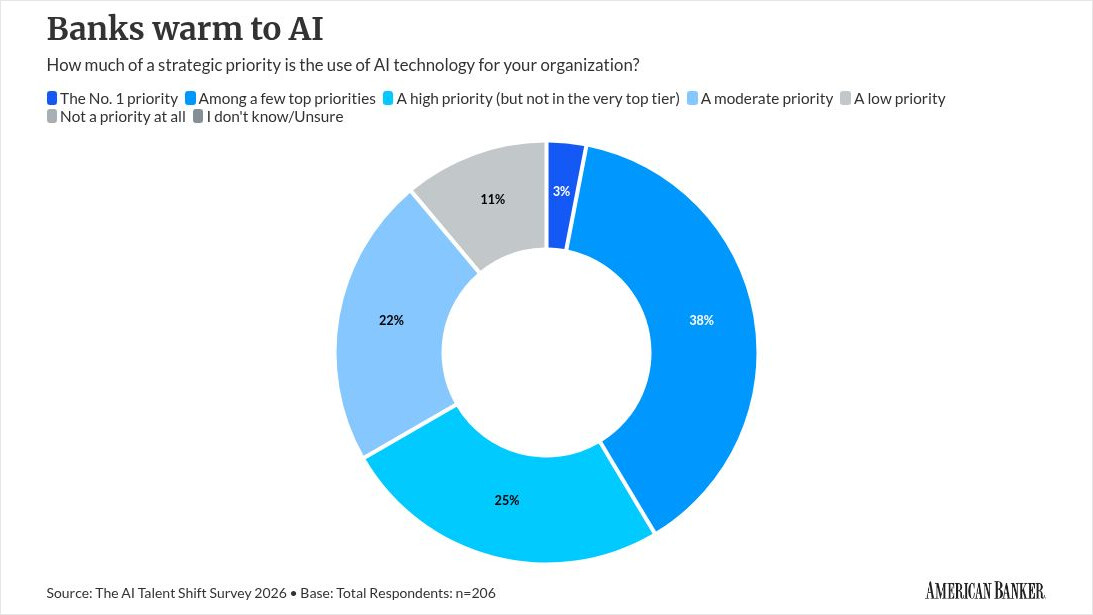
- Key insight: Banks are racing to adopt artificial intelligence while often de-emphasizing basic banking education. That’s a recipe for disaster.
- Supporting data: In a January 2024 survey, 80% of respondents reported their bank did no derivative hedging to offset higher rates in 2023.
- Forward look: Banks seeking ROI from their increased investment in AI must pair it with renewed investment in HI, from new employees to the C-suite to the boardroom.
AI minus HI reduces ROI.
Processing Content
The banking industry’s rush into
AI is moving
The industry provides financial literacy for consumers, but what about in-house banking literacy?
This is not an anti-AI column, but a pro-HI one.
Full disclosure: I’ve taught banking and finance at Wharton for over 40 years. I’m also a dedicated AI user with multiple premium platform subscriptions.
Closing the AI/HI gap starts with basic banking and financial education and understanding AI’s limits. AI can improve loan processing efficiency, but decisions on large commercial loans must rest with experienced officers. AI agents may recommend approval, but a seasoned lender, after meeting the borrower at their place of business and applying the traditional
Perhaps the strongest case for improving HI in risk management is the industry’s current
There were many warnings in
Many banks hedged with matching maturities, floating-rate assets and other traditional techniques. But that doesn’t explain hundreds of billions of unrealized losses.
In a subsequent
Traditional and derivative interest rate risk, or IRR, management tools are taught in introductory banking and finance courses.
The issue is not whether every bank should use derivatives. It’s whether management and boards have the HI to evaluate the full range of IRR tools and, when appropriate, use derivatives, even with outside expertise. Hundreds of billions of unrealized losses suggest this isn’t the case.
How could such huge industry losses occur with multiple
My Doubting Thomas answer is simple: The industry emphasizes eye-popping AI and other innovations over HI fundamentals. Not unlike my
Read more:
I would respectfully suggest the industry balance its intense focus on AI with renewed investment in HI across three levels.
First are our future bankers who are equipped with the AI tools but not always basic banking and financial literacy HI tools. A refreshing exception is the annual
I had the privilege of working with the partnering bank and
My second level of HI focus is the 75% of C-suite officers whose banks made little to no material use of derivatives, even if they employed traditional tools to manage post-pandemic IRR.
How did this happen with all the regulatory, industry and other available IRR educational resources? Having attended a few hundred industry conventions and meetings since 1970, I’ve concluded the main benefit of many of them is networking for bank employees and oftentimes regulators looking for better jobs. So-called “educational” conferences sponsored by private compliance firms often focus on selling their products and services.
Instead of industry conferences at luxury resorts, I prefer structured continuing education at specially designed, off-site, university programs. Some universities are affiliated with
After six years training hundreds of C-suite banking officers through numerous custom-designed
Bank boards represent my third and perhaps most serious level of concern. Having served on community bank boards and presented to several hundred as a consultant, I’ve found most directors are familiar with managing basic credit risks but not IRR. The role of directors is not to manage IRR but to oversee, question, and challenge management and, if necessary, bring in outside expertise.
This, however, was not done adequately by a large share of post-pandemic bank boards. Bank director attendance at industry conferences fell off after the pandemic, likely mimicking the national trend of a
Many of the pre-pandemic, director, education-credit seminars I attended were current event sessions by outside vendors promoting consulting and other services.
A preferred format is off-site,
Building on that, in-person attendance at structured, off-site, regulator or university programs should be mandatory. Doctors and lawyers on bank boards have continuing education requirements. Bank directors should too.
Separately,
HI created AI, but AI does not eliminate the need for HI. Banks seeking ROI from their increased investment in AI must pair it with