India’s senior living market to grow 4x, cross ₹1 trillion by 2030, Tier II, III cities to see most new projects: Report
The senior living market in India is projected to grow four times the current levels to cross ₹1 lakh crore and demand for senior housing to reach around 30 lakhs units by 2030, driven by evolving demographic shifts, according to a report by Colliers.
“While the segment is still at a nascent stage, it has evolved beyond conventional retirement housing to an organised market where senior housing is replete with healthcare facilities,” as per the report.
According to Badal Yagnik, CEO and MD of Colliers India, the country’s senior living market is entering a period of accelerated growth, driven by strong demographic shifts and evolving socio-economic dynamics.
He feels increasing policy support, growing investor participation and collaboration among leading developers and healthcare operators are likely to redefine senior living offerings across the country.
Trends in India’s senior living market size
“With a rapidly expanding elderly population and rising demand for professionally managed senior housing and care solutions, the market presents significant long-term growth opportunities. In fact, on the supply side, India’s organized senior living inventory is expected to quadruple over the next 3-4 years and become a ₹1 lakh crore market by 2030,” Yagnik said.
| Year |
2024 |
2026 E |
2028 F |
2030 F |
|---|---|---|---|---|
| Market size |
~ ₹180 billion |
~ ₹300 billion |
~ ₹700 billion |
> ₹1,000 billion |
| Note: Market size is estimated/forecasted basis overall inventory (supply side) | E-Estimate, F-Forecast. Source: Colliers | ||||
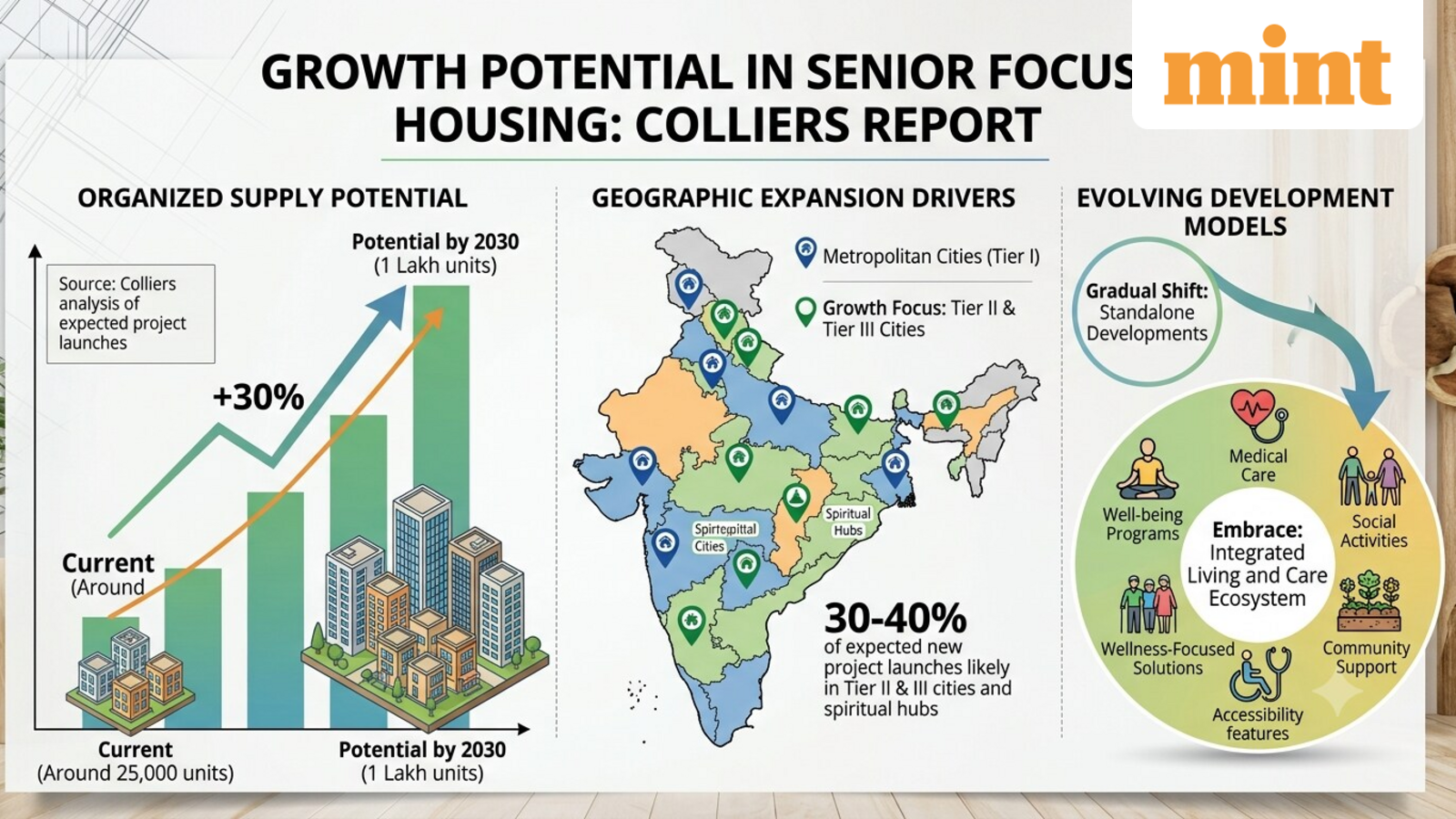
As per the report, organised supply for senior focused housing can potentially increase from around 25,000 units currently to 1 lakh units by 2030. Further, it expects penetration rate in the segment to rise from above 1% currently to around 4% in next three to four years.
Leading real estate developers and investors are expected to deploy more than ₹130 billion for senior living projects by 2030, of which 30-40% of the expected new project launches are likely to be in Tier II and III cities, and spiritual hubs, it said.
Tier II and III cities, spiritual hubs to gain momentum
The report further said that while Tier I cities currently account for majority of India’s organized senior living stock, the segment is gradually expanding into Tier II and III markets.
- Cities such as Coimbatore, Puducherry, Dehradun, Vadodara along with spiritual hubs like Tirupati, Vrindavan and Ayodhya are emerging as attractive destinations for senior housing due to evolving lifestyle preferences and cultural appeal.
- These locations offer a compelling value proposition in the form of lower cost of living, improving healthcare infrastructure, relatively affordable real estate price points and a slower pace of life in general.
“Looking ahead, as awareness and acceptance of senior living projects continue to grow and expand beyond Tier I cities, emerging Tier II/III cities are expected to account for a growing share of around 30-40% in new project launches and broaden the segment’s geographic footprint across the country,” it added.
Wellness, innovation, policy impetus to shape outcome
In terms of the future, the report said that developers will likely embrace integrated and wellness focused solutions — with a gradual shift away from standalone developments to integrated living and care ecosystem.
- While in case of both independent and assisted living formats, 1, 2 and 3 BHK configuration units continue to remain dominant, real estate developers are increasingly incorporating senior living clusters within villas, large mixed-use developments and integrated townships wherein senior residents can benefit from shared amenities, social interaction, healthcare access and community engagement.
- Going ahead, developers are likely to increasingly broaden their offerings and cater to diverse needs such as dementia care, emergency support, rehabilitation and wellness services.
- At the same time, operator-led models could gain further traction as leading real estate developers partner with local healthcare providers, unlocking investment opportunities in both established and emerging markets, it added.
Regulatory reforms to strengthen ecosystem
The report expects India’s regulatory environment for senior living to strengthen further in the coming years, following recent reinforcement of model guidelines for senior living projects, which were originally issued by the Ministry of Housing and Urban Affairs in 2019.
- This renewed emphasis is set to encourage states and union territories to develop guidelines that will strengthen the overall regulatory framework for senior housing in India.
- These guidelines along with mandatory Real Estate Regulatory Authority (RERA) compliance requirements will bring greater standardisation, transparency, operational efficiency and accountability across senior living projects.
- Select states like Haryana and Maharashtra have already taken proactive steps towards establishing dedicated guidelines / policies for senior living projects, signalling the growing need for regulatory oversight in the segment, it added.
Disclaimer: This story is for educational purposes only. The views and recommendations made above are those of individual analysts or broking companies, and not of Mint. We advise investors to check with certified experts before making any investment decisions.