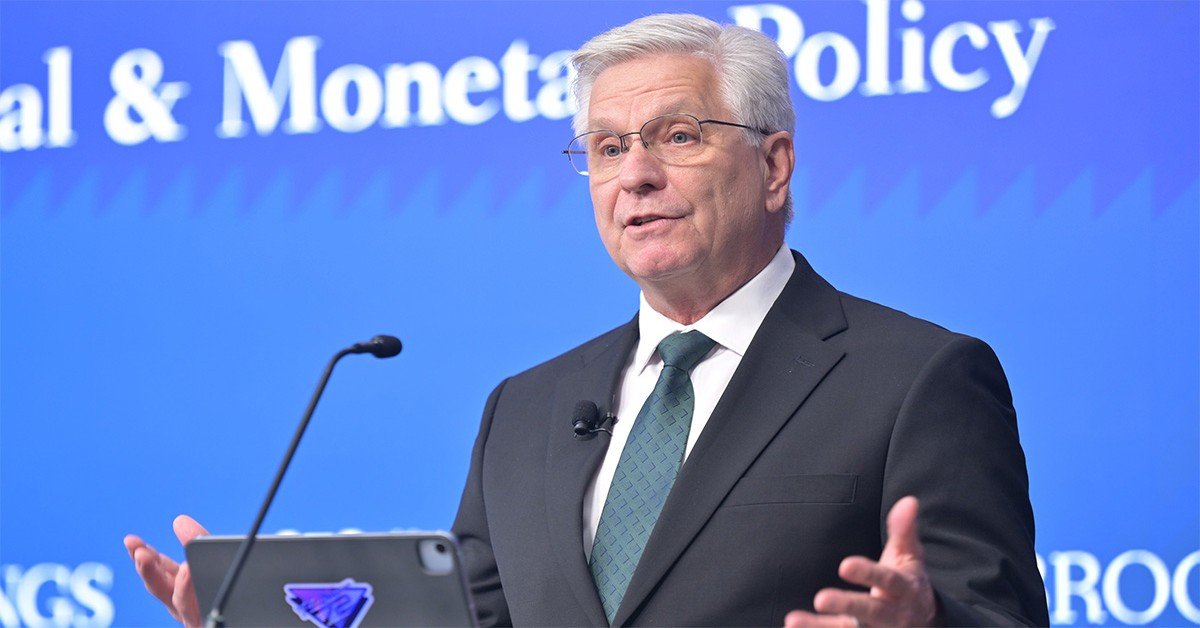
Did Chris Waller just torpedo a Fed rate hike in September?
In the hierarchy of Federal Reserve hawks and doves who lean tighter or looser on monetary policy, Christopher Waller could be considered a swing voter.
Throughout last year, the central bank governor and Federal Open Market Committee member took a dovish stance, notably dissenting at the July 2025 FOMC meeting in favor of an interest rate cut. He argued at the time that monetary policy was overly restrictive and that Trump administration tariff policies would not cause inflation to heat up “beyond a temporary surge.”
This year, concerns about the inflationary impact of the Iran war prompted a shift in Waller’s outlook. In April, he cautioned that markets were “undervaluing the risk” of prolonged energy and trade shocks. In July, he signaled his openness to hiking rates if core inflation — which strips out volatile food and energy prices — continued its warming trend.
Advertisement

‘Give disinflation a chance’
Following Kevin Warsh’s hawkish turn at last week’s closely analyzed speech in Jackson Hole, Wyo. — in which the Fed chair said the central bank may “have work to do” on its inflation mandate — comments from fence-sitting FOMC voters like Waller carry added weight ahead of the Sept. 15-16 policy meeting.
In prepared remarks released Thursday prior to a Reuters interview, Waller said recent economic data “suggest we are finally seeing some signs of disinflation.” He noted that about half of July’s increase in core prices in the personal consumption expenditures (PCE) price index came from “nonmarket services prices,” which are estimated rather than directly observed.
Waller added that pending changes to the Bureau of Economic Analysis’s methodology for estimating fees paid to stock traders and related market professionals could lower nonmarket prices and push 12-month PCE inflation down “by a few tenths of a percentage point.”
While acknowledging that August inflation data due next week could alter his views, Waller said that if July’s disinflationary trends continue, “I would be inclined to support holding the target for the federal funds rate at its current setting.”
Elaborating during the interview, Waller invoked a 1969 song from John Lennon and Yoko Ono’s Plastic Ono Band.
“Give disinflation a chance,” he said. “We can wait one meeting.”
Williams tilts dovish, Barr noncommittal
At the July FOMC meeting, nine members voted to hold rates, while three dissented in favor of a quarter-point hike. Those dissenting votes came from regional Fed presidents Beth Hammack of Cleveland, Neel Kashkari of Minneapolis and Lorie Logan of Dallas — all of whom have been outspoken inflation hawks this year.
On Thursday, following Waller’s interview, the odds of a September rate hike dropped from about 63% to roughly 50%, according to CME FedWatch.
Another potential September swing voter, Fed Governor Michael Barr, gave a studiously measured take during a speech Tuesday.
“If trends in the data give me some confidence that inflation is moderating on a path to 2%, then I think we can take a bit more time to assess our policy stance,” he said. “However, if inflation appears not to be moderating sufficiently, then I think we should act decisively to raise rates.”
New York Fed President John Williams struck a more optimistic tone during a Wednesday interview with CNBC, downplaying concerns over a recent spike in longer-dated U.S. Treasury yields, which some economists have tied to energy-driven inflation and massive federal debt burdens.
“I think what’s driving [higher yields] in large part is really a strong U.S. economy and a strong economic outlook, fueled by big investments in AI and data centers and technology in general, so I see this as more of a reflection of the strength of the economy,” Williams said.
Williams stressed he is taking a wait-and-see approach on future policy moves, he noted “well-anchored inflation expectations” and that he is not seeing broadening “second-round effects” of tariffs.
“I am actually seeing the trend in inflation moving slowly down as some of the effects of the tariffs kind of move into the rearview mirror,” he said. “But we’ve got to be data dependent, got to keep watching that data.”