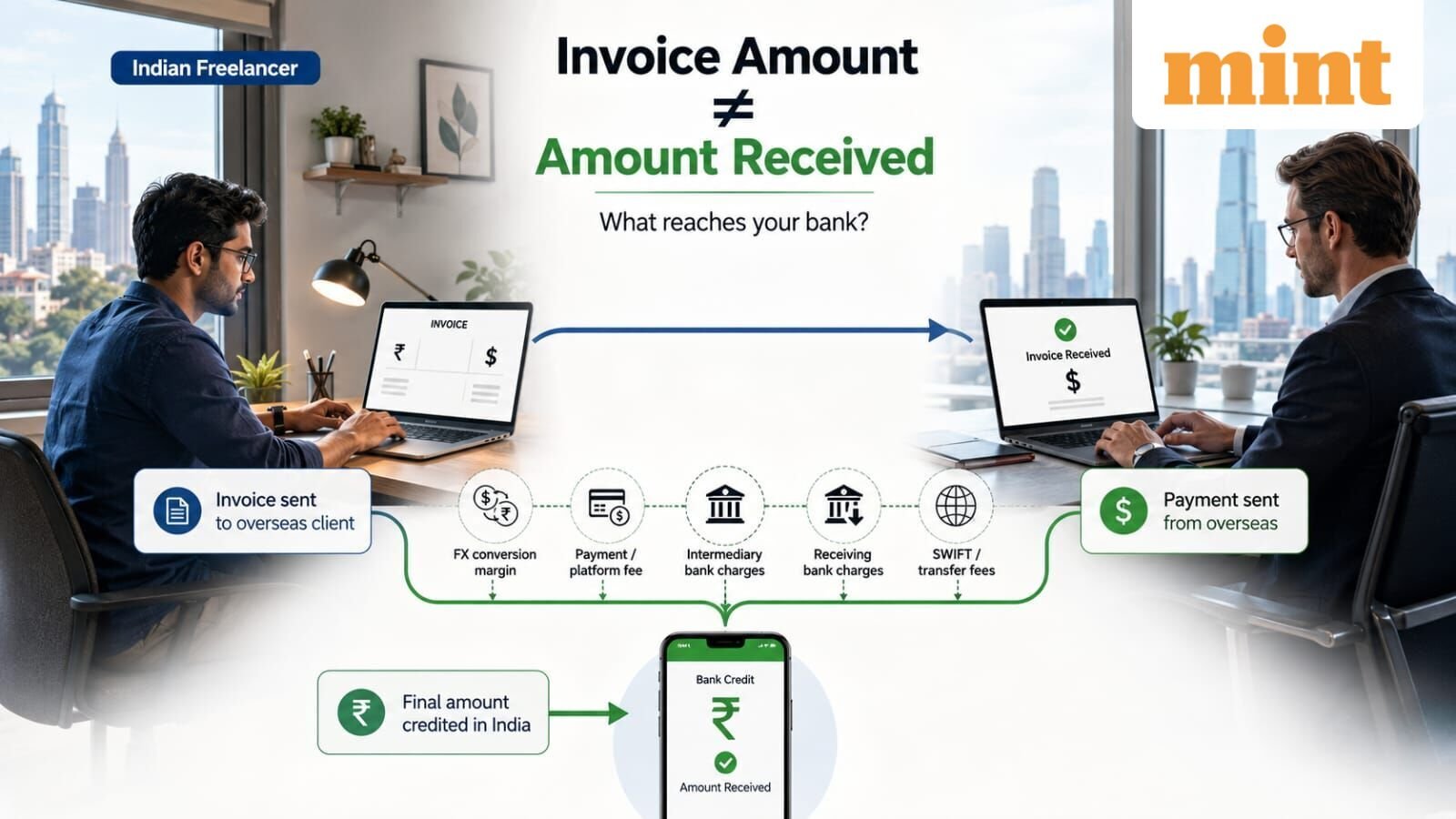
The hidden drag on freelance income: Why your overseas client invoices don’t match the money reaching your bank
If you’re an Indian freelancer receiving payments from overseas clients, the amount on your invoice may not be your net payout, as various charges can reduce the final amount credited to your bank account.
Hamraj Kumar, Founder & CEO of Testkart, explained that the final amount depends on how the freelancer receives the payment and the banks or platforms involved.
What can reduce a freelancer’s overseas payment?
Kumar mentioned that “the number on an overseas invoice is not always what you will finally get in your bank”.
He said freelancers should account for three key areas of costs.
- Currency conversion: Banks and payment platforms use their own exchange rates, which can differ from the mid-market rate people check on Google. The difference, known as the FX spread, can reduce the INR amount received.
- Payment or platform fees: Depending on how the client sends the payment, a platform may charge a flat fee, percentage fee, or both. The cost may either be shown separately or built into the transaction terms.
- Bank charges: Cross-border bank transfers may involve intermediary bank fees, receiving-bank charges and, on some routes, SWIFT or other transfer-related costs.
For a $2,000 invoice, how much could a freelancer actually receive?
Kumar said there is no fixed deduction.
“The final amount depends on the payment method, bank or platform, exchange rate, and who bears the transfer fees,” he noted.
What are the charges on overseas payments received by Indian freelancers?
Kumar said Indian freelancers receiving international payments should account for these five possible charges.
- FX conversion margin: This is the gap between the exchange rate people see in the middle of the market and the rate the bank or platform uses to turn foreign money into INR.
- Payment or platform fee: When a client pays through a payment service, that service can add a flat fee, a fee based on a percentage, or both.
- Intermediary bank charges: International transfers may pass through multiple banks. Intermediary banks can deduct charges before the money reaches the Indian bank.
- Receiving bank charges: The Indian bank receiving the payment may also levy a fee, depending on the account type, transaction, and remittance route.
- SWIFT and transfer network fees: Some transfers run on international banking networks. In that case, SWIFT and related transfer fees may be applied.
“There may be extra costs too, based on the provider and the details of the transaction. Also, minimum fees, percentage rates, and cutoffs do not stay the same across providers,” he noted.
Do charges vary by country?
Yes. Kumar said the sender’s country, currency, exchange rate, and payment route can all affect the final amount.
“Even two clients from the same country may have different take-home amounts. One may use a direct bank transfer, while another may use a payment platform with its own fees,” he added.
For freelancers, Kumar suggests comparing the country and currency first, followed by the payment route and fee structure.
Bank transfer vs payment platform: Which is cheaper?
According to Kumar, a direct international bank transfer includes intermediary-bank charges, receiving-bank fees and FX spreads.
“Some platforms offer better FX rates, while others may appear cheaper on fees but make up for it through the exchange-rate spread. So, a digital payment method may look cheaper, but that does not always mean you will receive the best INR amount,” he noted.
How should freelancers calculate their final amount?
Kumar suggests a six-step approach:
- Note the invoice value: For example, $2,000.
- Choose a reference rate: Check the day’s mid-market exchange rate.
- Calculate the reference INR value: At ₹94/$, $2,000 equals ₹1.88 lakh.
- Add all deductions: Include platform, bank, intermediary and other transfer charges.
- Calculate the effective exchange rate: Compare the actual INR received with the reference INR value to see the impact of FX and fees.
- Check the final bank credit: This is the net amount credited to your account.
Disclaimer: This is only for informational and educational purposes. Please consult a qualified expert for the latest charges and regulations.