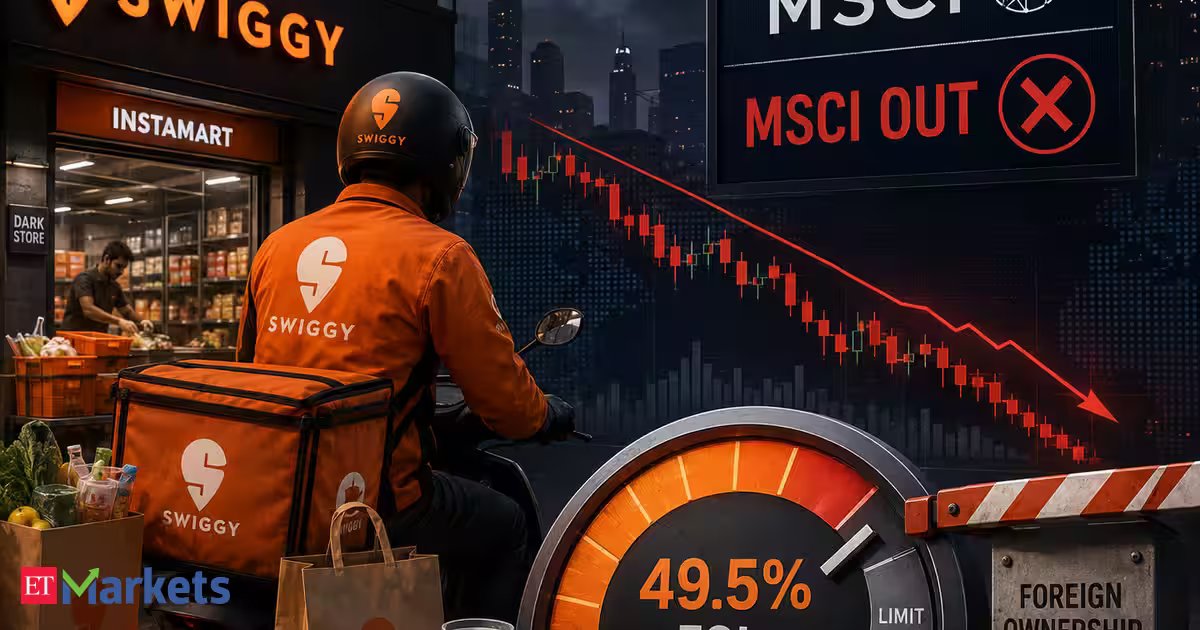
Swiggy shares fall 2%, down for 3rd session, as MSCI set to remove stock from Global Standard Indexes from September 7
MSCI said it will delete the stock under the foreign ownership limit event category, with the change taking effect from September 7, 2026.
The development follows Swiggy’s move to become an Indian-owned and controlled company, or IOCC. Shareholders approved proposals last month that will allow the company to cap foreign shareholding at 49.5%.
Also read: Swiggy to see $400 million outflows after Indian-owned status? Jefferies explains why
Swiggy was added to the NSDL red flag list on September 1 after foreign ownership came within 3 percentage points of the applicable FPI limit. The NSDL red flag list shows that foreign investors can now hold a maximum of 2.8 crore shares in Swiggy.

Stocks are placed on the red flag list when FPI ownership approaches the permitted foreign ownership limit. Jefferies had earlier said that for a stock with a foreign holding cap, FPI ownership within 3 percentage points of the maximum limit triggers its move to the red flag list.
If the FPI limit is breached, foreign investors have to sell the excess shares within five trading days from the settlement date, with such shares allowed to be sold only to domestic investors. Swiggy therefore faces two separate pressures.Its removal from the MSCI index may require passive funds tracking the index to cut their exposure, while the foreign ownership cap could limit fresh FPI buying.
Read more: Flipkart Minutes overtakes Swiggy Instamart in dark stores across top 10 cities
Swiggy’s foreign investors include Prosus, SoftBank, Tencent and Accel. Its Indian investors include SBI Mutual Fund, ICICI Prudential Asset Management and HDFC Mutual Fund, according to data compiled by LSEG.
Swiggy outlook
Swiggy has laid out an ambitious roadmap to achieve Rs 10,000 crore in adjusted EBITDA by FY31, with growth expected to come from improving efficiencies in its core food delivery business, expanding Instamart and scaling up Dineout.
The company also expects Instamart’s gross order value (GOV) to increase four to five times to Rs 1.5 lakh crore by FY31 from Rs 28,000 crore in FY26.
The company reported a consolidated net loss of Rs 791 crore for the first quarter of FY27, marking nearly a 34% year-on-year decline from the Rs 1,197 crore net loss reported in the year-ago period.
The company’s revenue from operations, meanwhile, increased more than 37% YoY to Rs 6,812 crore during the April-June quarter of FY27, from Rs 4,961 crore reported in the corresponding quarter of the previous financial year.
Instamart, the company’s quick commerce arm, also saw losses contract to Rs 651 crore in Q1 FY27 from Rs 797 crore in the year-ago period. Meanwhile, its revenue from operations soared nearly 53% YoY to Rs 1,232 crore. Instamart’s GOV rose nearly 40% YoY to Rs 7,907 crore, while contribution margin improved 440 bps to 0.2%.
(Disclaimer: Recommendations, suggestions, views and opinions given by the experts are their own. These do not represent the views of The Economic Times)