Starlink Made SpaceX’s Only Segment Profit While the AI Unit Took $15.8 Billion in Capital Spending — Here’s What That Does to the Stock.
A company that grows revenue 92% and still loses half a billion dollars is doing two very different things at once. SpaceX (SPCX +1.55%) did exactly that in the second quarter.
The rocket maker booked $7.8 billion of revenue across its three businesses, up 92% from a year earlier, and still lost $541 million.
The segment tables explain how. One business, the connectivity segment built around Starlink, earned a $1.66 billion operating profit. The other two, the original space business and the artificial intelligence (AI) unit, lost a combined $1.8 billion. And the AI unit absorbed $15.8 billion of the quarter’s $18.4 billion in capital spending.
In other words, one segment pays the bills while another spends at a pace the earner can’t come close to covering. That split, more than the growth, is what the stock’s nearly $1.9 trillion valuation turns on, I’d argue.

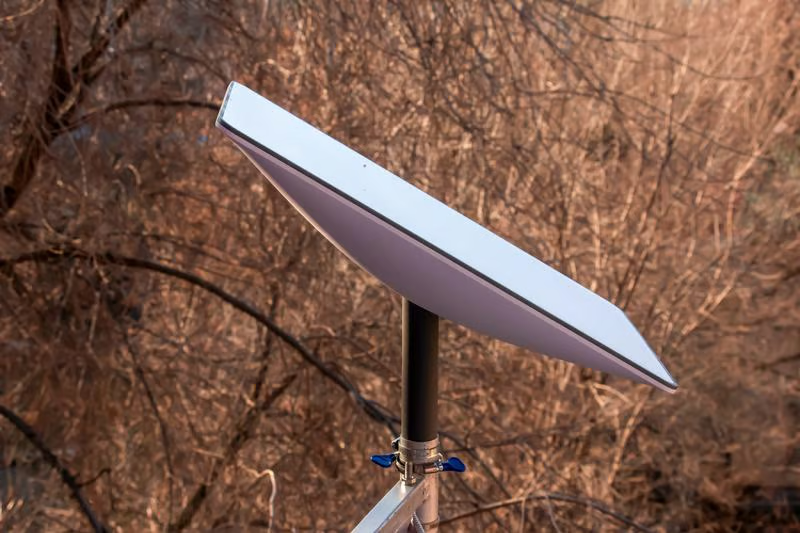
Image source: Getty Images.
The profitable segment is bigger than Starlink
The headline profit belongs to Starlink, but the segment earning it is broader than the consumer satellite internet service.
SpaceX‘s connectivity segment combines consumer Starlink ($2.5 billion of second-quarter revenue, up 44% year over year) with an enterprise and government business that grew 108% to $1.8 billion. The latter got help from new airline agreements and more than $6 billion in multi-year U.S. government contracts for Starshield, the company’s secure satellite network for government customers.
Add it up, and connectivity revenue rose 66% year over year to $4.3 billion, while the segment’s operating profit climbed 79% to $1.66 billion.
Notably, the growth is coming from subscribers. Starlink ended June with 12 million subscribers, double a year earlier, while average revenue per user held at $66 a month for a second straight quarter, down from $85 a year ago.
What the segment doesn’t spend matters just as much. Connectivity’s capital expenditures were $1.4 billion in the quarter, less than its operating profit. This is the one SpaceX business that funds itself.
The $15.8 billion quarter
The AI unit is the opposite case. The segment spent $15.8 billion on capital expenditures in three months, 86% of the company’s total. It spent $7.7 billion in the first quarter and $749 million in the year-ago period. That is a roughly 20-fold increase in four quarters, with the money going into the Colossus II data center build-out that pushed the company’s compute capacity to 1.4 gigawatts, up from 0.4 a year ago.
The spending is buying growth, to be fair. AI revenue more than tripled year over year to $2.6 billion, driven by cloud computing agreements ($14.1 billion in contracted sales signed during the quarter), and the segment’s operating loss narrowed to $1.3 billion from $2.5 billion in the first quarter. But the segment still loses money.
And the space segment added a $542 million operating loss of its own on $962 million of revenue, up 29%, as the company accelerated research and development spending on Starship — spending it plans to extend with a Louisiana launch complex, announced Aug. 25, that could cost up to $100 billion.
But who pays for all this? Not the profitable segment, at least not alone. Connectivity’s $1.66 billion quarterly operating profit covers about a tenth of the AI unit’s quarterly capital bill.
The rest comes from the balance sheet. SpaceX ended June with $100 billion of cash, cash equivalents, and marketable securities, built largely from about $85.7 billion in net proceeds from its June initial public offering (IPO). A $25 billion bond sale mostly refinanced a bridge loan, at a weighted average rate of about 5.9%.
What is the stock priced for?
Shares sit near $142 as of this writing, close to the $135 offering price, and SpaceX’s market value is roughly $1.9 trillion — about 60 times sales, annualizing the second quarter.

Space Exploration Technologies
Today’s Change
(1.55%) $2.19
Current Price
$143.69
Key Data Points
Market Cap
Day’s Range
$139.88 – $144.13
52wk Range
$104.83 – $225.64
Volume
63.1M
Avg Vol
115.1M
A sales multiple like that is not a bet on the business that already works. Starlink’s economics are impressive, and arguably proven. But a segment producing about $6.6 billion in annualized operating profit doesn’t support a $1.9 trillion price on its own.
The valuation is mostly a claim about the money-losing unit. It assumes today’s $15.8 billion quarters convert into an AI infrastructure business big enough to justify them.
Maybe they will. The AI segment’s revenue is scaling fast, its losses are narrowing, and on segment adjusted EBITDA (non-GAAP) the unit even earned $1.1 billion in the quarter. But shareholders are paying for that conversion up front, while the segment that reliably earns money could, by itself, justify only a fraction of the price.
Ultimately, the second quarter answered which business pays for the others. Starlink’s segment pays, the AI unit spends, and the stock trades on the spender’s future. The profitable business is excellent. But at about 60 times annualized sales, I’d stay on the sidelines for now.