Americans Are Leaving Areas at Risk of Poor Air Quality, Mostly Because They’re Expensive
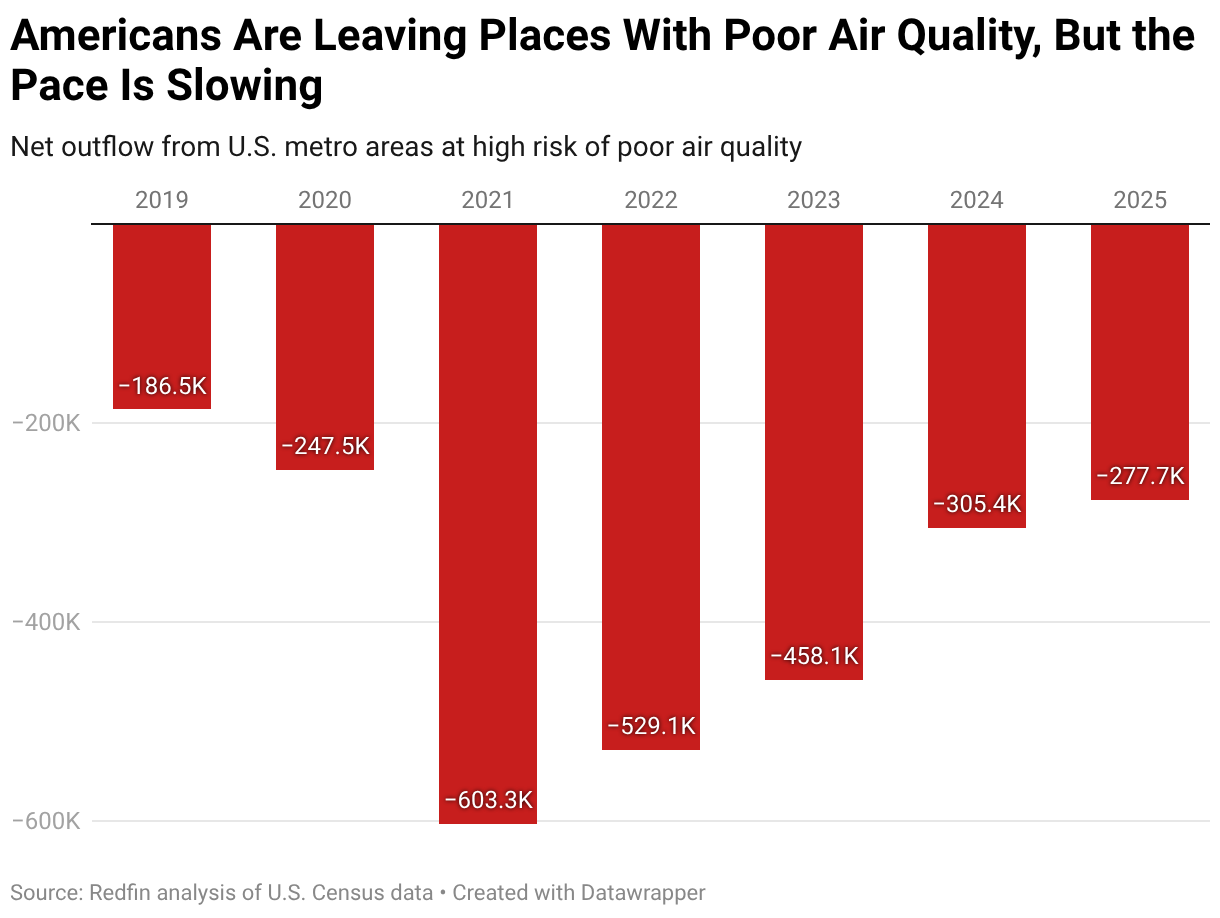
- U.S. counties at high risk of poor air quality lost 277,740 residents in 2025–roughly half as many as they lost in 2021, at the peak of pandemic-era migration.
- While air-quality concerns may influence some movers, affordability is a bigger factor, with Americans leaving expensive high-risk counties and moving into relatively affordable ones. Almost every part of the country faces at least some risk of poor air quality.
- The at-risk parts of the U.S. gaining the most residents are Boise, Palm Springs and Lake Tahoe.
- The at-risk places losing the most residents are expensive coastal markets: Los Angeles, New York City and Orange County.
Americans are moving away from places facing high risk of poor air quality, but at a slower pace than during the pandemic. In 2025, 277,740 more people moved out of high-risk U.S. counties than into them. That’s less than half the peak net outflow of 603,270 in 2021; the outflow has fallen each year since then.
Some places at high risk of poor air quality are bucking the trend. Boise, ID, Lake Tahoe, CA and Provo, UT are among the places that gained thousands of residents last year, suggesting that affordability, lifestyle and other draws are outweighing potentially smoky air.
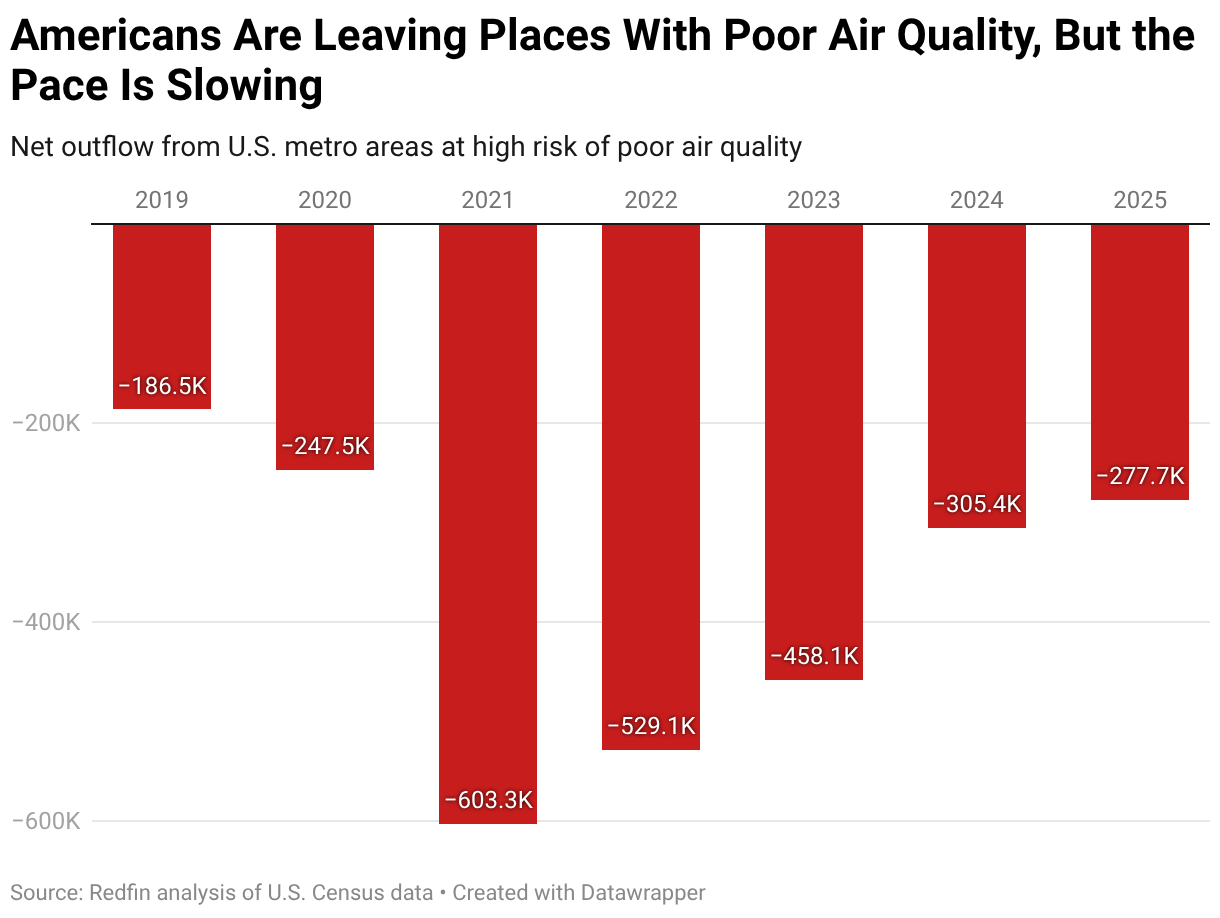
More people are moving into than out of U.S. counties at low risk of poor air quality–but at a slower rate than during the pandemic. Counties at low risk posted a net inflow of 296,342 in 2025, roughly half the 594,556 inflow in 2021; inflows have declined each year since then.
This is based on a Redfin analysis of domestic migration data from the U.S. Census Bureau (excludes immigration) and climate-risk scores from First Street, a part of MSCI. We define a high-risk county as one in the top 10% for the share of homes facing high risk of poor air quality—in other words, counties with 12.2%-100% of homes facing high risk. Migration data for 2025 covers July 1, 2024-July 1, 2025. Net outflow measures how many more people moved out of than into an area, while net inflow measures how many more people moved in than out. Data is subject to revision.
Relocation trends are strongly related to housing costs. Many high-risk counties that are losing the most residents–including Los Angeles County, Kings County (Brooklyn), Orange County and King County (Seattle)–are among the nation’s most expensive. Meanwhile, several high-risk counties gaining residents, like Ada County, ID (Boise) and Weld County, CO, are fairly affordable.
The slowdown in outmigration also reflects the fading pandemic-era exodus from major job hubs. Santa Clara County, CA, lost 19,775 residents in 2025, down from 58,753 in 2021. Los Angeles County’s net outflow fell to 105,471 from 195,168, while Kings County’s dropped to 38,847 from 100,839.
Air quality is top of mind as wildfire smoke becomes more frequent and intense. For instance, the Spokane Complex fires blanketed much of Washington, Oregon and Idaho in hazardous smoke in early August, and Canadian wildfires spread unhealthy smoke through the Midwest and East Coast in July. It’s possible air quality factors into some long-distance moves–perhaps for people with serious lung conditions–but it’s unlikely to be a decision-maker for most Americans. Nearly all of the country is susceptible to smoke and/or smog at least some of the time.
“Wildfire smoke doesn’t respect state lines,” said Redfin Chief Economist Daryl Fairweather. “My family left Seattle for a small town in Wisconsin during the pandemic. We had many reasons for moving, but a bad smoke event was the final straw. Then the smoke followed us. This summer, Wisconsin and the entire Midwest had stretches of awful air from fires hundreds of miles away. That experience evolved the way I think about climate migration: You can choose a place with lower risk, but there’s no smoke-free bubble to move to. For most people, the answer isn’t packing up and leaving—it’s adapting to a world where bad-air days can show up almost anywhere.”
Air Filtration Systems Top Homebuyers’ Wish Lists–and When Bad Air Moves In, Homeowners Should Use Them
A recent Redfin survey found that 36% of U.S. house hunters say a clean home–i.e. one with high-end filtration systems for air, water, etc.–is a must-have for their next house, making it the most common priority for prospective buyers. House hunters value clean air more than features including views, smart-home technology or luxury amenities like pools or gyms.
That’s emblematic of the increasing prevalence of wildfire smoke across the country, and the steps Americans are taking to live with it.
People who live in places prone to wildfire smoke or smog can prepare much like they would for extreme heat or a storm: Have a plan before bad air arrives. If possible, a clean air filtration system is a great first step. That can also mean keeping a few N95 masks on hand, buying a portable air purifier and stocking replacement HVAC filters. It’s also worth getting in the habit of checking the local Air Quality Index, since conditions can deteriorate quickly and may vary substantially over the course of a day.
When the air turns unhealthy, breathe as little polluted air as possible. Keep windows and doors closed, run air conditioning or HVAC on recirculate, use an air purifier and cut back on strenuous outdoor exercise until conditions improve. An N95 can reduce exposure to fine particles from wildfire smoke when going outside. People should also avoid making indoor air worse by burning candles, using fireplaces or doing lots of frying. When outdoor air clears, open up the house and let fresh air back in.
Boise, Palm Springs and Lake Tahoe Are Gaining Residents
Ada County, ID–home to Boise and Eagle–gained 8,528 more residents than it lost last year, the largest net inflow among high-risk counties.
Riverside County, CA–where Palm Springs and Temecula are located–followed with a gain of 7,758, and Placer County, CA, home to part of Lake Tahoe, gained 7,074 residents. Canyon County, ID and Weld County, CO round out the top five.
Americans are moving into those places partly because they’re fairly affordable, especially compared to coastal markets. The average median sale price in the top 10 is roughly $522,000, higher than the national median, but much lower than coastal job hubs like Los Angeles, San Francisco, New York or Seattle; some remote workers are still relocating to more affordable inland parts of the country. Plus, many of those expensive places are at risk of poor air quality, too.
A lot of these destinations also offer outdoor recreation and/or resort-town appeal, from skiing and boating in Lake Tahoe to sunny retirement living in Palm Springs.
| The 10 At-Risk* Counties With the Largest Net Inflows in 2025
*At risk of poor air quality Net inflow = How many more residents moved in than moved out |
||||
| Rank | U.S. county | Net domestic inflow | Share of homes facing high risk of poor air quality | Median home-sale price (July 2026) |
| 1 | Ada County, ID | 8,528 | 100% | $537,438 |
| 2 | Riverside County, CA | 7,758 | 76.1% | $609,260 |
| 3 | Placer County, CA | 7,074 | 100% | $674,997 |
| 4 | Canyon County, ID | 5,684 | 100% | $423,260 |
| 5 | Weld County, CO | 3,857 | 24.2% | $499,902 |
| 6 | Henry County, GA | 3,723 | 12.2% | $334,875 |
| 7 | Clark County, WA | 3,400 | 100% | $555,958 |
| 8 | Utah County, UT | 3,162 | 24.9% | $514,391 |
| 9 | Kootenai County, ID | 3,161 | 100% | $562,626 |
| 10 | Nassau County, FL | 2,578 | 51.2% | $511,111 |
Pricey Los Angeles and New York Lead High-Risk Counties Losing Residents
Los Angeles County lost 105,471 more residents than it gained last year, the largest net outflow among the U.S. counties at risk of poor air quality.
Next come two New York City boroughs: Kings County (Brooklyn) and Queens County (Queens), both with net outflows of about 38,000. Two other expensive parts of California, Orange County and Santa Clara County, round out the top five.
As noted above, housing costs are a major reason why Americans are moving away from New York and California. The average median sale price across those five counties is $1.1 million, and the average of all 10 high-risk counties with the largest outflows tops $900,000–more than double the national median. And while movement out of those places has slowed, some remote workers are still leaving job hubs for more affordable parts of the country.
| The 10 At-Risk* Counties With the Largest Net Outflows in 2025
*At risk of poor air quality Net outflow = How many more residents left than moved in |
||||
| Rank | U.S. county | Net domestic outflow | Share of homes facing high risk of poor air quality | Median home-sale price (July 2026) |
| 1 | Los Angeles County, CA | -105,471 | 85.4% | $913,583 |
| 2 | Kings County, NY | -38,847 | 50.2% | $1,029,603 |
| 3 | Queens County, NY | -38,449 | 21.4% | $740,267 |
| 4 | Orange County, CA | -25,357 | 48.2% | $1,195,479 |
| 5 | Santa Clara County, CA | -19,775 | 100% | $1,634,010 |
| 6 | Bronx County, NY | -18,685 | 17.8% | $624,521 |
| 7 | Alameda County, CA | -15,960 | 100% | $1,067,625 |
| 8 | King County, WA | -9,079 | 100% | $869,396 |
| 9 | DeKalb County, GA | -8,187 | 97.4% | $347,781 |
| 10 | Denver County, CO | -8,023 | 59.3% | $582,808 |
Methodology
This is based on a Redfin analysis of domestic migration data from the U.S. Census Bureau (excludes immigration) and climate-risk scores from First Street. We define a high-risk county as one that ranks in the top 10% when it comes to the share of homes facing high risk of poor air quality—in other words, counties with 12.2%-100% of homes facing high risk. The remaining counties are referred to as low-risk counties. Migration data for 2025 covers July 1, 2024-July 1, 2025. A “net outflow” measures how many more people moved out of than into an area, while a “net inflow” measures how many more people moved in than out. This data is subject to revision.
Climate-risk scores are based on a property’s current risk as well as how that risk is expected to grow over the next 30 years.
For every county identified, we calculated the net domestic migration using the U.S. Census Bureau’s 2025 Vintage Population Estimates data. Net domestic migration is the difference between the number of people moving into an area and the number moving out.
The United States has 3,144 counties and statistically equivalent entities. Redfin included in this analysis 3,103—those for which there is both consistent migration data from the U.S. Census Bureau and flood-risk scores from First Street.
The post Americans Are Leaving Areas at Risk of Poor Air Quality, Mostly Because They’re Expensive appeared first on Redfin Real Estate News.