DA hike explained: How much will your salary actually increase? Here’s the simple calculation
Dearness Allowance (DA) is an allowance given to government employees, public sector employees, and pensioners in India. It’s a way to mitigate the impact of rising costs of living and inflation on people’s earnings. DA is revised twice a year, in January and July, based on the Consumer Price Index (changes in inflation and cost of living).
Why is DA important in salary structures?
Dearness Allowance plays a key role in salary structures, primarily by adjusting for the cost of living and helping maintain a consistent standard of living for employees amid changing inflation rates.
It provides employees with financial stability by safeguarding their purchasing power against rising costs.
It also provides retirement benefits. For pensioners, DA impacts their pension amount, directly affecting their post-retirement life.
What does a DA hike mean?
A DA hike of 3 percent or 4 percent does not mean an employee’s total salary will rise by the same percentage.
The actual hike basically depends on the employee’s basic pay, since DA is calculated as a percentage of basic salary.
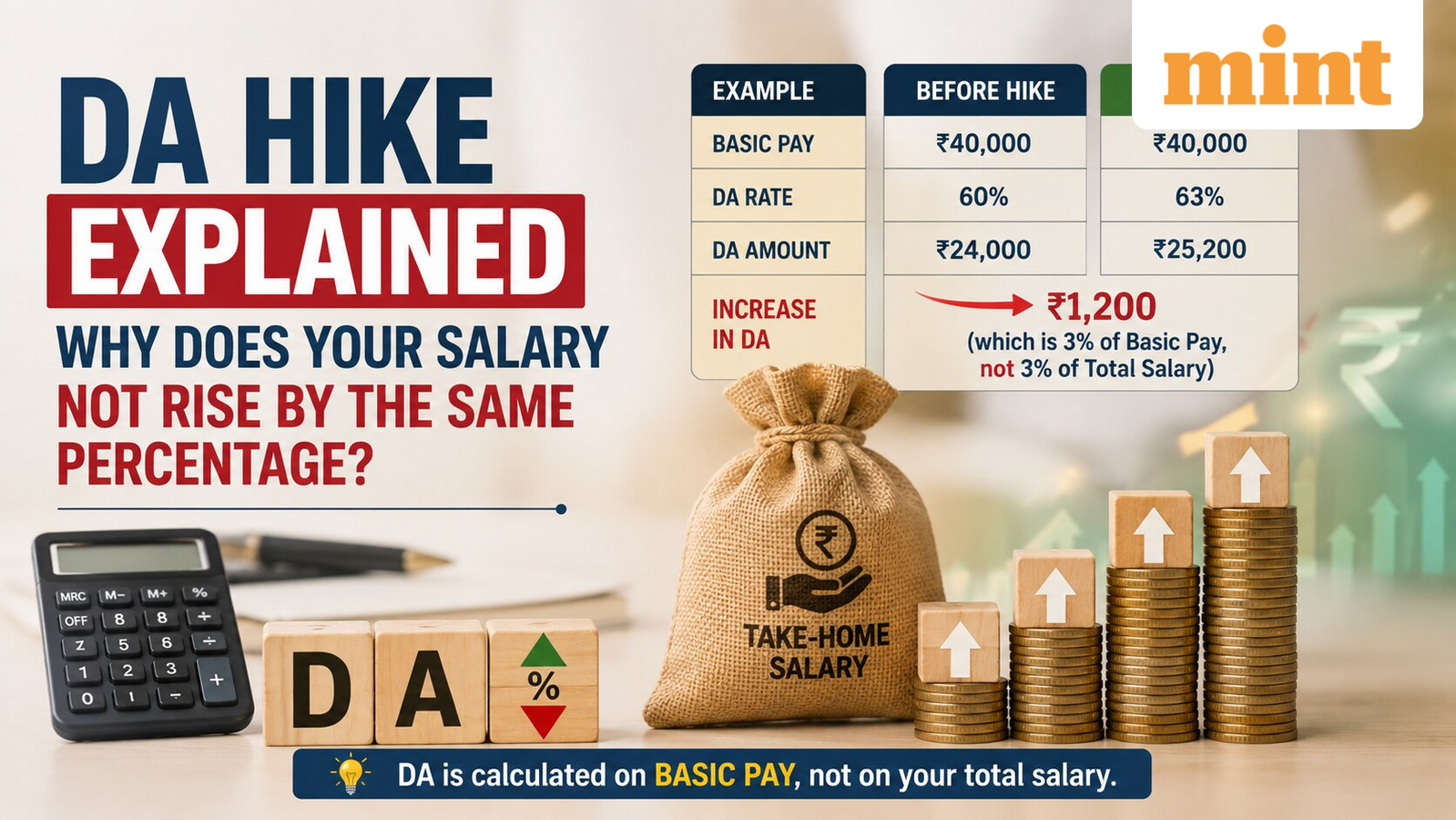
Suppose an employee has a basic salary of ₹40,000. If the Dearness Allowance (DA) is 60 percent, they will get ₹24,000 as DA.
Now, if the DA increases by 3 percentage points—from 60 percent to 63 percent — the employee will get ₹25,200 as DA instead of ₹24,000.
This means their DA increases by an additional ₹1,200 per month. Importantly, this ₹1,200 increase is calculated as 3 percent percent of the basic salary ( ₹40,000), and not 3 percent of the employee’s total salary.
Basic pay makes the difference
Since the hike is calculated as a percentage of basic pay rather than total salary, the same DA hike can result in different increases for employees.
The percentage-point increase is identical, but the rupee benefit varies because the basic pay is different.
An employee with a basic pay of ₹30,000 would get an additional ₹900 a month from a 3 percentage point increase in DA.
For an employee with a basic pay of ₹50,000, the same DA hike would add ₹1,500 a month.
This is also why employees should not calculate the impact of a DA hike by simply applying the announced percentage to their monthly salary.
What happens to total salary?
A hike in DA can increase gross salary, but the rise in take-home pay may be different. This is because deductions such as income tax and other applicable contributions can change when salary increases.
Is DA taxable?
DA is fully taxable under the Income Tax Act, 1961. Employees are required to declare it separately when filing Income Tax Returns.
Therefore, the amount an employee finally receives in their bank account may be lower than the gross DA increase.
The impact also depends on the employee’s basic pay and existing salary structure.
DA revision
DA is revised twice a year. The revisions are linked to changes in the Consumer Price Index for Industrial Workers (CPI-IW).
The DA revision doesn’t stop even when the tenure of a pay commission ends.
For example, the 7th Pay Commission’s tenure ended on December 31, 2025, but the DA was revised in January 2026 and is expected to be revised soon.
The government will keep on revising it till the 8th Pay Commission is implemented.
Announcements are generally made later, with the revised rates applying from the relevant month.
DA Revision History: Central Government Employees
| Effective Date | DA (%) | Increase (%) |
|---|---|---|
| Jan 2021 | 17% | – |
| Jul 2021 | 28% | +11% |
| Jan 2022 | 34% | +3% |
| Jul 2022 | 38% | +4% |
| Jan 2023 | 42% | +4% |
| Jul 2023 | 46% | +4% |
| Jan 2024 | 50% | +4% |
| Jul 2024 | 53% | +3% |
| Jan 2025 | 55% | +2% |
| Jul 2025 | 58% | +3% |
| Jan 2026 | 60% | +2% |
Conclusion
Therefore, a DA hike announced as a 3 percent increase does not mean that an employee’s total salary will rise by 3 percent.
The actual rupee benefit depends primarily on basic pay, while the final increase in take-home salary also depends on applicable deductions.
(Data source for table ‘DA Revision History’: Kotan Mahindra website)