Meet the Albanian Developer Who Ushered In 99-unit Projects
Andrea Gjini’s claim to fame is bittersweet: By his telling, he developed the first 99-unit, 485x project.
Why bittersweet? He’s proud of making the tax break work, but bristles at the distortions required to do so.
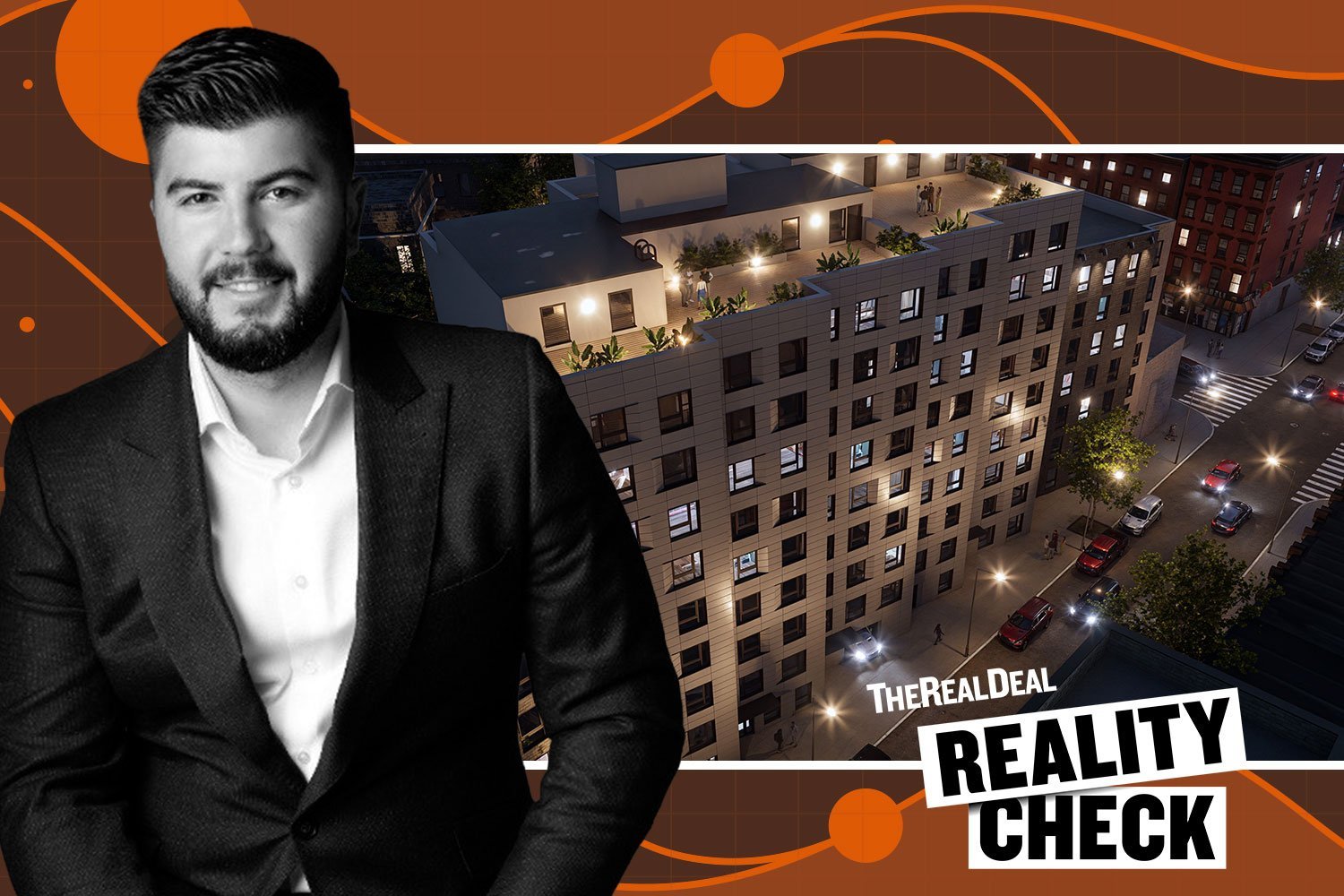
Gjini just put up 166 units at 19 and 21 East 198th Street in the Fordham section of the Bronx, splitting the project into two buildings to avoid the 485x wage scale that kicks in at 100 units. State lawmakers included that provision at the request of construction unions.
Asked what he would change first to improve development in New York, he cited how 485x results in inefficient, duplicative design.
“If they push me to go chop my properties, they are doubling the waste of time,” said the 28-year-old Albanian immigrant, whose English phrasing has an endearing quality. “It’s way easier to build one foundation.”
The wage floor for larger projects starts at $40 an hour, which generally means hiring union contractors. At 150 units, the wage can be as high as $72, and the penalty for not complying can bankrupt a project.
“If we build 100 or more units, you are restricted to different contractors,” he said. “If we go in that direction, and pay those wages, the pencil is not going to write the right numbers and the deal is going to be at risk of falling apart.”
Paying prevailing wage, he realized, would not work in the Bronx markets where he builds. The rents that new buildings command are just not high enough.
“I’m not saying to go against unions; they are very professional,” he said. “I would rather give a project to them, but the Bronx can’t afford such big expenses.”
Buying on spec
The 28-year-old arrived from Albania just eight years ago and, coming from a family of builders, immediately set about becoming one himself. “To build buildings is in my genetics,” he said.
But fools rush in, as the saying goes, and Gjini made a seemingly reckless gamble in acquiring the East 198th Street site in 2023, a year before 485x was created. With 421a having expired, no viable path existed for developing market-rate multifamily in the Bronx.
“We were young and dumb,” he laughed. “I have so much energy. I was 25. I bought this property when there was no tax abatement at all. Everybody was thinking that I’m crazy.”
The deal came together by happenstance, as they sometimes do in New York. In 2022, Gjini was putting up two buildings on Crescent Avenue, one block away, when he was approached by one of three Bangladeshi brothers who owned some single-family and two-family homes on East 198th Street.
The man said they wanted to sell five small buildings in a package deal. A third owner was from Costa Rica, and a fourth was Albanian, like Gjini. It was a quintessential, mid-market New York real estate transaction. They agreed on a price: $9.3 million.
Gjini was smarter than he lets on: He specified in the contract that the buildings had to be vacant prior to closing. But he didn’t just rely on the sellers to clear them out.
“It’s not easy to make five houses in a row,” Gjini said. “It’s a real challenge but it was in my interest to work with them.”
The developer helped to relocate the tenants, finding them new places and even co-signing some of their leases. “Some had credit, some not,” he explained.
He made sure the relocated tenants, a mix of young families and senior citizens, were happy. “If you start a journey with a lot of trouble, that journey’s going to end up in trouble,” he said.
Pencils down
Gjini recalled when he broached the idea of building 99 units, pushing the no-wage-scale version of 485x to the limit. It wasn’t initially clear that side-by-side buildings would be counted as separate projects under the law, and construction union leaders are still pushing for the wage floor to apply to such projects.
Gjini recalled, “My tax guy was like, ‘Can you please say 98 [units]? Because if you say 99, they will ask questions.’”
No one asks questions any more: The 99-unit project has become the go-to for multifamily developers.
A report released Monday by the Real Estate Board of New York found 19 more 99-unit projects filed in the second quarter, and only nine larger ones. Those with 100 or more tend to be subsidized affordable housing developments that don’t require 485x to pencil out.
The July 2025 version of REBNY’s report documented the beginning of the 99-unit era, with 28 such buildings filed in the previous four quarters — more than twice as many as in the previous 16 years combined.
Gjini might have ushered in the 99-unit era, but the idea didn’t begin with him. It had been predicted by the industry when state lawmakers approved 485x, aka Affordable Neighborhoods for New Yorkers, in April 2024, to replace 421a, which expired in June 2022.
It’s one thing to make predictions. It’s another to bring them to reality, as Gjini did on East 198th Street. He liked the location, with a supermarket across the street and Fordham University and the Bronx Zoo nearby. He put in a fully automated laundromat on the ground floor as a convenience for tenants and the community and to bring in extra revenue.
Twenty percent of his apartments are affordable at 80 percent of the area median income, and he expects rental vouchers to contribute a lot of the building’s income. Funding came from Kearny Bank and Northeast Community Bank.
He uses an in-house general contractor, architect and property manager to keep costs down, which he estimates saves 10 percent to 12 percent. One glitch was a month-long delay getting utilities connected; Gjini said that cost him $200,000.
His next steps are to lease up the remaining market-rate units and refinance. Demand from renters so far has been good.
“I’m pretty confident,” Gjini said.
Read more
The developer bucking New York’s 99-unit trend

How 485x is distorting development and raising rents

The Daily Dirt: We got 99 problems with 485x