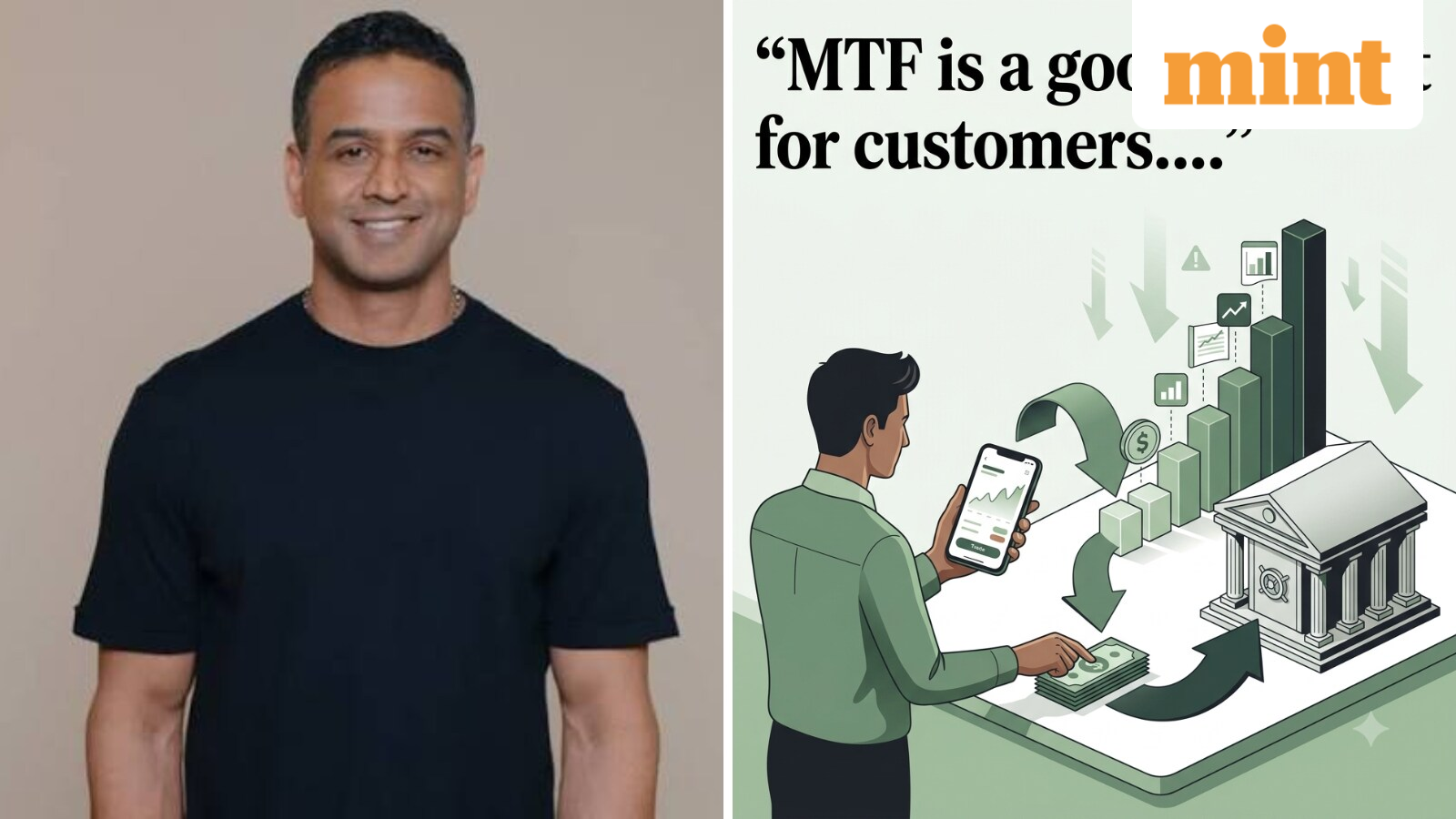
Is MTF a good product for customers? Zerodha’s Nithin Kamath says it isn’t suitable for most of them: Here’s why
For consumers, borrowing money to invest can be far riskier, as market losses can quickly turn a leveraged investment into a financial burden.
Margin Trading Facility (MTF) allows investors to purchase shares by paying only a portion of the investment upfront, while the broker funds the rest. This can increase an investor’s market exposure, but it also means higher risk if share prices fall.
Let’s look at why Zerodha Founder and CEO Nithin Kamath is becoming increasingly cautious about the MTF.
Why is MTF worrying Nithin Kamath?
“With the start of the MTF (margin funding) business in Dec 2024, there’s been some predictability in revenue, since we earn interest income on it. MTF currently makes up ~10% of our revenue,” Kamath mentioned in his note titled 16 years of Zerodha: Fresh enthusiasm.
However, he said the product may not be suitable for most customers. “But if you ask me whether MTF is a good product for customers, I’d say it isn’t for most of them,” he noted.
For retail investors, this is an important distinction. MTF may increase purchasing power, but it does not reduce investment risk. In a falling market, leverage can work against the investor just as quickly as it works in their favour during a rally.
“The only thing we can really do is educate customers on the risk and not push it constantly or nudge them into borrowing money to invest,” Kamath added.
Why is Zerodha’s MTF book scaring Kamath?
Kamath’s concern is also linked to the rapid expansion of the business. “MTF is one area where the business growth is scaring me. Our MTF book now stands at ₹9,000 crores, and the risk here is that the Indian markets could fall sharply,” he noted.
“Leverage always looks great when markets are doing well, and the risks become obvious only when things go wrong,” Kamath added.
He said Zerodha is keeping a close watch on the MTF business because a sharp market correction could expose the risks associated with leveraged positions.
How much have customers borrowed through MTF?
“While the book size is ₹9000 crore, our clients have borrowed ~ ₹6000 crore, which is ~25% of our net worth,” he said.
Kamath also flagged the broader systemic risk from leverage in the brokerage industry.
“This MTF business is scary, as brokers can borrow up to 5 times their net worth. While we are okay, we might get pulled down if there were a market contagion due to this leverage,” he noted.
What does this mean for investors?
Kamath’s comments come as Indian equities have remained relatively subdued while some global markets have performed strongly.
“Nifty 500 has gone nowhere in the last two years, while international markets like the US, Japan, Europe, South Korea, and Taiwan have been on a roll,” he noted.
He pointed to the absence of major AI-related investment opportunities in India and pressures from the rupee and foreign investor outflows as factors weighing on the domestic market.
For investors using MTF, the broader message is clear. A sideways or falling market can make leveraged positions particularly uncomfortable.
When the market is weak or falls sharply, leverage can magnify losses while interest on the borrowed amount continues. This makes MTF riskier than investing entirely with your own money.
Kamath also said running a large brokerage requires substantial capital because of regulatory requirements.
“The fact that being at our scale requires something like ₹11,000 crores is in itself a moat for us,” he said.
“There are also a lot of small add-on costs that other brokers pass on that we don’t. Like, if you sell shares once a day or multiple times, we charge the DP charge only once. A lot of our competition charges you every single time you sell,” Kamath said.
He also questioned the practice of brokers charging uncapped brokerage fees on MTF, saying this raises questions about whether such platforms can truly be considered discount brokers.
For investors, this highlights the importance of looking beyond headline brokerage rates and checking the additional charges and borrowing costs associated with MTF.
Disclaimer: This is purely for educational/informational purposes and should not be taken as any sort of investment advice. Always consult a SEBI-registered advisor before making any investment decisions.