Attention GST-registered taxpayers: Know right ITR form, turnover reconciliation and key checks for AY 2026-27
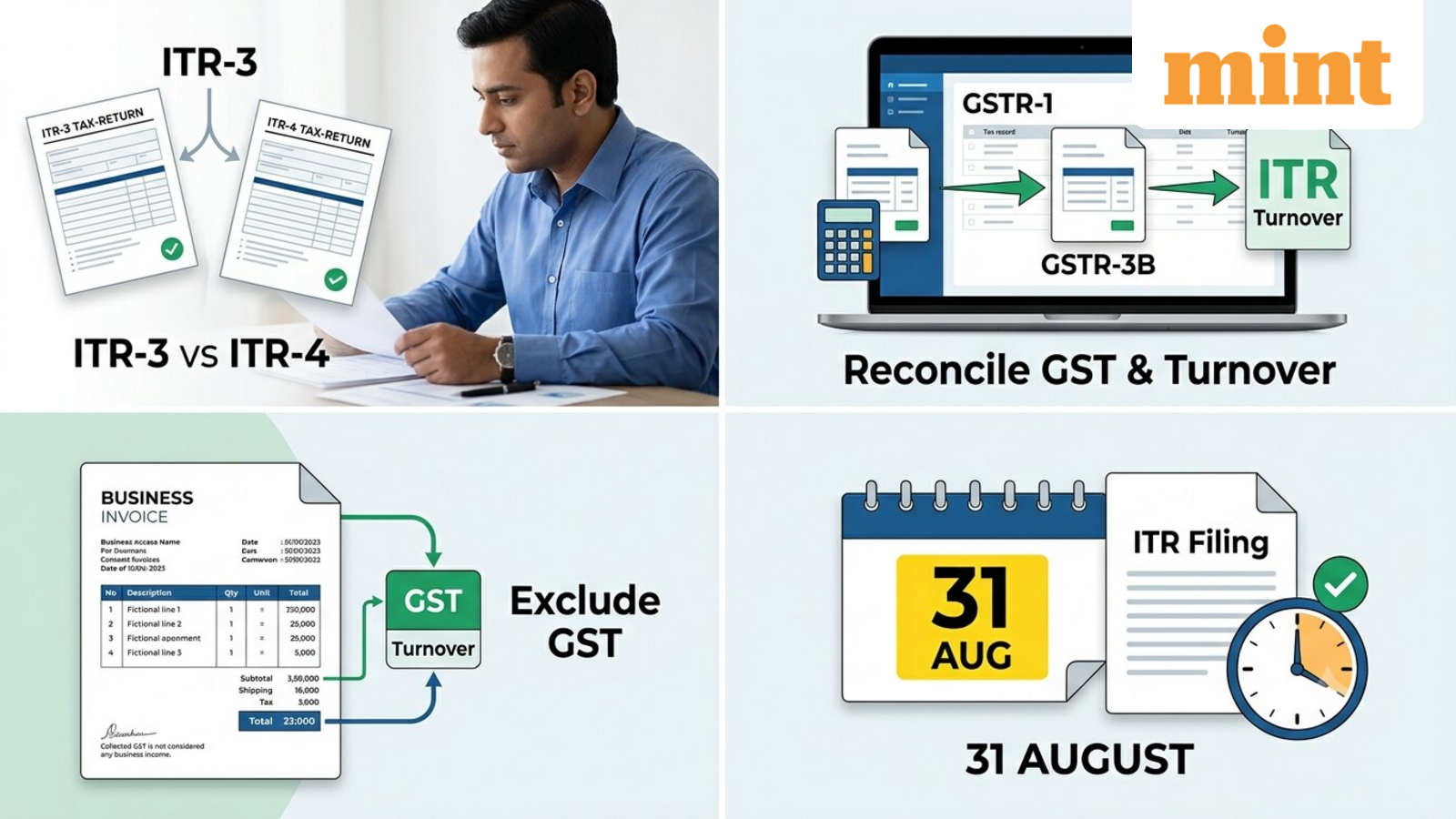
As the ITR filing deadline of 31 August for AY 2026-27 approaches for individuals with business or professional income whose accounts are not subject to audit, GST-registered taxpayers need to ensure they choose the correct ITR form.
They should also accurately report their turnover and income and reconcile the figures with their GST records before filing their ITR.
Here’s what GST-registered taxpayers need to know about ITR filing and the key checks to make before submitting the return.
Which ITR form should GST-registered taxpayers file?
Siddharth Maurya, Managing Director of Vibhavangal Anukulkara, explained that taxpayers who maintain regular books of accounts and declare their business or professional income on an actual basis are required to file ITR-3.
GST registration, by itself, does not determine the ITR form. He added that ITR-4 is available to eligible resident individuals and HUFs who have opted for the presumptive taxation scheme under Sections 44AD, 44ADA or 44AE.
He further mentioned that income should be reported under the head “Profits and gains of business or profession”.
“Taxpayers should first check their eligibility for the relevant ITR, compute their income on the applicable basis—actual or presumptive—and reconcile the figures with their GST records before filling in the required details in the ITR form,” he noted.
How should taxpayers reconcile turnover for ITR filing?
Maurya said taxpayers should match the turnover reported in their financial statements or ITR with the actual turnover reported in GSTR-3B and GSTR-1.
“For annual reconciliation, GSTR-9 or GSTR-9C can be used to reconcile the figures reported in the books with those reported in returns,” he noted.
For comparison, taxpayers should check total taxable supplies reported in GSTR-3B, total outward supplies or sales reported in GSTR-1, and the annual turnover reported in GSTR-9.
Maurya recommended reconciling these figures regularly, preferably every month or quarter, to promptly identify and resolve differences.
What happens if ITR and GST turnover do not match?
A mismatch in the turnover reported in the ITR can trigger automated scrutiny or notices, including GST notices for short payment or suppression of turnover and income-tax scrutiny for possible misreporting, Maurya explained.
“Such differences can arise due to differences in the timing or method of recognising income, income that is not subject to GST, or delayed reporting of exports in GSTR-1,” he noted.
He advised taxpayers to maintain adequate documentation, reconcile the figures periodically, and retain supporting evidence to explain any differences.
How should GST collected from customers be treated?
“GST collected is the statutory levy which is on account of the government and therefore should not be business income and therefore excluded from turnover/gross receipts in the ITR,” Maurya said.
He added that for 44AD presumptive taxation, the income is calculated on the actual sales turnover, excluding the GST component. If GST is shown separately on the bill, it should be excluded from turnover. If the bill is GST-inclusive, the GST component must be separated out.
He cautioned that including GST in income would amount to charging tax on tax. Taxpayers need to manually remove any GST amount that has been incorrectly auto-filled in the ITR.
What should GST-registered taxpayers keep in mind when filing ITR?
“Match your turnover with your GST returns, Form 26AS and AIS, and check it again before submitting the return. When calculating turnover, exclude the GST component. Confirm that you are eligible for presumptive taxation and meet the applicable limits,” Maurya said.
He further shared a few common mistakes:
- Reporting lower turnover than required.
- Not reconciling GST and AIS details.
- Using presumptive taxation when not eligible.
- Missing the deadline for carrying forward losses.
Disclaimer: This is only for informational and educational purposes. Please consult a qualified expert for the latest laws and regulations.