
Three Charts Show Who Wants a Federal Bank Charter and Why
The Office of the Comptroller of the Currency’s charter-granting activity doesn’t just show that a new rash of financial services firms are successfully becoming banks or bank-like institutions. The applications, viewed collectively, also show what the 21st century financial sector thinks a bank charter should permit them to do.
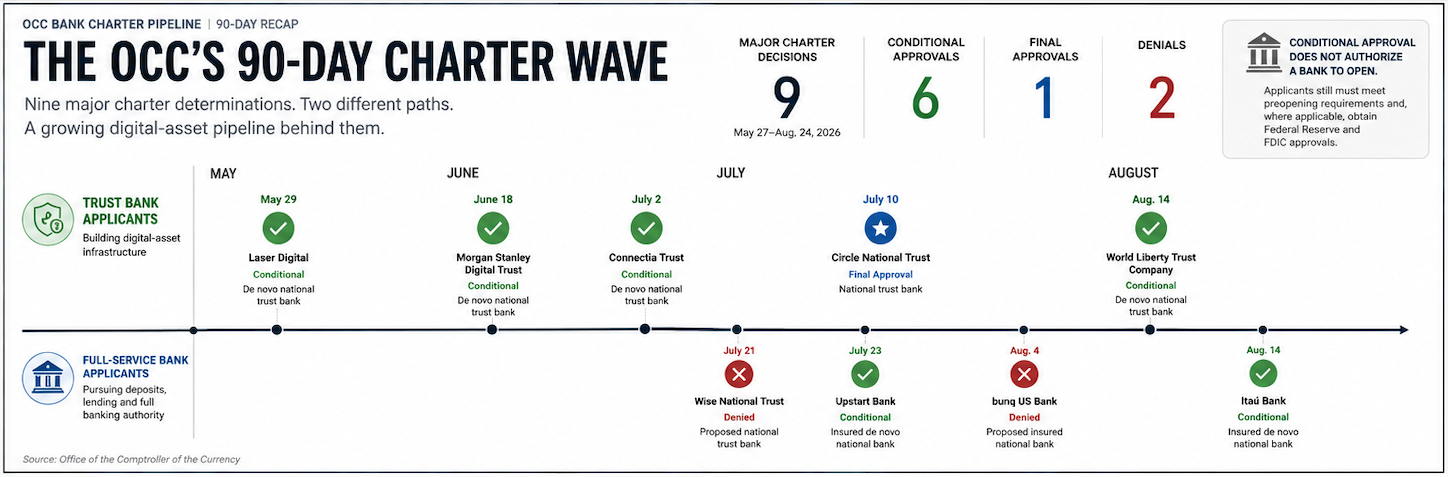
Over the 90 days ending Monday (Aug. 24), the OCC made nine significant charter determinations, including six preliminary conditional approvals, one final approval and two denials. Four of those six conditional approvals went to companies building digital asset infrastructure, while the FinTech firms Upstart and Itaú pursued insured, full-service national banks.
“For more than a decade, regulators signaled that those seeking a federal bank charter and federal deposit insurance need not apply,” Comptroller of the Currency Jonathan V. Gould said in an August statement. “Entities that engage in legally permissible activities, including those involving digital assets and other novel technologies, should have a path to becoming a national bank. America and the OCC are once again open for business.”
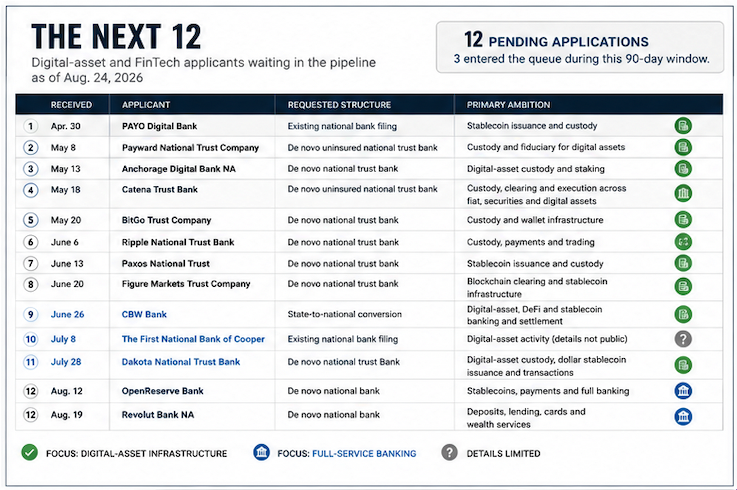
Meanwhile, the OCC’s digital assets application tracker contained another 12 pending applicants as of Monday. That pipeline points to a larger structural shift.
See also: The New FinTech Scorecard Starts With a Bank Charter
The OCC’s Full-Service Applicants Are Making a Different Bet Than Crypto Charters
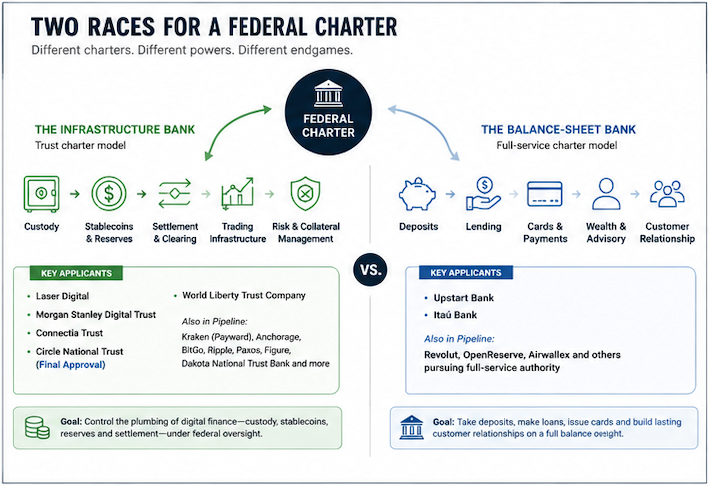
The clearest dividing line in the OCC pipeline is between companies pursuing national trust banks and those pursuing insured full-service national banks. These are fundamentally different economic strategies.
Digital asset applicants are clustering around national trust charters designed to bring activities such as custody, stablecoin reserve management, settlement and asset conversion under direct federal supervision. Full-service applicants, by contrast, are seeking the traditional powers of banking, including deposits, lending, cards and direct control of a balance sheet.

We’d love to be your preferred source for news.
Please add us to your preferred sources list so our news, data and interviews show up in your feed. Thanks!
Of the digital asset applications pending as of Monday, many center on activities that sit underneath financial products rather than directly in front of consumers. Dakota National Trust Bank is proposing digital asset custody, dollar stablecoin issuance and customer-directed transactions. Agora National Trust Bank is targeting stablecoin issuance infrastructure, reserves and related custody. Bastion Platforms National Trust Company is seeking a state-to-national trust conversion for white-label stablecoin issuance and related infrastructure. Payoneer’s proposed PAYO Digital Bank would support its PAYO-USD stablecoin, reserve management and collateral trustee services.
The strategic implication is easy to miss if the charter wave is viewed simply as another chapter in crypto regulation. A company that controls only the customer-facing stablecoin product remains dependent on other institutions for critical pieces of its infrastructure. A company that controls the regulated institution managing reserves, custody or settlement potentially removes intermediaries while gaining greater control over how its product operates.
Read also: Kraken Cracked the Fed’s Vault. It Still Can’t Spend
Conditional Approval Is Only the Starting Line for FinTechs
A preliminary conditional approval does not authorize an institution to begin banking operations. It creates a bank in organization that must still satisfy OCC preopening requirements and, where applicable, obtain approvals from the Federal Reserve and Federal Deposit Insurance Corp.
Some digital asset companies appear to be concluding that custody, reserves and settlement are too central to their products to leave entirely to third parties. Some FinTechs and international banks are making the larger bet that deposits, lending and balance sheet control are worth assuming the obligations of a full-service bank.
That makes Circle National Trust Bank especially significant. Circle received final approval on July 10 for a national trust bank whose activities include fiduciary custody for Circle and its affiliates, potential institutional custody and USDC reserve management. The difference between that final approval and the conditional approvals elsewhere in the pipeline is more than procedural.
At the same time, “Waiting for Certainty: Why Most CFOs Are Holding Back on Crypto and Stablecoins,” the March installment of PYMNTS Intelligence’s 2026 Certainty Project, showed that most middle-market companies remain cautious about digital assets. Usage is limited, with 13% of firms using stablecoins and 5% employing other cryptocurrencies.
For all PYMNTS digital transformation and B2B coverage, subscribe to the daily Digital Transformation and B2B Newsletters.