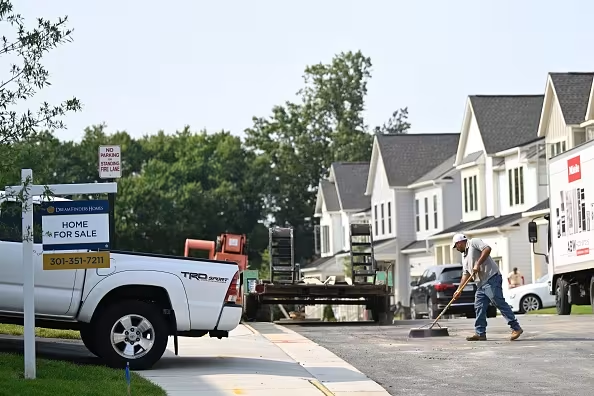
Home Values Firm Up as Chicago, New York and Cleveland Post Big Gains
National home value growth modestly accelerated in June, extending May’s momentum, driven by strong demand in the inventory-strapped Midwest and Northeast markets.
The value of single-family homes as measured by repeat transactions rose 1.5% nationally in June compared to a year ago, up from a revised 1.2% annual increase the month prior, according to data from the S&P Cotality Case-Shiller Index released Tuesday.
Among the 20 cities tracked by the index, Chicago led the nation for the fourth consecutive month with a 6.9% annual gain, same as in May. New York was once again in second place with a year-over-year increase of 4.8%, up from 4.2% the previous month, followed by Cleveland, which saw a surge of 4.1%, up from 3.1% in May.
Despite the acceleration at the national level, home values continued to decline in real terms for a 13th straight month as June’s 3.5% inflation reading outpaced the 1.5% nominal home price gain.
“While home prices continue to decline in real terms, lower inflation and firmer nominal home price growth in June helped slow that pace of erosion,” says Rebecca Kaufman, associate director of commodities at S&P Dow Jones Indices.
The latest Case-Shiller report highlights a widening regional split between housing markets, with Western metros posting the biggest losses amid a wave of new construction.
A stark regional split
Seattle recorded June’s largest decline, dropping 2% from a year ago, closely followed by Las Vegas (-1.9%) and Denver (-1.2%).
“This geographic divide reflects a years-long trend, with housing markets in the Northeast and Midwest
regaining strength while many Western and Sunbelt markets soften,” says Kaufman.
A nearly 9-percentage point gap separates June’s strongest and weakest markets, underscoring the divergence in price trends that remains the defining feature of the current housing cycle.
“The housing market remains under pressure, with 30-year mortgage rates holding near 6.5% in June,”
notes Kaufman. “As financing costs are kept high for prospective buyers, current homeowners
remain reluctant to give up the low mortgage rates secured in prior years.”
Realtor.com® senior economist Anthony Smith points out that despite the elevated borrowing costs tied to the ongoing war in Iran, existing-home sales notched a fourth consecutive month of annual gains, with June’s pace revised up to 4.13 million.
However, pending home sales fell 5.4% in June from both the prior month and the prior year as the highest rates in nearly a year began weighing on contract signings.
What’s ahead for housing?
Smith notes that the rate backdrop has grown even more challenging since the end of June. By mid-August, the 30-year fixed rate has since climbed to 6.65%, pushed higher by bond market turmoil that sent the 30-year Treasury to a nearly 20-year high.
Meanwhile, July pending home sales fell another 2.3% as rates hit their highest level of the year.
“If financing costs stay elevated into the fall, June’s pickup in price growth may prove difficult to sustain, particularly in supply-heavy Southern and Western markets still working through a construction backlog,” cautions the economist.
The Case-Shiller Index reports on a two-month delay and reflects a three-month moving average of home sales prices.
Homes usually go under contract a month or two before they close, so the June report primarily reflects purchase decisions made in the spring.
Although the Index’s price data is delayed by several months, it is considered one of the best available measures of changing home values, because it is based on repeat transactions on the same properties.