‘Hurricane Resistant’ Community Hope to Be Hub for Climate Innovation
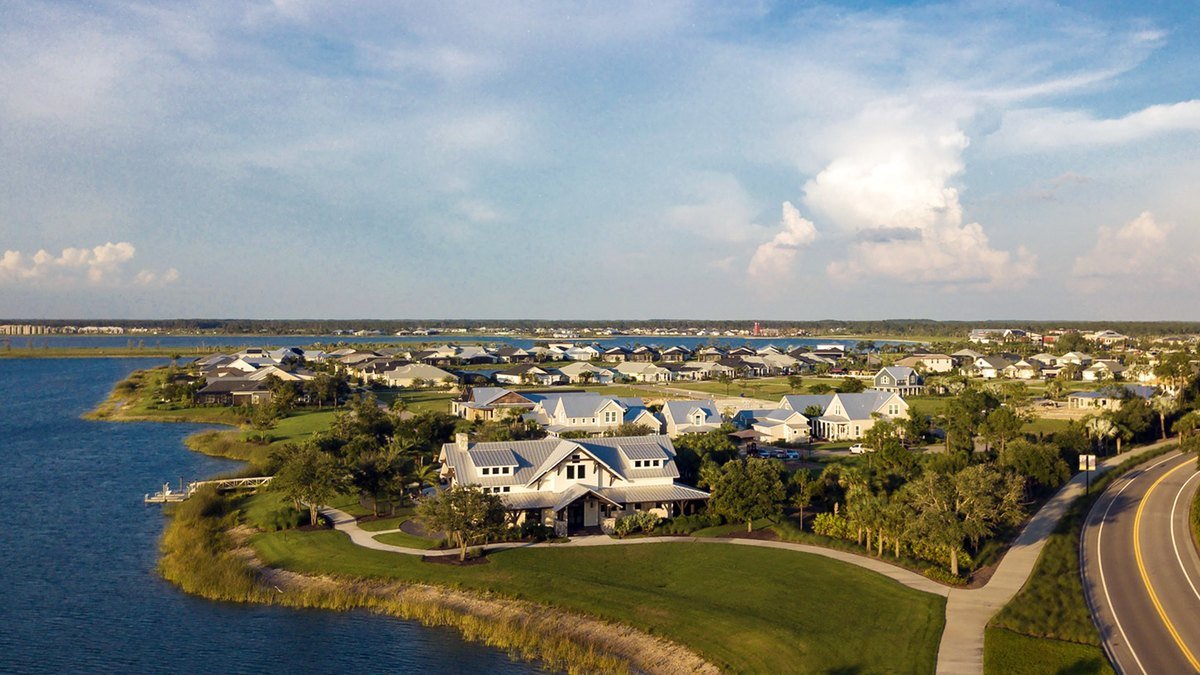
A masterplanned community in Punta Gorda, Florida is already famous for being America’s first solar powered town and surviving a direct hit from Hurricane Ian unscathed. Now it plans to be an innovation hub for climate change solutions.
Developed as a sustainable and “hurricane resistant” town by former professional football player Syd Kitson and Kitson & Partners in 2006, Babcock Ranch currently has approximately 15,000 residents.
With the residential plan spread out over 18,000 acres, the rest of the 91,000-acre tract of land formerly owned by Pittsburgh lumber magnate Edward Vose Babcock is preserved for nature conservation.
Designed to be hurricane resistant, the community not only runs on 687,000 solar panels (with battery backup) but has a unique storm-water drainage control system that allows flood waters to be moved through the roads and numerous man-made ponds without ever touching the homes.
In September 2022, the ranch was tested in how hurricane resistant it was by taking a direct hit from Category 5 Hurricane Ian. It emerged with flying colors, never losing electricity.
A subsequent 60 Minutes segment brought the community nationwide attention—and a surge in sales that has hardly slowed to this day.
New home sales are up almost 30% this quarter, according to Benjamin Board of The Ferrari Team with Nicklaus Vance, who specializes in selling Babcock Ranch real estate. He says after a “stagnant” 2025, resales have picked up, too.
Board and his partner, Christy Ferrari, both live in the community as well as rep its real estate.
The pair attribute much of Babcock Ranch’s desirability to its wide-ranging amenities, including 150 miles of of trails, lakes, and parks; walkable multiple town centers, and bike- and golf cart-friendly streets; a retail plaza with restaurants and grocery stores (the community is excited for its first Publix, now being built); and medical, pharmacy, and vet facilities. It also has its own cradle-to-cap school system.
But the community’s reputation for never losing power or flooding during extreme Florida storms acts as a continual lure for new residents, many of whom are older retirees.
“We have the peace of mind of never losing power,” Ferrari tells Realtor.com. “That safety is why people come here.”
The agent recalled to Realtor.com how she emerged from her Babcock home after Ian passed over and noted the barely-detectable damage.
“Maybe a few trees were uprooted and a couple of street signs were blown over, just because they were newly planted,” she says.
Board recalls how he and Ferrari recently went to three different big box home stores, each of which had staff that tried to sell them a backup generator.
When Board explained that one wasn’t needed for their home because they lived in Babcock Ranch, he says, “They all went, ‘Ohh, okay!’ They knew that because they had heard we don’t lose power.”
A special storm water drainage system means that homes don’t flood in extreme storms, either.
“You’ll see water in the streets, but it doesn’t come up to the homes,” says Board. “If we know a hurricane is coming, we do go get supplies—water, food, whatever—but we don’t feel we have to leave.”
He says many of his clients are local to Florida, and moving into the community because “they are tired that every time there’s a storm coming, they have to vacate.”
He says some clients have a home “on the water” and will stay there until hurricane season hits, then migrate to Babcock Ranch for two or three months.
“They feel safe here,” he says. “They know if something is coming, they can stay in their homes.”
Florida’s climate change innovators at Babcock Ranch
Now, Babcock Ranch will serve as the anchor for a statewide climate resilience program called Southwest Florida Resilience Accelerator.
The program will be a hive mind of CEOs, founders, investors, universities, and corporate partners building the next generation of climate resilience solutions.
Southwest Florida has a resilience sector GDP growth rate of 41.9% over the past five years, according to The Florida Council of 100. Starting in October, Babcock Ranch will host at least two weeks of an eight-week inaugural cohort introducing various early stage companies in the extreme weather resilience sector.
Lucienne Pears, Vice President of Economic and Business Development for Kitson & Partners, developer of Babcock Ranch, tells Realtor.com that the inaugural cohort will discuss new innovations that will make homes more resilient and affordable.
“How can we support those innovative companies so that the Babcock story is more the ‘everybody’ story?” she asks.
Pears says she is especially interested in the intersection of insurance companies and climate innovation—in other words, what can be done to build homes that are not only safer but cheaper, with lower premiums?
“The best way to affect the cost of insurance is through the quality of construction,” she says. “So what are those things we can do to create a stronger home that would then be recognized by insurance companies that would have the cumulative effect of a lower premium?”
Whether it’s a different roof strap, a different plywood material, or another way of designing a building altogether, Pears says that Babcock Ranch intends to be at the forefront of finding what works best for climate resilience, now and in the future.
“The ideal person is bringing something I haven’t thought of yet,” she says of the innovators who will attend.
Babcock Ranch may have shrugged off a Category 5 hurricane, but Pears says the community isn’t finished evolving when it comes to sustainability and resilience.
“We’ve solved a lot of the concerns of today, but that doesn’t mean we’re done,” she says. “There is always ‘How do we address the concerns of tomorrow’?”