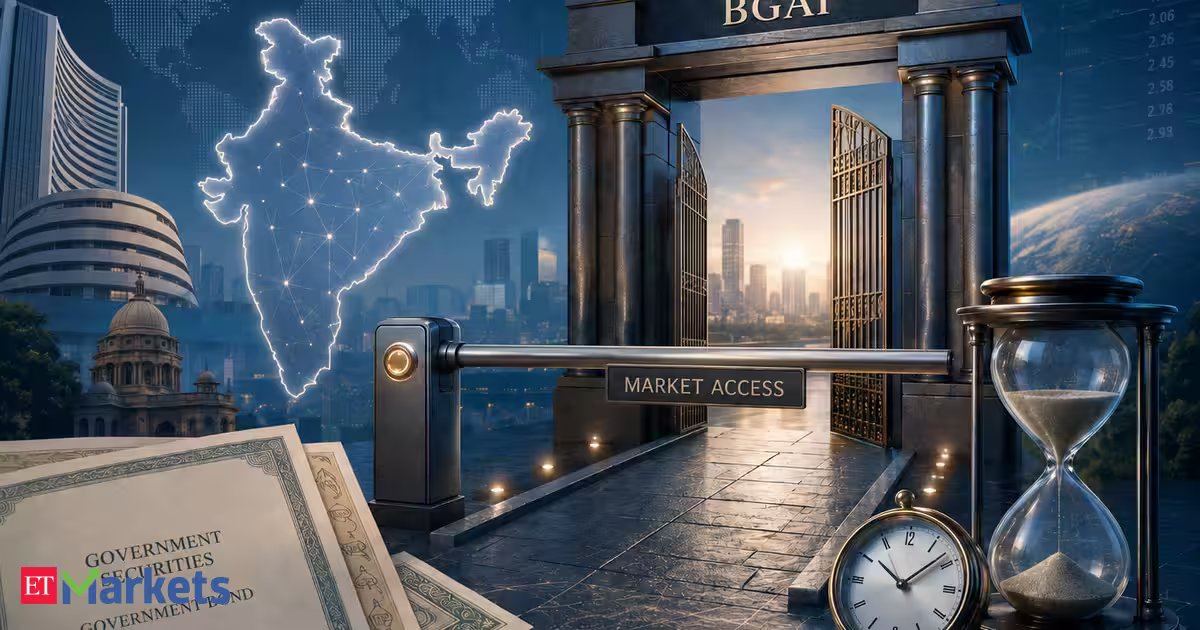
Delayed, Not Denied: India’s BGAI Entry Waits on Market Access
Why does access beat scale in global indices
For BGAI, this distinction matters because the sheer heft is not the entry ticket, it is frictionless global accessibility. It’s possibly why other smaller markets such as Mexico, Thailand, Indonesia and the Philippines qualified to be a part of BGAI. In fact, most of these countries have been in the index since the 2000s; China was the last major addition in 2019. India’s delay, then, is less a snub and more a signal: the plumbing still needs work.
Sitting with the Big Guys
When India does make it in – and the direction of travel still looks that way – it will likely be a bigger milestone than the country’s earlier inclusion in J.P. Morgan’s Emerging Market Government Bond Index (GBI-EM). The key difference is that BGAI isn’t an emerging-markets-only club; it spans developed and emerging market bonds. It’s used by a much broader investor base, including large developed-market institutions. The scale gap is quite striking: assets tracking BGAI are widely estimated around US$2.5 trillion, versus roughly US$200 billion tracking the GBI-EM. That broader bench of investors is precisely why BGAI inclusion carries a different kind of weight.
How much does it weigh
Naturally, the next question is: how much weight would India actually get? Unlike GBI-EM, which caps country weights at 10%, BGAI has no such limits, which helps explain why the US dominates the index at 40.8%, followed by China and Japan. Look at it through the currency lens and the picture is similar: Dollar bonds make up about 45% of the index (these include US Treasuries, US corporates and other USD issuances), with Eurozone currencies at 25%, and Renminbi and Yen as the next large constituents. In that context, India’s potential currency-based weight is likely to be about 0.60% to 1.0% of BGAI – roughly in the neighbourhood of South Korea (0.98%) and Switzerland (0.55%). It would also place India ahead of several emerging markets sitting below the 0.5% mark.
That may sound small, but this “small” allocation inside a US$2.5 trillion ecosystem is still meaningful. If India’s weight lands around 0.6% to 1.0%, the potential inflow is estimated at US$15-25 billion -equivalent to about 0.4%-0.6% of India’s annual nominal GDP.

Why this matters at home: who funds the borrowing programme
That’s where the domestic relevance sharpens. India’s fiscal consolidation has been a gradual glide path, and government borrowing needs remain elevated and may continue to be sticky, for some time. That’s the supply part; On the demand side, it is a bit chunkier too, with heavy lifting done by four major buyer groups: the Reserve Bank of India, Commercial banks, Insurers, and Provident/Pension funds. Over the past couple of years, RBI and foreign portfolio investor (FPI) ownership has risen – RBI due to asset purchases to manage domestic liquidity, and FPIs as India embarked on index journey with BGAI a key prospect. A small trivia worth stating here is that FPI ownership has increased notably to 3% from 1.5% in CY22, just before the JP Morgan GBI-EM Index inclusion. At the same time, banks’ appetite has softened at the margin as they focus on meeting the economy’s expanding credit needs, particularly in a period where credit growth has outpaced deposit mobilization. So, even as the demand base is still deep, the incremental buyer mix is changing.
The next buyer could be offshore
Looking ahead, it is not fully certain that the Banks and the RBI could absorb incremental bond supply at a similar pace. The RBI’s buying capacity is largely tied to the policy cycle, while banks’ demand depends on how credit growth tracks deposits. That uncertainty strengthens the case for broadening the investor base In an index-inclusion scenario, foreign investors could increasingly become a fifth structural buyer group, stepping in when local demand is constrained.For instance, India’s annual gross borrowing has averaged nearly INR 15 lakh crore over the past five years. Under a BGAI inclusion scenario, potential inflows could help absorb around INR 1.5–2.5 lakh crore, roughly 10–15% of annual gross market borrowing needs; Easing pressure at the margin. While that works in favour for India, why would FPI’s want to take up Indian bonds?
Well, it is not just yield, India acts as a portfolio diversifier for the FPIs.
From a portfolio construction angle, India also has a simple pitch: comparable BBB-rated sovereign markets suggest Indian bonds can work as a diversifier for foreign debt investors, rather than a pure yield punt. In fact, policy measures have also improved India’s investment proposition. In June 2026, authorities announced measures such as the removal of withholding tax and capital gains tax for foreign debt investment, alongside RBI steps to expand the investible universe and ease investment restrictions; making Indian bonds attractive in the EM-space and also, strengthening India’s case materially for Index Inclusion.
Besides, the sharp swing in global yields and comparatively, modest change in India’s yield does make it that additional EM-market that the FPI’s should tap into. Of course, the FX moves may diminish India’s rates and returns story, but the yield levels still support the diversification story.
The timeline: a waiting game, not a rejection
The latest BISL stance appears best read as an ongoing review with cautiously positive signalling, wrapped in neutral governance language. A plausible path from announcement to inclusion could involve roughly a 6–12-month lead time, followed by a 6-10-month phase-in. China’s inclusion, for reference, unfolded over about 20 months, reaching a 6.0% weight through a phased addition of 0.3% per month.
So yes, for the next six months it may feel like a snooze period for those waiting for the index inclusion boost. But the bigger message is intact: the signal is not a no, it’s “just not yet”. For India, this looks like timing, not direction – delayed, not denied.
Country weights in BGAI
 ETMarkets.com
Source: Bloomberg data as of Aug 18, 2026, Trading Economics, HSBC AMC
Currency weights in BGAI; India’s weight could be 0.6-1.0%
ETMarkets.comSource: Bloomberg data as of Aug 18, 2026, HSBC AMC
Foreign ownership across countries shows India’s is the lowest.
ETMarkets.comSource: Bloomberg data as of Aug 18, 2026 or as latest available, HSBC Global Research note dated 14-August
Note: Views provided above are based on information in public domain and subject to change. Investors are requested to consult their financial advisor for any investment decisions. Past performance may or may not be sustained in future and is not a guarantee of any future returns.
Shriram Ramanathan is CIO–Fixed Income, and Achala Jethmalani is an economist at HSBC Mutual Fund.