Share of equity rich, mortgaged properties nears 5-year low
The estimated share of mortgaged properties with at least half of their equity available has now officially sunk to a level not seen in almost five years.
Processing Content
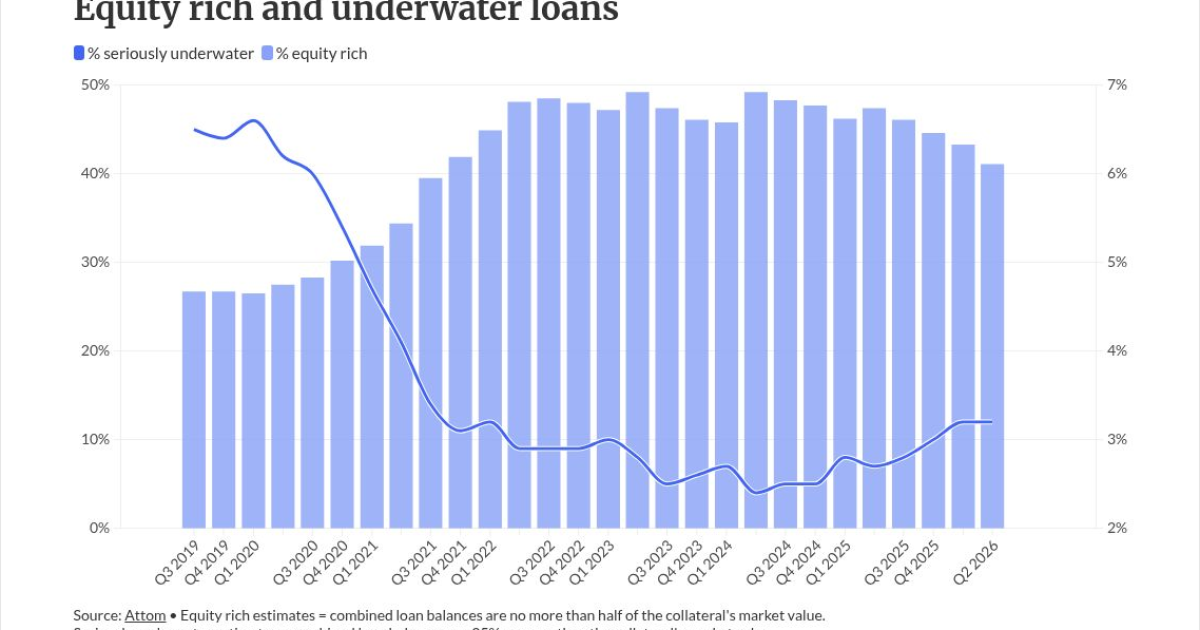
The percentage of equity rich properties had approached the fourth-quarter 2021 low of 41.9% during the previous fiscal period,
Attom’s second-quarter data adds to
“Two measures of home equity strength, the rates of equity rich and seriously underwater homes, remain healthier than they were prior to 2020. However, both have been moving in a less favorable direction,” Attom CEO Rob Barber said in a press release.
Putting things in perspective
Estimates for the national share of seriously underwater loans that exceed 25% of their collateral value matched the first quarter’s number at 3.2%, sticking fast to a high not seen since 2022 that suggests pandemic-era lows with a 2% handle may not return.
However, the share of seriously underwater loans is still far below higher prepandemic levels, which were above 6%.
And while equity-rich loans are down considerably from when they represented nearly half or 49.2% of the market
That said, there is a lot of variation at the state level.
The share of mortgaged properties that are equity rich ranges from just 17.5% in Louisiana to 78.9% in Vermont. Rhode Island had the lowest share of seriously underwater loans at just 1.1%. Minnesota recorded the highest percentage in that category at 12.1%.
The North Star State also experienced the largest annual increase in the percentage of loans seriously underwater with its share being just 2.6% a year earlier.
Louisiana experienced the biggest annual drop in the share of seriously underwater mortgages, with the percentage falling from 11.9% to 10.3%.
In examining trends on a more local basis, Attom found that almost all large metropolitan statistical areas experienced declines in the share of equity rich homes in the past year.
While the share in these areas can still be as high as 59.1% (San Jose, California), out of 108 MSAs with at least 500,000 people and sufficient data, 96.3% or 104 recorded annual declines. Baton Rouge, Louisiana, had the lowest share at 15.4%.
Attom’s report on home equity and underwater mortgages measures loan-to-value ratios based on a record-level mortgage model that estimates the position and amount of borrowing on properties.
The company combines this information with a record-level automated valuation model based on publicly-recorded mortgage and deed of trust data for over 160 million properties.
Attom has updated its report over time to exclude activity in which it found investors offset the LTV ratio through sales involving multiple properties with a single jumbo loan. Attom excluded the investor data to focus more on trends that reflect traditional consumer mortgage activity.