ITR filing 2026: What happens if you miss the August 31 deadline and who gets more time?
The income tax return (ITR) filing deadline for taxpayers with income from business or profession is now less than two weeks away. While missing the last date does not mean you lose all options, filing late can come with additional interest, late-filing fees and other consequences.
The August 31 deadline applies to taxpayers filing ITR-3, ITR-4, ITR-5 or ITR-7 who have income from business or profession, but are not required to get their accounts audited under the Income-tax Act, 1961.
Who gets more time after the August 31 deadline?
But August 31, 2026 is not the deadline for everyone. Your due date depends on your income, whether your accounts are subject to tax audit, and the income tax return form applicable to you.
Certain taxpayers, including those whose accounts are required to be audited, get more time to file their returns. So, before you start filing, make sure you know which deadline applies to you and avoid delaying it until the last minute.
If you have income from business or profession and opted for the presumptive taxation scheme which is liable for tax audit (where applicable), then your due date for filing ITR is October 31, 2026. In such cases, you still need to file ITR-4 but get additional time to fulfill the compliance requirement.
Meanwhile, transfer pricing cases has time until November 31, 2026 to file their ITR. Transfer pricing refers to the pricing of goods, services or intangible assets between related entities, like a holding company and its subsidiaries or different divisions within a corporate group.
What happens if you miss the August 31 deadline?
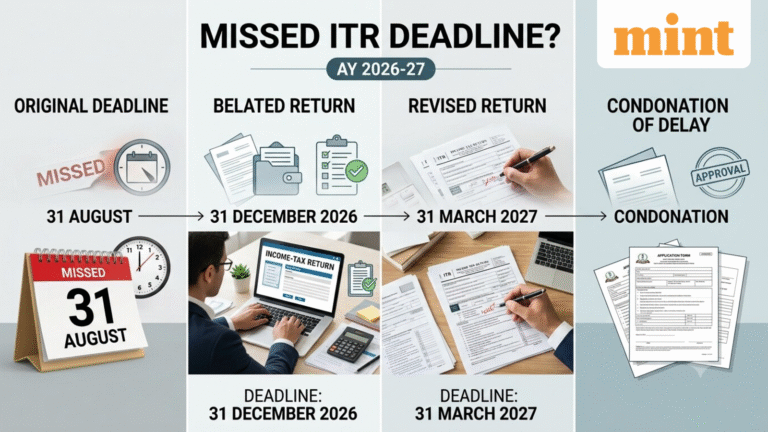
If August 31 is your applicable ITR deadline and you miss it, you can generally file a belated return within the stipulated due date.
For AY 2026-27, a belated return can generally be filed until December 31, 2026, or before the completion of assessment, whichever is earlier. But missing the original ITR deadline also comes with late filing fee as mentioned below:
- If the taxpayer’s income is above ₹5 lakh, filing a belated return will incur a penalty of up to ₹5,000.
- If the taxpayer’s income is up to ₹5 lakh, the maximum penalty for filing a belated ITR is ₹1,000.
Additionally, the taxpayer will be liable to pay interest at a rate of 1% per month or part month on the unpaid tax amount as per Section 234A. The interest is calculated from the applicable ITR due date for the relevant financial year until the date the return is actually filed and only applies to those who have outstanding tax dues and yet fail to file their return on time.
There can also be consequences if you want to carry forward certain eligible losses to future years. This makes timely ITR filing particularly important for business owners, traders and other taxpayers who may have losses to set off against future income.
Can you correct details or omissions in your filed ITR?
Yes, a taxpayer is allowed to make corrections in their filed tax returns under Section 139(5) of the Income-tax Act, 1961.
The window to file a revised return remains open until 31 December 2026. However, taxpayers can also file a revised return by 31 March 2027, after the payment of the prescribed late fee.