To Rein In Costs, Philly Affordable Housing Players Look To Become ‘Less Reliant On Consultants’
Affordable housing developers are looking for new ways to make projects pencil as they face soaring costs caused by factors they can’t control — from global market conditions to government regulations.
In Philadelphia, some developers of low-income and attainable housing buildings are turning to one area they do have control over: doing more work in-house.
:no_upscale():quality(75))
Photo credit: Bisnow/Noah Zucker
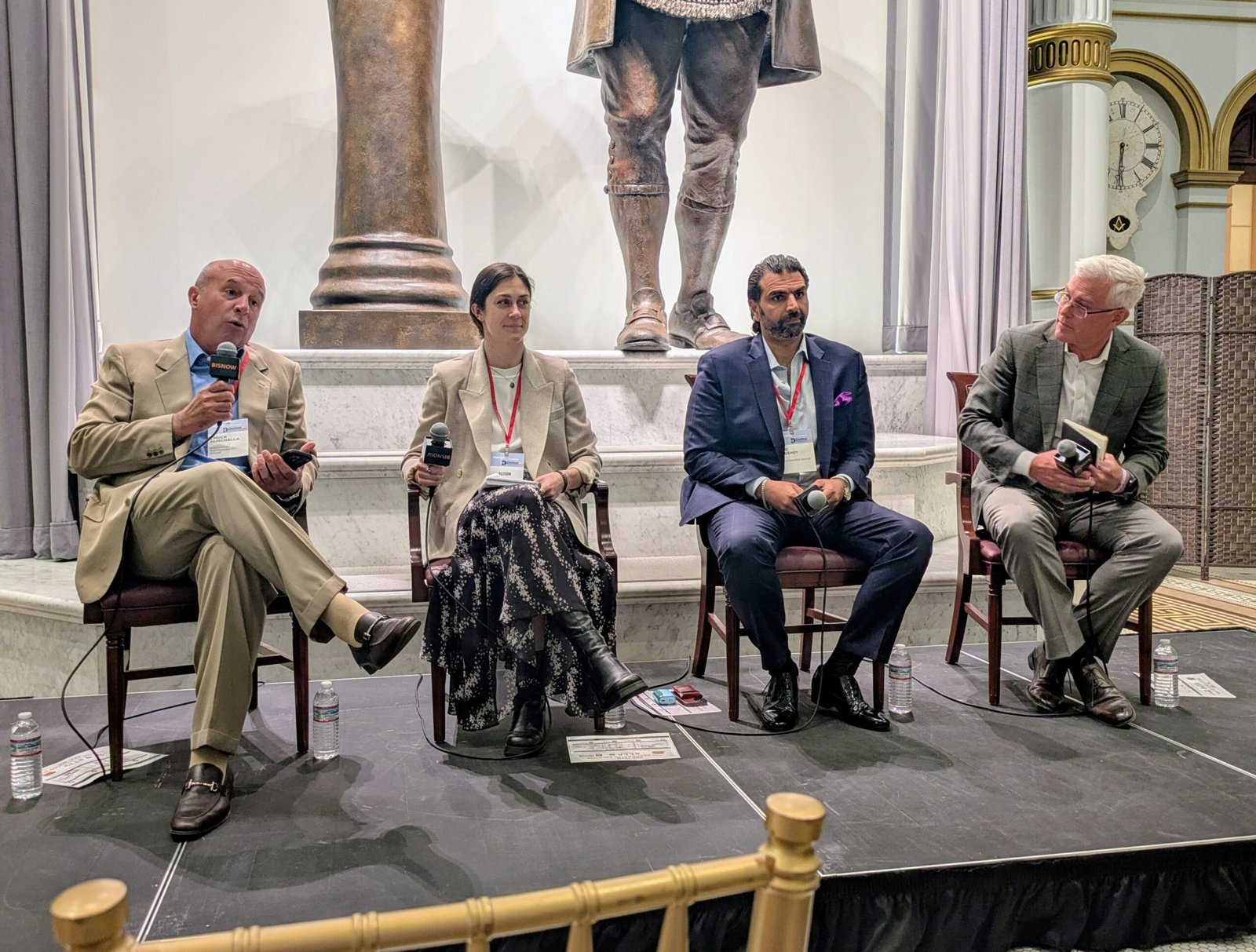
Evolution Sustainability Group’s Chuck Hurchalla, Aedera Cos.’ Alison Carey, Riverwards Group’s Mo Rushdy and Pennrose’s Timothy Henkel
“Sometimes we hire consultants to help us put these deals together because they’re very complicated,” HACE President Maria Gonzalez said during Bisnow’s Philadelphia Affordable Housing Conference on Tuesday at One North Broad.
“Trying to bring the capacity and skills in-house so that you are less reliant on consultants, that helps us be able to have additional savings. We don’t have to use our developer fees to pay a consultant for the product.”
Rising construction material costs, elevated interest rates and ballooning insurance premiums are impacting the entire real estate sector. On top of that, Gonzalez said affordable housing nonprofits like HACE rely heavily on federal programs such as the low-income housing tax credit, which includes cumbersome guidelines that bloat construction costs far beyond what is seen in market-rate housing.
:no_upscale():quality(75))
Photo credit: Bisnow/Noah Zucker
Select Redevelopment’s Travis Seal, Philadelphia Housing Development Corp.’s David Thomas, LeadingAge PA’s Garry Pezzano, NewCourtland’s Joe Duffey, TD Bank’s Sue Taylor and HACE’s Maria Gonzalez
But even in the market-rate sector, Riverwards Group Managing Partner Mo Rushdy said “paper developers” who bring in third-party contractors to build out projects can’t survive in many of Philly’s outer neighborhoods.
While rents there are lower than in highly desirable neighborhoods like Center City, the construction costs are the same.
“If you look at the upside on market-rate stuff that’s in these neighborhoods, we’re talking about 6% to 8%,” Rushdy said.
“Can you imagine how thin these deals are in terms of profit?” he added. “That upside is just enough to pay the equity, and the developer’s left with little to nothing. So we have to be dependent on ourselves to grow.”
That is why he built the firm on a full-service model from design to property management.
While Gonzalez said it is sometimes possible to save some money on construction by using nonunion workers, she said that isn’t a viable route for every project in an organized labor stronghold like Philadelphia.
:no_upscale():quality(75))
Photo credit: Bisnow/Noah Zucker
The Michaels Organization’s Jonathan Lubonski, Project HOME’s Donna Bullock, Pennsylvania Housing Finance Agency’s Robin Wiessmann and the city of Philadelphia’s Jessie Lawrence
In-house asset management teams are a relatively new concept for the affordable housing sector, according to Timothy Henkel, CEO of national development firm Pennrose.
“About 10 years ago, owner-operators of affordable housing began to create asset management departments because of the scale, because it becomes data-rich,” he said.
In a sector defined by increasingly tight margins, Henkel said there is little room for error. The teams made up of tax and utility specialists can catch and address issues quickly before they become grave.
But they aren’t available to most smaller affordable housing owners and operators, so they may not be a solution to the industry’s operating woes.
“If our portfolio weren’t big enough, we wouldn’t be able to afford that,” Henkel said. “That’s something that I know challenges some of our partners who operate on their own or are partners with us in parts of their portfolios.”