Pets are Family, and Budgets Show It: New AICPA Survey Finds Owners Prioritize Pet Care and Long-Term Planning
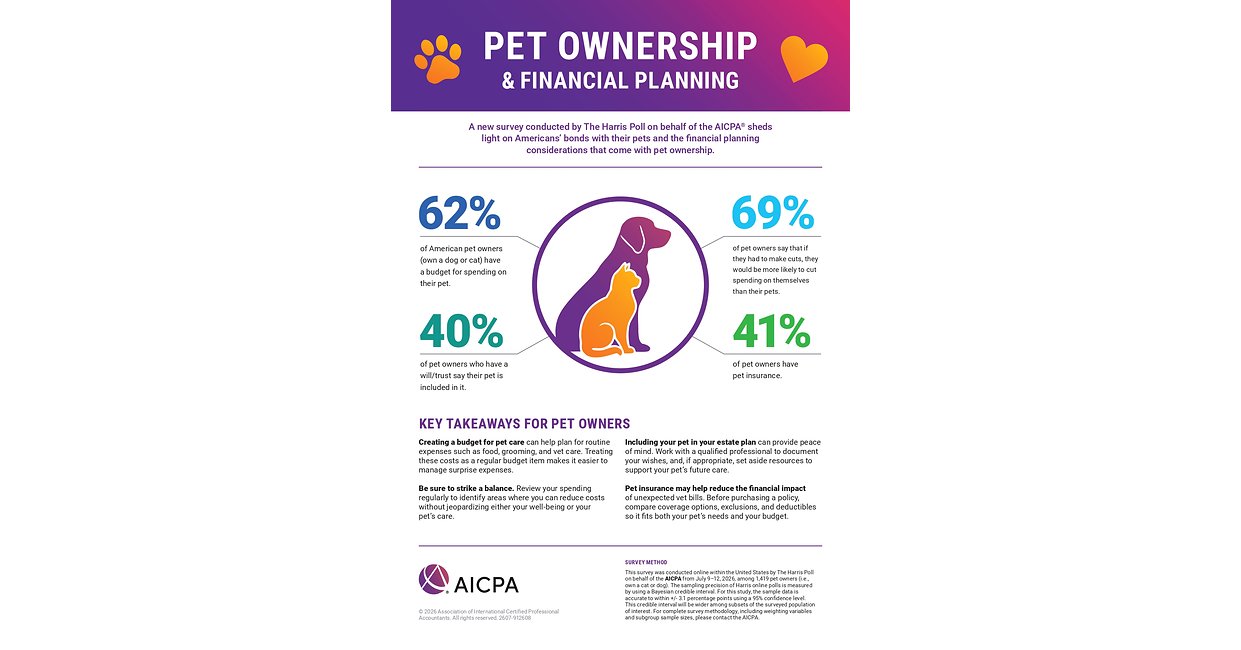
40% of pet owners with wills/trusts have included provisions for their pets
WASHINGTON, Aug. 19, 2026 /PRNewswire/ — Ahead of National Dog Day (August 26), a new survey conducted by The Harris Poll on behalf of the American Institute of CPAs (AICPA) shows that Americans don’t just love their pets, they are making personal financial decisions around them. The survey found that 57% of Americans own a dog, 40% of Americans own a cat and 95% of those pet owners consider their pet(s) to be a member of the family.
Pets are a Financial Priority
The survey, done in mid-July 2026, shows that 62% of American pet owners (i.e., own a dog or cat) have a budget for spending on their pet. Devotion to pet(s) runs deep – 69% of pet owners say they would be more likely to cut spending on themselves than their pets if they had to make cuts, highlighting the important role pets play in American households. The survey also revealed that older pet owners may be especially devoted to protecting their pets’ well-being. Pet owners age 65 and older (81%) are more likely than younger pet owners to say that if they had to make cuts to their spending, they would be more likely to cut spending on themselves than spending on their pets (64% age 18-34, 63% age 35-44, 71% age 45-54, 73% age 55-64).
“These findings show that Americans view pets as a member of the family and that the money spent to care for them is not an afterthought but a core household expense,” said Cary Sinnett, Director of Personal Financial Planning for the AICPA. “For many families, pets provide companionship, emotional support and stability, so it’s not surprising that some would prioritize their pets’ needs over their own, even during times when budgets are tight.”
An Estate Plan with Fur
The love for pets is also showing up in Americans’ estate planning. The interest in including pets in a will/trust, reflects the trend of treating pets as family members. Of the 73% of pet owners who report having a will or trust, 40% of those individuals have included provisions for their pets.
Among those who have a will/trust but do not have provisions for their pet, when asked why:
- 40% say they hadn’t thought of adding their pet(s) to their will/trust.
- 38% say that their family/friends would figure out what to do with their pet(s) if needed.
- 25% feel that wills/trusts are only meant for people, not animals.
- 18% say they haven’t updated their will/trust since getting their pet(s).
“Many people overlook what would happen to their pet(s) if they became incapacitated or pass away,” said Erin Itkoe, CPA/PFS, member of AICPA’s PFP Champions Task Force. “Discussing long-term care arrangements for your pet(s) and documenting those wishes in your estate plan benefits not only your pet(s), but the people you’ve selected to care for them.”
AICPA Tips for Pet Owners
- Create a dedicated pet budget and emergency fund – the American Veterinary Medical Association (AVMA) reports that pet-owning households spend an average of about $1,515 per year on their pets (excluding adoption or purchase costs). Make sure your budget includes recurring expenses such as food, grooming, medication and routine veterinary visits. Set aside extra money for any unexpected expenses, including veterinary bills, emergency boarding, or temporary care needs. Keep in mind that costs may increase as pets age and require additional medical attention (similar to human healthcare). Larger veterinary expenses can occur unexpectedly.
- Evaluate pet insurance – determine whether coverage makes sense based on your pet’s age, health and breed as well as your budget. According to the survey, 41% of pet owners have pet insurance. Consider whether you would be comfortable paying for significant unexpected veterinary expenses out of pocket. Pet insurance policies vary widely in terms of coverage, deductibles, and exclusions, so review the details carefully before purchasing.
- Review your estate planning documents – pets generally cannot inherit assets directly, but you can create a plan to provide for their care. Identify who would care for your pet and how that care would be funded if something happens to you. Depending on your circumstances, a pet trust or other legal arrangement may provide additional protection. Be sure to update your documents following major life events including adopting a new pet, moving, retirement or other changes in financial circumstances.
- Create a pet care plan for emergencies – prepare written instructions for your pet’s care, including feeding routines, medications, veterinary contact information, behavioral notes, and emergency contacts. Consider keeping this information with your important documents, so a family member, friend, or caregiver can quickly step in if needed.
For more financial tips on pets, visit AICPA’s Financial Literacy Page.
Survey Method:
This survey was conducted online within the United States by The Harris Poll on behalf of the AICPA from July 9-12, 2026, among 1,419 pet owners (i.e., own a cat or dog). The sampling precision of Harris online polls is measured by using a Bayesian credible interval. For this study, the sample data is accurate to within +/- 3.1 percentage points using a 95% confidence level. This credible interval will be wider among subsets of the surveyed population of interest. For complete survey methodology, including weighting variables and subgroup sample sizes, please contact the AICPA.
About the American Institute of CPAs
The American Institute of CPAs® (AICPA®) is the world’s largest member association representing the CPA profession, with a history of serving the public interest since 1887. AICPA members represent many areas of practice, including business and industry, public practice, government, education, and consulting. A founding member of the Association of International Certified Professional Accountants, the AICPA sets ethical standards for the profession, attestation standards, and U.S. auditing standards for private companies, not-for-profit organizations, and federal, state, and local governments. It develops and grades the Uniform CPA Examination, offers specialized credentials, partners across the profession to build future talent, and drives continuing education to advance the vitality, relevance, and quality of the profession.
SOURCE AICPA