Global Bonds Rally as US Treasury Boosts Market Support
Global Bonds Rally After US Treasury Expands Liquidity Support Operations
Market Reactions and Economic Impacts
By Iain Withers and Dhara Ranasinghe
US Treasury Actions and Bond Market Response
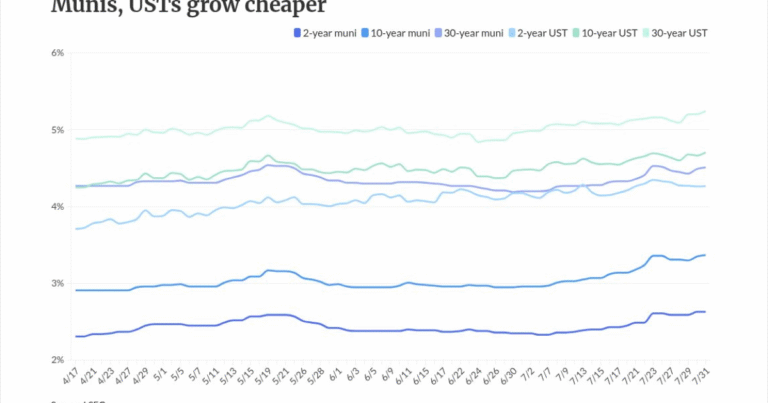
LONDON, Aug 19 (Reuters) – Global bond yields retreated from multi-decade highs on Wednesday after the U.S. Treasury Department said it would boost liquidity support for longer-dated securities, following a broad selloff driven by fears of swelling sovereign debt.
The U.S. Treasury Department said it would double the size of liquidity support buyback operations for longer-dated nominal coupon securities to at least $4 billion per operation from $2 billion.
U.S. long-dated government yields fell by as much as 10 basis points, dragging European government bond yields down too. U.S. long bonds had hit their highest in nearly 20 years on Tuesday, at nearly 5.34%, reflecting growing concerns about inflation and high debt.
Yields go up when bond prices go down, and the selloff matters because long-end sovereign yields act as an anchor for the price of nearly every other asset in financial markets, including mortgage rates.
Global Geopolitical Developments and Market Sentiment
Hopes for Peace in Iran Recede
HOPES FOR PEACE IN IRAN RECEDE
Oil futures gained around 0.2% as the prospect receded of a deal to end the conflict in the Middle East. [O/R]
Stock Market Movements
Wall Street’s S&P and Nasdaq were both up 0.4% in early trade, while European stocks were broadly flat. Earlier, stocks across Asia fell on concerns about the outlook for semiconductor companies. South Korean shares closed nearly 6% lower, posting their biggest one-day drop in three weeks.
Long-Term Borrowing Costs and Inflation Concerns
Long-term borrowing costs from the U.S. to Germany and Japan have soared as investors fret over ballooning government debt and high inflation, in part driven by the Iran war pushing up oil prices.
German and French long-dated bond yields, which had earlier risen to their highest in 15 and 18 years respectively, traded lower on the day.
Expert Commentary
“What we’ve seen in the course of recent days is that the long end of the bond market has obviously been selling off and potentially becoming somewhat problematic for the play through to other asset classes,” Jeremy Stretch, head of G10 FX strategy at CIBC, said.
“So, clearly, the Treasury Secretary has to be mindful of those risks and has made adjustments. That’s why we are (now) seeing US 30-year Treasury yields down sharply and the dollar cheapening.”
Japan’s Bond Yields and Global Implications
A rise in Japan’s benchmark 10-year bond yield toward 3%, a three-decade high, is also a warning sign for global debt markets that for years have depended on low Japanese rates driving a constant flow of Japanese investment abroad.
“There is a narrative of are we going to have continued higher-for-longer inflation and what does that mean for longer-term interest rates?” said Neil Fisher, investment specialist at St James’s Place.
“Then you have a narrative around how sustainable is some of this long-term government debt in the UK and Europe, in the U.S. as well?”
Upcoming Federal Reserve Announcements
Later on Wednesday the U.S. Federal Reserve releases minutes from the July meeting. It left rates on hold, but Chair Kevin Warsh spooked markets by offering few clues about whether and how the central bank might respond to persistent inflation.
Other Notable Market Events
Unitree Soars on Debut
UNITREE SOARS ON DEBUT
In China, shares in the world’s biggest humanoid-robot maker, Unitree, soared 460% on its debut, a listing that was more than 8,000 times oversubscribed by retail investors.
Bond Selloff and Tech Sector Impacts
The bond selloff and reports that Anthropic’s annual revenue run-rate topped $65 billion at the end of July, which was behind some market hopes, were triggers for selling chipmaking shares.
Currency Market Movements
The U.S. dollar index was last down 0.6% at 99.018. [FRX/]
The euro gained 0.6% to above $1.64 and the yen traded at 158.34 per dollar.
The Canadian dollar rose slightly after U.S. President Donald Trump paused imposing a 50% tariff on Canadian goods for three days, saying the countries had reached a deal. [CAD/]
Reporting Credits
(Reporting by Iain Withers and Dhara Ranasinghe, Additional reporting by Tom Westbrook; Editing by Shri Navaratnam, Sam Holmes, Elaine Hardcastle and Barbara Lewis)