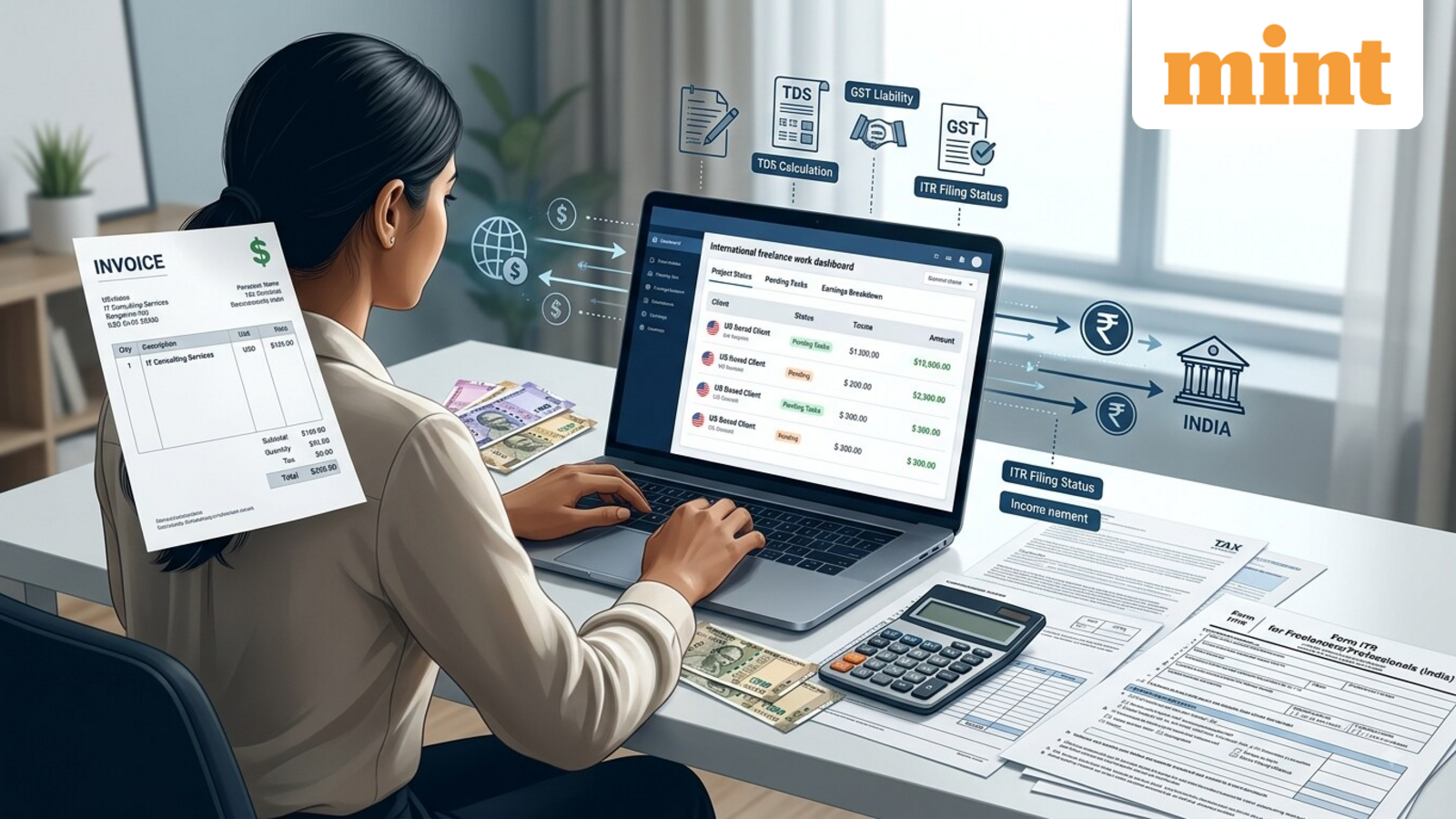
Freelancers earning income from US IT companies: Key FAQs answered on tax calculation, TDS, GST and ITR filing
Indian freelancers working for US-based IT companies need to understand how their income should be classified, converted into rupees, and reported in the income tax return.
Isha Sekhri, Founder, Isha Sekhri & Associates LLP, explains the key tax, ITR, GST, and foreign-income compliance requirements.
How is freelance income from a US IT company reported?
Sekhri noted that freelance IT/software work is generally taxed under “Profits and Gains of Business or Profession.”
Specified professionals, including technical consultants and certain IT-related professional services notified under Section 44AA(1), can opt for the presumptive scheme.
Under Section 44ADA, 50% or more of gross receipts is deemed as income. The gross receipts limit is ₹50 lakh, or ₹75 lakh where at least 95% of receipts are through banking channels. If receipts exceed the applicable limit, tax audit provisions apply.
For non-specified professions, income is treated as other service income.
How should US dollar income be converted into INR?
Sekhri explained that the SBI TT Buying Rate on the last day of the month immediately preceding the month in which income accrued or was received should be used.
For example, if a USD 1,000 invoice is raised in February 2026, the relevant date is 31 January, 2026.
How is tax calculated?
Sekhri suggested the following steps:
- Calculate total gross receipts in INR.
- Compute taxable income under the presumptive scheme or normal provisions and add other income, if any.
- Check whether the old or new tax regime is more beneficial.
- Add 4% cess and applicable surcharge.
- Pay advance tax in instalments, wherever applicable.
Is TDS deducted in India or the US?
Sekhri explained, “No Indian TDS applies — Section 195 targets Indian residents paying non-residents, not a foreign payer with no India presence paying an Indian resident.”
US withholding typically also does not apply if Form W-8BEN is on file and services are performed remotely from India. Without W-8BEN, some payers may apply default backup withholding.
How do India-US DTAA and foreign tax credit apply?
Sekhri noted that independent-services income is generally governed by Article 7 (Business Profits) of the India-US treaty, since there is no applicable “make available” clause and no permanent establishment in India.
If US tax is withheld, a foreign tax credit (FTC) can be claimed in India through Form 67, filed on or before the ITR due date.
The credit is the lower of foreign tax actually paid or Indian tax payable on the same income. Supporting documents such as Form 1042-S should be maintained.
Which ITR should freelancers file?
Sekhri stated, “File ITR-3 — even under the 44ADA presumptive scheme.”
Freelancers should report income in Schedule BP, fill Schedule FSI for foreign income, and Schedule TR for tax relief. Schedule FA must also be completed if foreign bank accounts or assets were held during the year.
The due date is 31 August where tax audit is not applicable. Where a tax audit applies, the tax-audit deadline is 30 September, followed by the ITR deadline of 31 October.
Which documents are required?
Sekhri shared the list of documents to be maintained.
- Signed service agreement with the US company
- Invoices raised
- Bank statements showing credits
- FIRC for each remittance
- Form W-8BEN
- Form 1042-S
- Proof of business expenses claimed
What expenses can freelancers claim?
Sekhri listed these business or professional expenses:
- Internet and mobile costs
- Software subscriptions
- Depreciation on laptop
- Professional/CA fees
- Bank charges and forex remittance charges
Does the nature of the US company affect taxation?
No. Sekhri mentioned that “the tax treatment under Indian law doesn’t change based on the nature of the US company”.
Whether the company is product-based, service-based, or an IT consultancy does not by itself change the freelancer’s Indian tax treatment.
Is GST registration required?
Sekhri explained that GST registration is generally not mandatory if the aggregate turnover from all sources is up to ₹20 lakh. Above this, registration becomes mandatory.
Services provided to a US client by an Indian freelancer qualify as export of services. An individual can file an LUT for zero-rated treatment. Without an LUT, the technically correct route is to pay IGST and claim a refund.
Does it matter where the freelancer receives the money?
For income-tax purposes, Sekhri explained, “it makes no difference and is taxable.” However, the mode matters for compliance.
- Foreign bank accounts or platform balances held abroad must be disclosed in Schedule FA, even for small amounts and irrespective of the 44ADA option.
- Receipts through platforms such as Payoneer, Wise and PayPal may not automatically generate an FIRC-equivalent bank realisation certificate for EDPMS closure, so it may need to be actively requested.
Disclaimer: This is only for informational and educational purposes. Please consult a qualified expert for the latest laws and regulations.