
Better Tech Behemoth: Alphabet vs. Microsoft Stock
Alphabet (GOOG +0.46%) (GOOGL +0.82%) and Microsoft (MSFT +0.90%) are two of the biggest tech giants on the market, and the third and fourth-largest companies in the world. Each has posted terrific results in its most recent quarter, but which one is doing better?
Let’s take a look at which one of these stocks makes the most sense for your investment dollars, or if they’re both worth buying now.

Image source: Getty Images.
The businesses are similar
Microsoft has built a software empire used by businesses and consumers around the globe. Microsoft also has a growing artificial intelligence business with its Copilot application, which allows companies to input internal data without fear of it leaking into the outside world.

Today’s Change
(0.90%) $4.45
Current Price
$496.88
Key Data Points
Market Cap
Day’s Range
$493.01 – $501.34
52wk Range
$349.20 – $553.72
Volume
95.2K
Avg Vol
40.7M
Gross Margin
67.94%
Dividend Yield
0.72%
Alphabet’s business is more advertising-focused, with the Google Search engine headlining its primary business. Advertising has been strong lately, but it tends to decline during times of economic uncertainty. Overall, Microsoft’s software business is more stable, but Alphabet’s business can grow faster during the good times.
Both also have a cloud computing business unit, which gives each massive exposure to rising AI computing needs. This is also the primary reason why each is spending hundreds of billions of dollars on data centers, and the payoff is starting to show up for those major investments.

Today’s Change
(0.82%) $2.82
Current Price
$346.36
Key Data Points
Market Cap
Day’s Range
$343.76 – $347.93
52wk Range
$196.59 – $408.61
Volume
172.6K
Avg Vol
32.7M
Gross Margin
60.94%
Dividend Yield
0.25%
I think you’re splitting hairs as to which company has the better business model. As a result, I’m giving this category a tie.
Winner: Tie
Alphabet is growing faster
From a growth standpoint, Alphabet has the edge. In the second quarter, Alphabet’s revenue increased by 24% year over year, headlined by its booming Google Cloud division, which saw 82% revenue growth. Microsoft posted an admirable 18% revenue growth, with Azure (its cloud computing division) seeing 43% growth.
Comparing earnings-per-share growth isn’t easy, as Alphabet reported a huge gain thanks to its long-term investment in Space Exploration Technologies (SpaceX). As a result, the better metric to look at here is operating income growth. During the quarter, Alphabet’s operating income rose 30%, while Microsoft’s increased by 18%.
With Alphabet winning on profit and revenue growth, it’s impossible to declare Microsoft the winner.
Winner: Alphabet
Valuing these stocks isn’t easy
Thanks to Alphabet’s SpaceX investment gains, its price-to-earnings ratio is a poor measure for valuing the company. Additionally, both are spending a ton of money on data center build-outs, so free cash flow is also a bad metric to use.
Instead, I think using operating profits is a smarter way to value these two. For the better part of the past three years, Microsoft has always maintained a premium over Alphabet. That flip-flopped late last year, and now Alphabet is the more expensive stock.
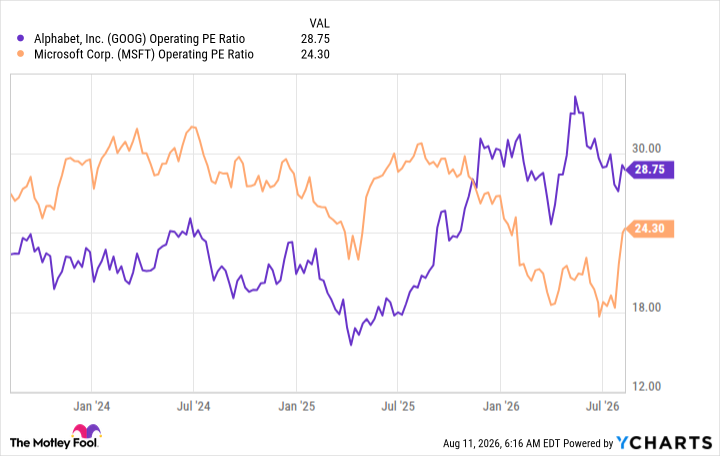
GOOG Operating PE Ratio data by YCharts
As Microsoft is slightly cheaper, I think it takes the cake here, as Alphabet is still trading at an elevated valuation, even if it deserves it.
Winner: Microsoft
Which is the better stock to buy?
With the analysis ending in a tie, it would be easy to declare both stocks winners. But that’s no fun. Which stock do I think is the best? I think it’s clearly Alphabet.
While it may be more expensive, its cloud computing division is growing far faster than Microsoft’s. Furthermore, its growth rate is accelerating rapidly, while Microsoft’s has only increased slightly in the quarter. For reference, Azure’s growth rate went from 40% in Q3 to 43% in Q4 in fiscal year 2026. Google Cloud went from 34% in Q3 2025 to 48% in Q4 2025, then to 63% in Q1 2026, and to 82% in Q2 2026.
There’s clearly something special about Google Cloud compared to Azure, and with it becoming a major part of Alphabet’s business, I think it will deliver superior stock performance relative to Microsoft over the next five years.