Texas Pauses Data Center Power Connections, Which Could Speed Up Rapid Development
Gov. Greg Abbott is using uncharacteristically heavy-handed government intervention to question data center developers’ needs.
The construction pipeline in Texas will make it the world’s largest data center market, according to a new report from JLL. But opposition to data center development has become bipartisan, even among rural Texans.
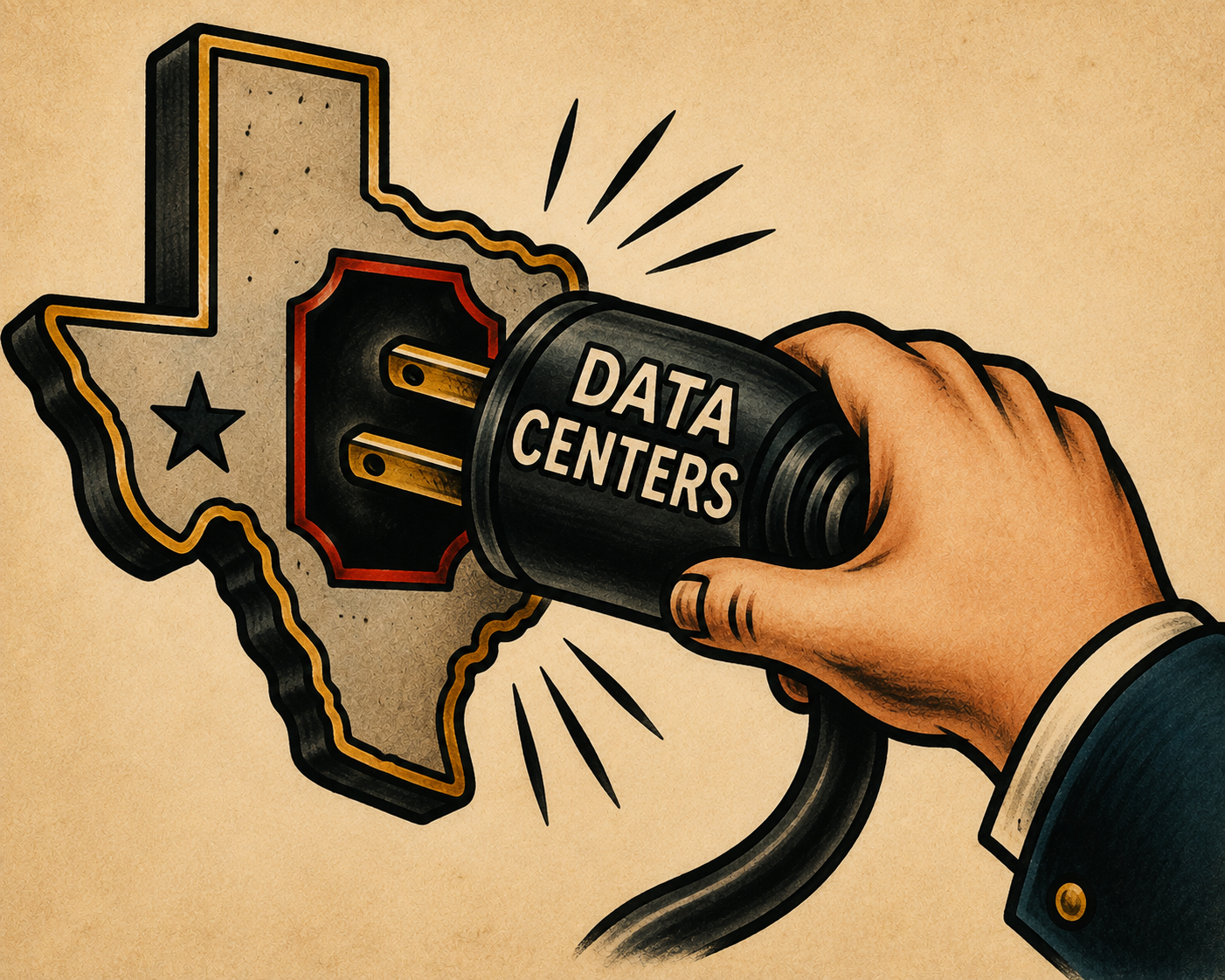
The governor’s latest directive halted all data center connections to Texas’ grid as state agencies audit their power demands, ownership and other information, appealing to those concerned.
:no_upscale():quality(75))
Photo credit: Bisnow/created with ChatGPT
But this is not a moratorium. Experts say that rather than slowing the pace of development, the new regulations will likely prop up more established developers by clearing out a glut of speculative projects requesting more than five times the amount of power the state grid has ever produced.
The regulations will also further drive development in off-grid connections, which Texas already leads the nation in, while speculators that have snapped up vacant land with the goal of lining up electricity later could be left out in the cold.
“This is a road bump, and possibly one that’s partially intended to promote the industry by cleaning up the queue,” said Dan Walters, professor of energy law at Texas A&M University School of Law.
“I don’t think this is going to tarnish Texas’ reputation as being extremely friendly to data center development.”
The number of data centers already under construction will more than double the state’s existing inventory, according to JLL’s midyear data center report, released Tuesday. But Abbott’s maneuver will lead to some short-term slowdown in development, Walters said.
Abbott boasted in late July that an East Texas data center project was no longer being pursued after it fell short of standards he had laid out in a June 10 letter to state regulators.
This is a far cry from his messaging in November, when he praised a $40B cloud and artificial intelligence-related investment from Google and called Texas “the epicenter of AI development, where companies can pair innovation with expanding energy.”
It’s not unusual to see politicians be more attentive to loud voices in the lead-up to an election, Walters said, which could help explain Abbott’s rare use of executive power as he campaigns to be reelected for his fourth term in November. A poll from June found that only 29% of Texans support the construction of a data center in their community.
“This order seems performative in a way that you would totally expect in an election year where you’ve got very heated opinions about this issue,” Walters said. “It’s there to try to find a middle ground and to show that he’s doing something about it but not completely shutting down the industry. It’s great political theater.”
Rapid Growth
:no_upscale():quality(75))
Photo credit: Courtesy of JLL
While Virginia’s built data center market is still larger than Texas’, the Lone Star State is seeing a much more rapid pace of development. There are 171 data centers under construction and another 878 planned projects in Texas, while Virginia has 144 data centers that have begun work and 545 more in the planning stages, according to Aterio.
The affordability of electricity in Texas, coupled with the state’s abundance of land and business-friendly climate, has made it a favorite location for developers of artificial intelligence data centers.
But they’ve come with soaring power demand that is troubling to residents who have dealt with catastrophic power failures in recent years. The Electric Reliability Council of Texas grid’s peak load reached a record of 91.1 gigawatts in late July.
ERCOT is considering more than 474 GW of power capacity requests from large projects, which would be enough electricity for 415 million new homes.
About 90% of those power requests are tied to data center projects, according to Abbott’s directive.
ERCOT and the Public Utility Commission of Texas will conduct the audits to gather information on water use, power sources, whether projects received state and local tax incentives, and what measures are being taken to limit impacts on neighboring property owners and communities.
Abbott called for the audit because load growth could jeopardize the grid’s reliability and stability.
The governor’s directive may read like moratoriums that are being considered and implemented in other parts of the country, but the audit halts connections to the grid, not development.
:no_upscale():quality(75))
Photo credit: Bisnow/Maddy McCarty
Gov. Greg Abbott
“It’ll be a little bit of chaos, but I don’t think what they’re asking is very difficult,” said Mark McNees, a faculty member at Florida State University’s Jim Moran College of Entrepreneurship who has researched data center cost allocation across 13 states.
This kind of regulation tends to give a leg up to the best firms, those able to comply with laws and finance their projects, Walters said.
“It’s more the shooting-from-the-hip kind of firms that want the regulatory environment to remain extremely undeveloped and unsettled,” he said.
Though it remains to be seen how quickly Texas officials can work through the audit process, the endeavor could help separate speculative from definite projects, McNees said.
“This is not a moratorium like we’re seeing other places,” McNees said. “Abbott’s not stopping anybody from building – it’s just putting a condition in front of getting connected to the grid.”
Power Options
It’s unclear how much of the 474 GW of electricity requested by large projects in Texas will come to fruition, and how much more power is requested by projects outside of ERCOT’s transmission area.
Walters said the audit could prompt developers to seek out independent grids or turn to on-site electricity production, commonly referred to as behind-the-meter, that doesn’t go through public transmission lines. The concept has significant emissions implications, he said.
Texas projects like Meta’s 1 GW data center outside of El Paso will initially get electricity from a power plant of 800 gas-burning generators, which Texas regulators approved in 20 days, The New York Times reported.
Texas has the most behind-the-meter data center activity in the U.S., with 40 GW of announced capacity, according to CleanView, which tracks power infrastructure and data center development.
Abbott directed the PUC and ERCOT to determine the extent to which data centers are providing their own power or relying on the ERCOT grid, including any efforts and processes to construct or procure on-site electric generation.
Projects that are already approved for power, and have additional behind-the-meter capability through natural gas, solar or another source, are now “a lot more valuable than what they were a week ago,” said Brian Chen, vice president of sales in Stewart Title’s energy and infrastructure group.
Ultimate Impact
:no_upscale():quality(75))
Texas politicians’ objections to more data centers aren’t new, as the industry was being compared to pigs at the trough for its power demands in 2024, three years after a winter storm led to outages that caused hundreds of deaths.
Abbott has since focused on the reliability of the ERCOT grid, while data center development has become increasingly unpopular. JLL found in its midyear report that while 79% of survey respondents support the U.S. as the leading voice in AI, only 14% are in favor of data center development in their communities.
Texas lawmakers passed a bill last year requiring data centers and other large-load customers to contribute to interconnection costs when they use the Texas grid.
But as new standards arise, the data center industry will just shift its approach, Walters said.
A spokesperson for Dallas-based data center developer CyrusOne said the company is prepared to provide the requested information for the audit and supports a “clear, consistent process” that ensures data centers meet requirements and are developed responsibly.
The Data Center Coalition, an industry association, is hopeful that Abbott’s audit directive will highlight the good actors in the data center industry rather than unnecessarily delay them.
Chen said he supports the industry having a framework and goalpost it can strive to meet while bringing its economic impact to Texas communities.
“The investments that are being made are going to be made,” Chen said. “It’s just where are they going to be made? Is your community going to be able to take advantage of that, or is another community or another country?”