Strategic focus and disciplined execution drive top-performing banks

- Key insight: The joint American Banker-Capital Performance Group study of 2025’s top-performing banks reveals that for institutions under $2 billion of assets, success comes from a fee-income engine, a defensible lending niche and radical cost discipline.
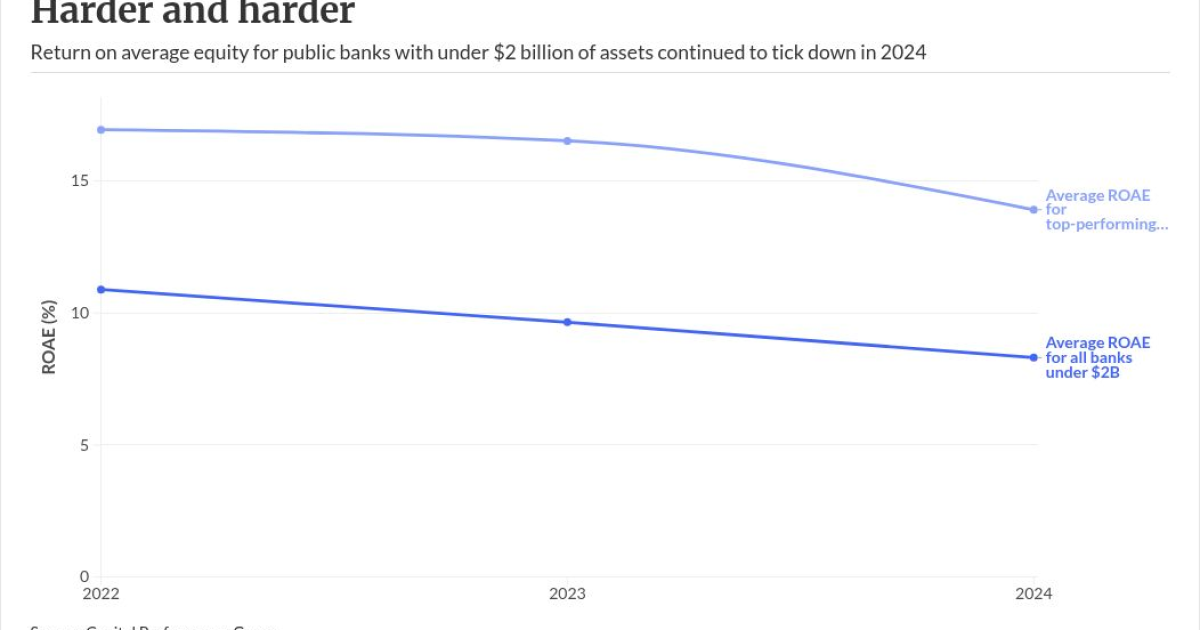
- Supporting data: The median three-year return on average equity of the top 100 held steady at 14% to 15% over five years. Meanwhile, the median of the sub-$2.0 billion public banks declined from about 8.6% to 7.5%.
- Forward look: A protected market or niche focus creates the opportunity, but disciplined execution turns that opportunity into sustained performance.
Every year, American Banker and Capital Performance Group rank the country’s
Processing Content
Let’s first establish the factors that do not correlate with top performance. It is not driven by
Top performance is also not a function of scale. The median assets among the top 100 hovered around $850.0 million throughout the period, and roughly 60% of top performers were under $1.0 billion.
Rather, in this asset tier, excellent financial performance depends on the business model. A closer look at the trends reveals two distinct types of top performers. The first is the one-hit wonder: banks that rose on temporary tailwinds. For instance, the 2021 list included many mortgage-refinance and SBA gain-on-sale operations benefiting from pandemic-era volume, such as Oregon Bancorp, Salem; University Bancorp, Ann Arbor; and BayFirst, St. Petersburg. As that windfall year fell out of the three-year averaging window, their rankings dropped. Oregon Bancorp fell from No. 1 to below No. 250 in four years. These rankings reflected a favorable operating environment, not a durable model.
The second type comprises the consistently top-performing banks. Thirty-three banks made the top 100 in all five years. Their businesses share a common characteristic: None is a plain-vanilla branch bank. FFB Bancorp, a single-branch Fresno institution, pairs SBA lending with a merchant-payments business. Truxton Corporation, Nashville, runs a private bank and trust company where fee income rises regardless of the rate environment. Solera National operates a Denver business bank with an efficiency ratio in the low 40s. Bank7 Corp., Oklahoma City, lends to energy and hospitality niches. The recurring themes are consistent: a fee-income engine, a defensible lending niche or radical cost discipline. Often, banks in this group pursue more than one of these strategies simultaneously.
Read more:
Geography plays a role as well, and the Southeast Corridor is on the rise. California still leads in the total number of top performers, but its count peaked in 2023 and has since declined, while Virginia, Tennessee, Georgia and the Carolinas have surged. Ohio deserves special mention as a quiet stalwart. Six Ohio banks made the top 100 list in each of the past five years. They’re all small-town institutions with disciplined, low-cost models. In lower-competition markets, a well-run local bank can retain more of its margin.
Five years of data tell a clear story: a pandemic-era cohort of gain-on-sale banks that burned out; a stable core of 33 niche, consistent top performers built on fee income, specialty C&I, or extreme efficiency; and a widening quality gap as rate pressure punished undifferentiated balance sheets.
However, the winning traits do not guarantee the outcome. Not every rural franchise, fee-oriented bank or lean operator earns a top ranking. Many banks share the profile yet still underperform. Consider CNB Community Bancorp in Hillsdale and Commercial National Financial in Ithaca, both rural Michigan banks with the same lower-competition environment that made FFD Financial Corporation in Dover, Ohio, a five-year stalwart. FFD tightened its cost structure and came to dominate its home county; the two Michigan banks let their efficiency ratios drift into the mid-60s and slide down the rankings. Same advantage, different execution. Or consider the handful of self-described “business banks” whose noninterest income is negligible relative to their size.
The lesson for community bankers is that institutions that are consistent top performers did not outgrow their peers; they out-focused them by building fee businesses, owning defensible niches or operating with unusual efficiency. But those traits alone are not enough. A protected market or niche focus creates the opportunity, but disciplined execution turns that opportunity into sustained performance.