Bank of America, JPMorgan Chase join new Swift framework
- Key insight: JPMorganChase and Bank of America are among the early adopters of a new Swift cross-border framework.
- What’s at stake: Digital assets are emerging as a cross-border option, creating both a new opportunity for banks and a potential threat.
- Forward look: Swift’s framework has about 60 adopters and the organization hopes to recruit more banks.
Four months after Swift floated its new
Processing Content
“Typically banks don’t play in this space because of the low margins involved. That’s less about them wanting more revenue, but more about the costs of delivering the payment,” Gareth Lodge, principal analyst at Celent, told American Banker, adding banks are getting more involved as a way to provide a broader set of services beyond payments.
What Swift is doing
Swift’s framework uses the messaging association’s international network to connect different parties in a transaction. “Greater transparency, speed and predictability are key to improving the cross-border payments experience. This framework is designed to deliver those benefits, and we look forward to seeing more U.S. banks join over time,” Leigh Amaro, chief executive for the Americas at Swift, said in a release.
For sending banks, the customer can view the cost, exchange rate and estimated processing time. There’s also a tracker that customers can view to see the status of a transaction. Receiving banks credit the receiving customer in near real-time, if the local market allows that.
“This allows a cross-border payment to look and feel a bit more like a local payment, or how we experience moving money within our own countries,” AJ McCray, head of global payments products at
The Swift rail adds another option in addition to the newer methods that involve blockchains or other technology related to digital assets.
“Those newer schemes are all using great technology,” McCray said. “The power of Swift is its network of 11,000 banks, which immediately brings scale, and the simplicity of using existing fiat currency. “Swift is also suggesting
What banks can get
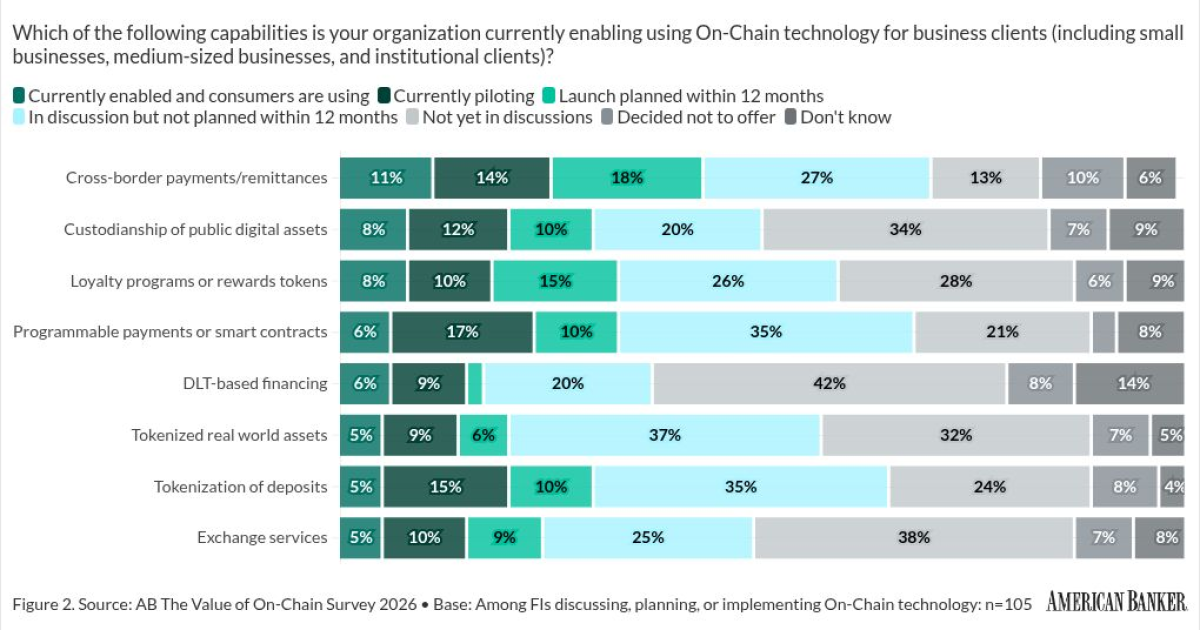
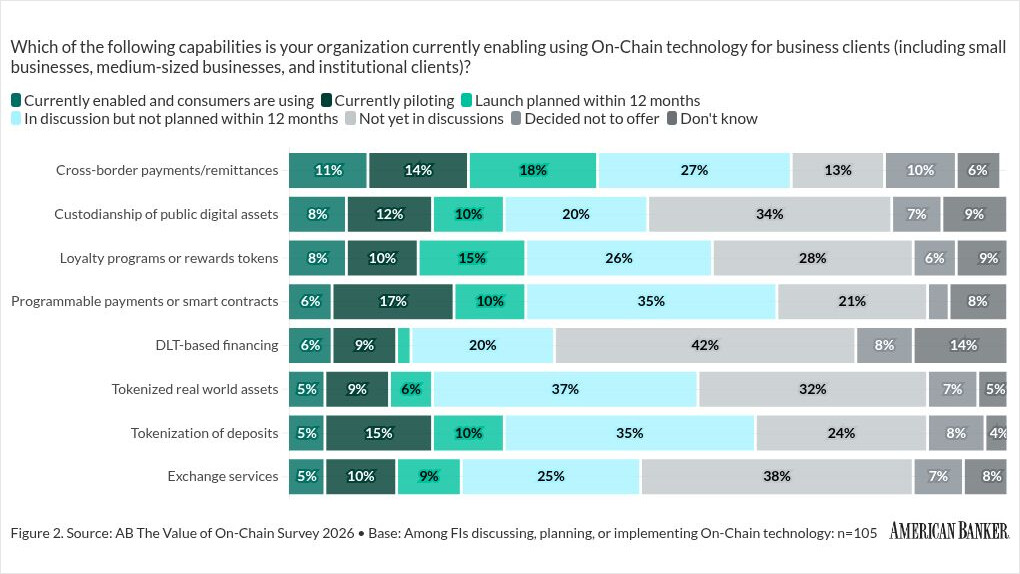
Swift is recruiting banks at a time when interest in digital assets is accelerating. About 40% of banks are either live or in some form of development of a blockchain-powered cross-border payment product, according to an
“By improving speed and predictability in cross-border payments, the Swift initiative gives consumers clearer visibility into when funds will arrive and what the costs will be,” Andrew Smith-Plenderleith, global head of high value payments at
For businesses, Swift and its network of banks have the compliance, AML, and sanctions-screening infrastructure and bank connectivity that regulators and treasurers worldwide already trust and understand, according to Phillip Philliou, a payments industry consultant.
“Those characteristics and historical use are difficult to replicate,” Philliou told American Banker. “Improving pricing visibility and delivering near-real-time funds transfer and availability will surely be well received by all participants.”
Read more:
In contrast, stablecoin rails still lack those features at scale for regulated, high-value flows, according to Philliou.
“Time will tell how stablecoins win over the trust of treasurers and CFOs,” Philliou said. “For consumer-to-consumer remittances, the market is nuanced depending on geography. For example, in Mexico, the remittance market is strong for bank and traditional money-send and pick-up businesses with strong regulatory ties, whereas India and the Philippines skew app-based and mobile wallet-based with gamification.”