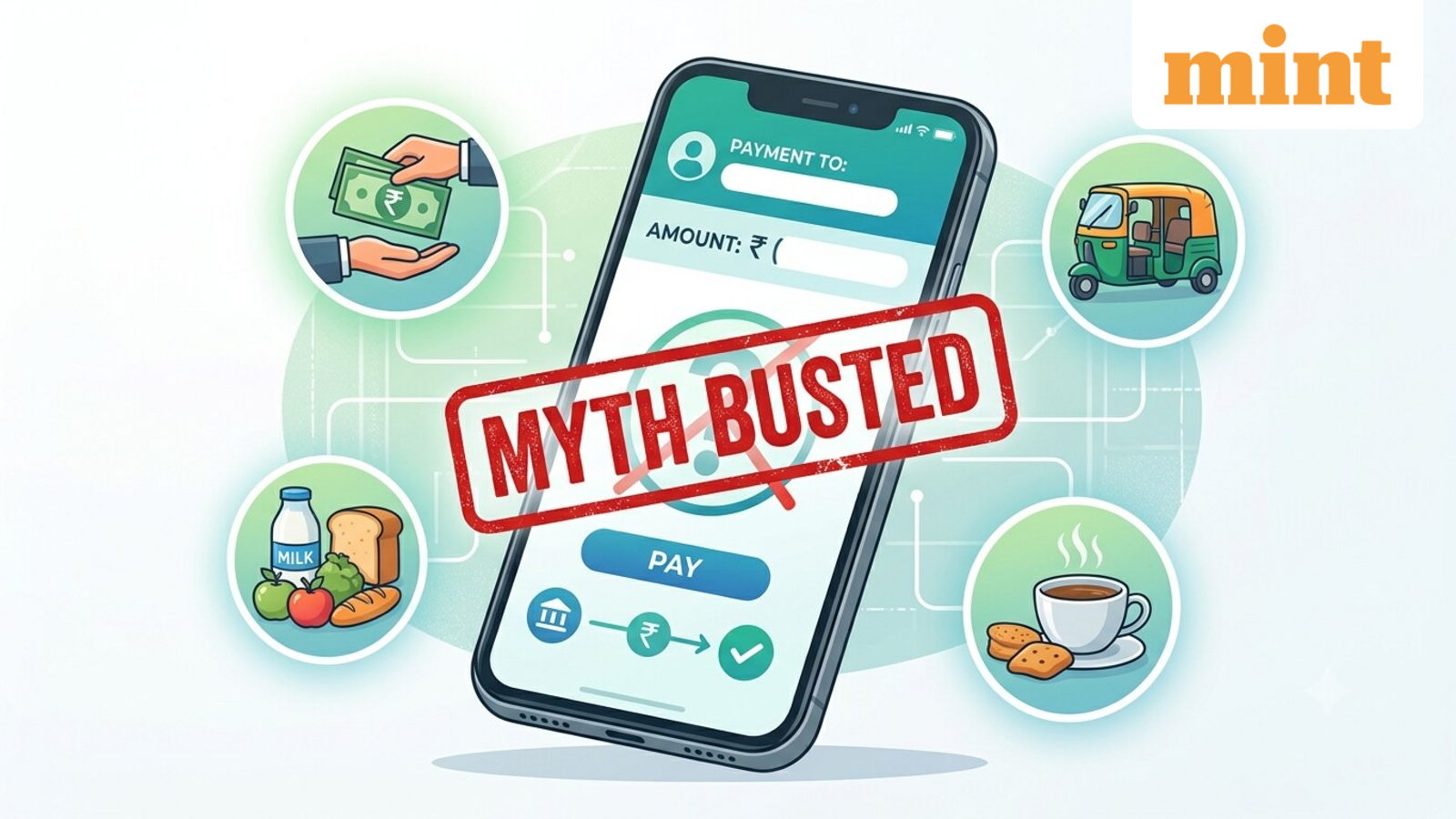
Will you be charged for UPI peer transfers, grocery payments? MyGovIndia busts myths on MDR; here’s what stays free
UPI users have little reason to panic over viral claims that everyday digital payments will soon become chargeable. A recent amendment to the Payment and Settlement Systems Act (PSS Act) has triggered debate, with some social media posts suggesting that users could soon have to pay for sending money through UPI.
In a post on X, MyGovIndia sought to debunk several claims circulating online and clarified that personal UPI payments remain free. Here’s what UPI users should know about the myths and facts.
Myth 1: Sending money to friends and family will become chargeable
Fact: All person-to-person (P2P) UPI transactions remain free.
MyGovIndia noted, “Standard bank-to-bank UPI transfers remain completely free for everyday personal use, with zero transaction charges added to your payments.”
This covers common transactions such as splitting a restaurant bill with friends, transferring rent, or sending money to family members.
So, if you use UPI to transfer money from your bank account to another person’s bank account, there will be no transaction charge imposed on you.
Myth 2: Every merchant accepting UPI will have to pay charges
Fact: Everyday UPI payments at merchants remain free for users.
MyGovIndia mentioned that any future merchant discount rate (MDR) framework, if introduced, would apply only to a limited set of merchant transactions above a specified threshold and at a nominal rate.
“Any future fee will only affect certain high-value business payments. The rate will be small and it will still cost much less than using a debit or credit card,” MyGov explained.
For users, this means paying for groceries, a cab ride or coffee through UPI does not become chargeable.
Myth 3: The amendment means UPI is no longer free
Fact: The amendment is an enabling provision, not a direct UPI fee.
According to MyGovIndia, the amendment “doesn’t introduce charges for everyday users”. Instead, it provides the groundwork for a possible future MDR framework while supporting the wider UPI ecosystem.
The post highlighted that the ongoing changes are aimed at making UPI “future-ready” by strengthening cybersecurity, improving network stability, preventing fraud and encouraging innovation.
Creating a legal framework for a possible future MDR mechanism is different from actually imposing a charge on UPI transactions.
Myth 4: The amendment is being driven by external pressure
Fact: UPI remains India’s home-grown digital payments system.
MyGovIndia described UPI as India’s own indigenous innovation. “If outside pressure had shaped its journey, it would not have launched in 2016, stayed 100% free for citizens and merchants since 2020, or grown into the world’s largest real-time payment network.”
The government also highlighted UPI’s growing international footprint, saying the payment system is now live in 11 countries.
Myth 5: Believe that WhatsApp forward? Think again
Fact: Viral messages claiming that UPI payments are becoming chargeable should not be taken at face value.
MyGovIndia urged users to look at the facts instead of relying on forwarded messages. UPI has become one of the world’s largest real-time payment systems. In July 2026 alone, users made more than 2,300 crore transactions worth nearly ₹30 lakh crore, according to the government.
“All these continuous updates are just meant to keep UPI safe, fast, and reliable, while keeping it completely free for everyday users,” as per the X post.
What should UPI users do now?
For consumers, there is no need to change how they use UPI based on these viral messages. The main thing to watch is whether an MDR framework is introduced for specific merchant transactions. For now, the viral claim that “UPI is ending free payments” is misleading.
Disclaimer: This is only for informational and educational purposes. Please visit the official website for the latest updates.