What’s Driving CMBS Distress in the Top U.S. Metro Areas – Commercial Observer
Across the 50 largest commercial mortgage-backed securities (CMBS) markets, $45.8 billion of $393.5 billion in outstanding balance is currently distressed, a balance-weighted rate of 11.6 percent, according to CRED iQ data.
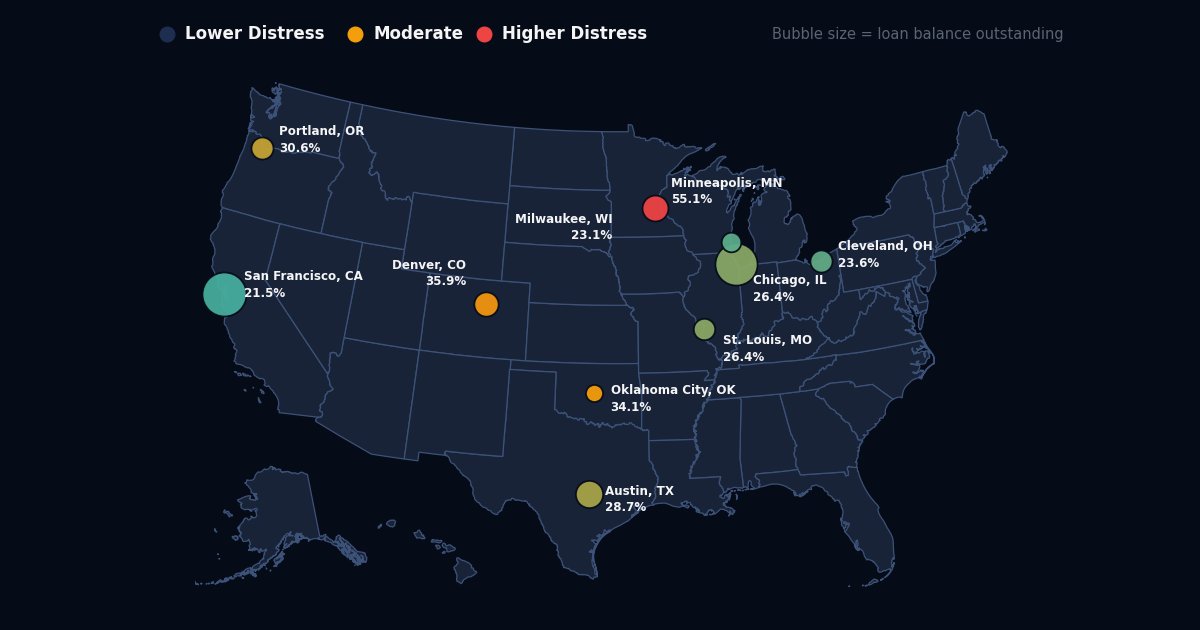
Minneapolis, Denver and Oklahoma City lead the distress rankings at 55.1 percent, 35.9 percent and 34.1 percent, respectively, each shaped by a handful of very large loans rather than broader weakness, while Salt Lake City sits at zero, and is therefore the cleanest metro in the top 50. Underneath it all, the property type driving distress has shifted. Multifamily distress has more than doubled since February, from 6 percent to 13 percent, while office distress has eased off from 21.2 percent to 16.7 percent.
Minneapolis, Denver and Oklahoma City top the list of most distressed metropolitan areas, followed by Portland, Ore. (30.6 percent), Austin (28.7 percent), and a cluster of Midwest metros, specifically Chicago (26.4 percent), Cleveland (23.6 percent) and Milwaukee (23.1 percent), plus San Francisco (21.5 percent). At the other end of the spectrum, Phoenix, Boston, Las Vegas and Orlando, Fla., all sit around 3 percent, with San Diego and Salt Lake City as the most stable large markets at 0.4 percent and zero percent, respectively.
Office remains the largest source of cumulative distress at 16.7 percent ($22.5 billion, roughly half of all distressed balance nationally), followed by mixed-use (14.4 percent), multifamily (13 percent), lodging (10.6 percent) and retail (8.8 percent). Industrial is the clear outperformer at just 1 percent.
Regionally, the Midwest’s 10 metros average 22.7 percent distress, driven by concentrated issues in Minneapolis, Chicago, St. Louis, Cleveland, Milwaukee and Cincinnati, while the Northeast, West and South all cluster near 10 percent.
July movers and the trend since February
In July, 180 loans totaling $992 million became newly distressed. Approximately 96 percent of this total was multi-
family, led by an $84 million Houston apartment loan, with the largest single distressed event being a joint $111 million special servicing transfer of two Santa Monica, Calif., hotels.
Since February, Denver experienced the most significant move of any major metro, jumping 13.5 points from 22.4 percent to 35.9 percent due to two large office defaults and becoming the No. 2 most distressed market nationally. Minneapolis held steady at No. 1. In more positive news, Portland and Oklahoma City both improved by several points, while New York, Los Angeles and Washington, D.C., stayed roughly flat.
The bigger story is the property-type shift: Office distress fell nearly five points since February while multifamily distress more than doubled.
Deals that drove distress in July
• Weston Medical Center apartments in Houston: $84 million loan, newly 60-plus days delinquent.
• Ariza Forest View apartments in Santa Rosa Beach, Fla.: $61 million loan, newly delinquent, less than 30 days.
• Mirasol apartments in Las Vegas: $53.1 million loan, newly delinquent at performing maturity.
• Solaire apartments in Bethesda in Bethesda, Md.: $49.6 million loan, newly delinquent less than 30 days.
• The Sophia apartments in Dallas: $38.9 million, newly 60-plus days delinquent.
Other notable July movers
• Bank of America Tower in Midland, Texas: $19 million loan, newly 121-plus days delinquent; part of a five-property, $43 million distressed office portfolio.
• Hawthorne At Clairmont in Atlanta: $36.6 million multifamily loan, newly delinquent.
• Multiple small Brooklyn multifamily loans, including 836 DeKalb Avenue, 105–107 Vanderveer Street and 431 Grand Street — all newly delinquent in July.
Liam Mulcahy is senior product manager for CRE data and applied AI at CRED iQ.