Method Financial CEO: Lenders Spot Borrower Distress Too Late
A lender underwrites a borrower on the strength of a financial picture that starts aging the moment the loan closes.
It’s then when things move. The borrower pays down a card. Picks up an obligation the lender can’t see. Improves enough to qualify for cheaper money somewhere else. Cancels autopay.
Every one of those is a fact about a loan the lender already owns. Almost none of them arrive in time to be useful.
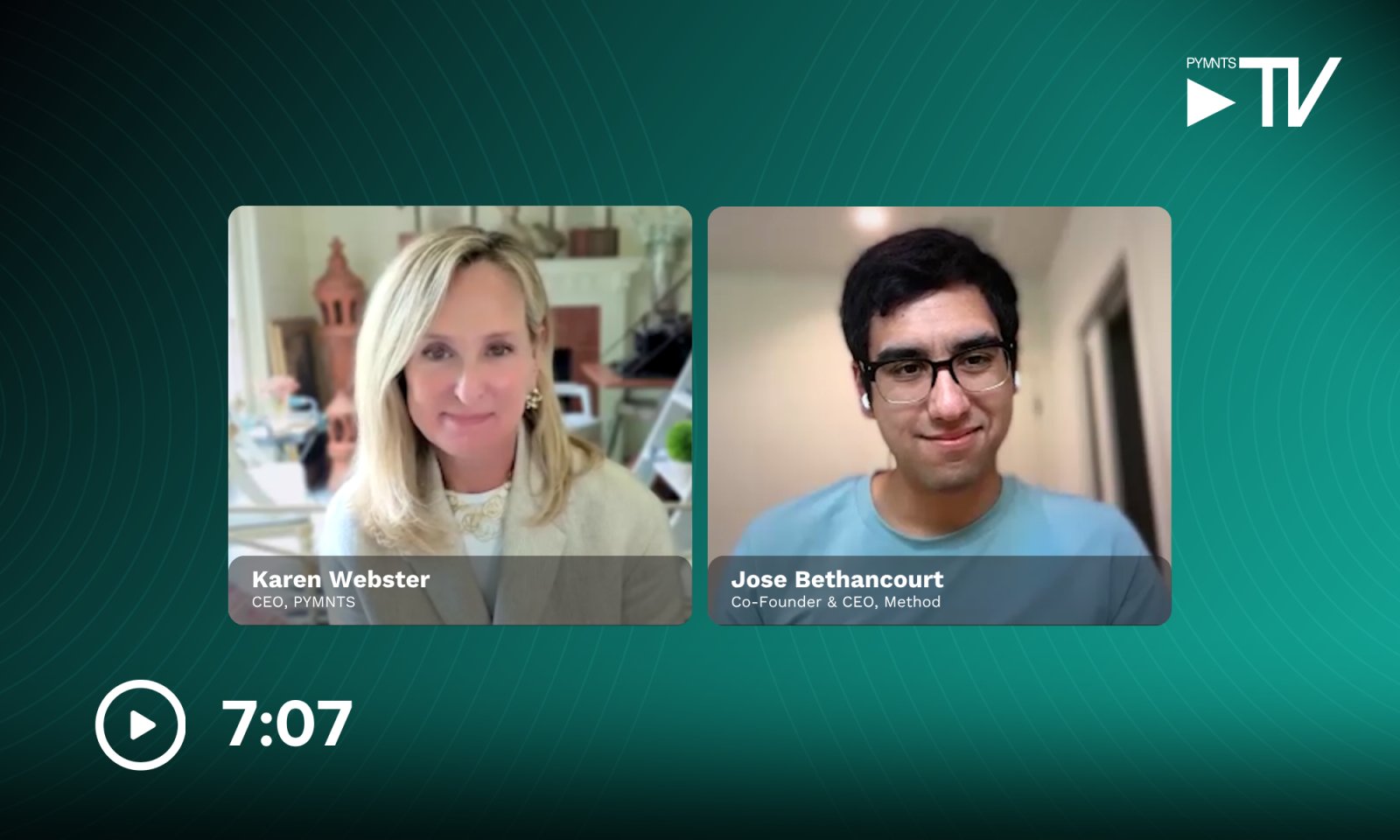
That gap framed PYMNTS CEO Karen Webster’s Monday Conversation with Jose Bethancourt, co-founder and CEO of Method Financial.
“Millions of Americans are in this debt cycle,” Bethancourt said.
They aren’t well served by what passes for debt information. An app shows a due date or suggests an extra payment. It doesn’t tell a consumer whether refinancing would lower the cost of what they already owe, or whether something else on the household balance sheet has exposed a better option.
The appetite for that guidance is real. As Webster put it, “people take their use of credit very seriously, and they want to be responsible with it.”
The lender wants the same clarity, for less altruistic reasons.
“Everyone’s trying to acquire more” customers, Bethancourt said. Institutions are hunting for “positive signals” that identify consumers they can serve, and trying to reach them before a competitor does.
That race doesn’t stop once the lender wins the account. The next loan can go somewhere else. A borrower who was declined can become creditworthy without ever coming back to the institution that turned them down. A customer paying high rates elsewhere can sit there as a refinancing prospect the existing lender never knows it has.
So the problem isn’t a shortage of data. It’s whether a lender can recognize a meaningful change while there’s still time to act on it.
What Changed Since the Loan Was Made?
CEO Bethancourt said that’s the case behind Method’s Portfolio Intelligence, announced at the end of last month. The product tracks more than 90 financial-health signals after origination and notifies lenders when a borrower crosses criteria the institution sets. Once consent is captured at origination, Bethancourt said, monitoring continues without asking the borrower to reconnect accounts again and again.
Method leaves the definition of a relevant event to the lender. That might be becoming eligible to refinance, or improving enough to justify revisiting a rejection.
The early demand is on that side of the ledger, and the early numbers are good. In an eight-week pilot with a major mortgage provider, the company said, the lender saw a 40% increase in borrowers who qualified for debt consolidation and a 27% increase in HELOC-eligible borrowers.
Those are customers the lender had already paid to acquire and had already written off as ineligible. Falling utilization, declining balances and improving payment behavior turned them back into prospects.
The Signal That Shows Up Before the Missed Payment
Read the same feed in the other direction and it does something the underwriting industry has wanted for a long time and rarely gets.
Utilization climbing. Payment-to-minimum ratios sliding toward the floor. Autopay switched off. None of those is a default. All of them tend to precede a default.
PYMNTS CEO Webster called the two sides of the proposition “grow and protect.” Method CEO Bethancourt acknowledged that demand today leans toward grow. Lenders are buying a pipeline before they buy an alarm. But he said the same information supports the other case. When a borrower deteriorates, the lender has an opening to offer a payment plan or another response to financial distress.
The timing is the whole point. A lender that learns a borrower is straining while the account is still current has a conversation available to it. A lender that learns it from a missed payment has a collections problem. The distance between those two outcomes is a few weeks of signal.
It’s also the harder sell, and the more durable one. Acquisition lift is a good quarter. Loss avoidance is what a portfolio manager gets asked about when the cycle turns.
Getting the Liability Data Without Adding Another Barrier
None of it works without the plumbing, and the plumbing came from a much smaller problem.
Method CEO Bethancourt and co-founder Marco Segura left college with roughly $100,000 each in student loans, he said, and no clear sense of who serviced them, what the rates were or how to manage them. They built an app for themselves and found that displaying the debt was the easy part. Connecting reliably to the information underneath it wasn’t. That connectivity became Method’s B2B business.
Method can begin identifying liabilities without asking a consumer to hand over individual account passwords. It works with mobile network operators to confirm that a phone number belongs to the consumer and that the consumer is physically holding the device, and layers in Touch ID, Face ID and mobile-network signals alongside KYC and CIP procedures.
“We had to figure out a way where we could still keep that high security and high fidelity that we need” in an era of AI and cyberattacks, Method CEO Bethancourt said.
That architecture is also why the unsettled Section 1033 debate lands on Method’s desk, though Bethancourt didn’t treat the prospect of paying for data access as existential. He said Method considers access to financial data a consumer right while accepting that the institutions supplying it incur costs, and noted the company already compensates some data providers, including credit bureaus.
Which is where the two sides of this stop competing. Consumers want better terms on debt they already carry. Lenders want performing customers, and a second chance at the ones they lost. Knowing what changed after the loan was made is what tells either side it’s time to talk. Knowing it early is what determines whether the conversation is an offer or a workout.
Watch the full Monday Conversation with Jose Bethancourt to learn more about:
- Why lenders want better visibility into BNPL and other obligations that may not surface through conventional reporting.
- How Method uses mobile-network and device signals to authenticate consumers without requiring individual financial-account passwords.
- Why Bethancourt’s own student loans led him from a consumer app to the liability connectivity underneath Method Financial.