Prediction: This Crucial Rivian Metric Will Turn Positive by Year-End
One of the most important ways Rivian (RIVN -1.16%) has separated itself from rival Lucid (LCID +4.18%) has been its ability to improve vehicle unit economics. It’s well known that Rivian expects the R2 to check in at about half the production cost of even the more recent R1 vehicles. Rivian’s improving unit economics have consistently improved its gross margins, even achieving its first full-year gross profit in 2025.
Rivian is about to be put to the test during the R2 ramp-up, and my prediction is that we’re about to see Rivian’s automotive gross profit finally turn positive as early as the third quarter — software and services have largely been driving overall gross profitability. Let’s take a look at where the EV maker‘s automotive gross profit is trending and why it matters.
Gross profit progress
Here’s a quick look at the consistent progress that Rivian has made in its gross profitability compared to rival Lucid, which has been unable to make the same improvements to vehicle costs and scale.
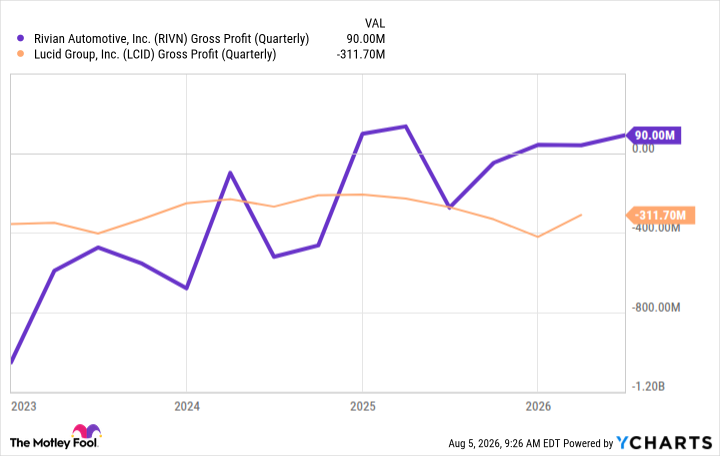
RIVN Gross Profit (Quarterly) data by YCharts
As you can see, while Lucid has remained largely flat in gross profitability, Rivian’s improving unit economics have consistently driven its results higher, despite starting from a worse initial position than Lucid. Rivian’s second quarter brought more improvement: Consolidated gross profit was $179 million, a significant $385 million improvement over the prior year.
It’s important to break down consolidated gross profits into two segments: automotive, software, and services. As R2 deliveries accelerate, it should drive automotive gross profitability higher and provide a nice boost to the company’s efforts to one day reach operating profits and become a self-funding business — exactly what will generate demand for the stock and send its price higher.

Rivian’s R2. Image source: Rivian.
Breaking it down
During the second quarter, automotive gross profit was a loss of $36 million, still a vast improvement over the prior year’s $335 million loss. Software and services gross profit not only checked in at $215 million but also at an impressive 42% margin. Those are not margins historically associated with the automotive industry, but that narrative is slowly changing for the better as more vehicles are software-defined and loaded with apps, services, and subscriptions.
While software and services have been the gross profit engine, Rivian has significant upside in automotive gross profitability as the R2 continues to accelerate production and even adds a second production shift toward the end of the third quarter.

Today’s Change
(-1.16%) $-0.18
Current Price
$15.38
Key Data Points
Market Cap
Day’s Range
$15.30 – $15.87
52wk Range
$11.58 – $22.69
Volume
13.9M
Avg Vol
34.2M
Gross Margin
2.06%
What’s in store for Rivian stock?
Rivian’s automotive gross profit was a little tricky to gauge in the second quarter because the improvement was aided by factors beyond increases in production and delivery volumes. Rivian benefited from increased revenue from regulatory credits, as well as from an IEEPA tariff refund receivable. On the flip side, as Rivian only began external deliveries of the R2 as of June 9, it recognized roughly $100 million in incremental cost of revenues due to the early production ramp-up relative to expected levels.
All that said, analysts at Baird cited improved gross margins as a primary reason for upgrading Rivian stock to “outperform.” Meanwhile, analysts at TD Cowen also raised Rivian’s price target to $21, maintained its “buy” rating, and also noted improved margins and a bright outlook for the R2 program.
It’ll be a significant challenge for Rivian to flip automotive gross profit into positive territory in the third quarter due to early-launch economics as it works toward normalized production levels. Still, it’s possible given the progress it has consistently made.
Starting with the second quarter of 2025, Rivian’s automotive gross margin has moved from (36%) to (11%), (7%), (7%), and (3%) each quarter. But my prediction is that once a second shift of R2 production is added, improving scale and plant production optimization, it will turn positive during the fourth quarter and quickly grow to rival, and perhaps surpass, software gross profits in the medium term.