South Korea’s Kospi tumbles 5% after 2-day rally, angry retail investors vow not to invest again
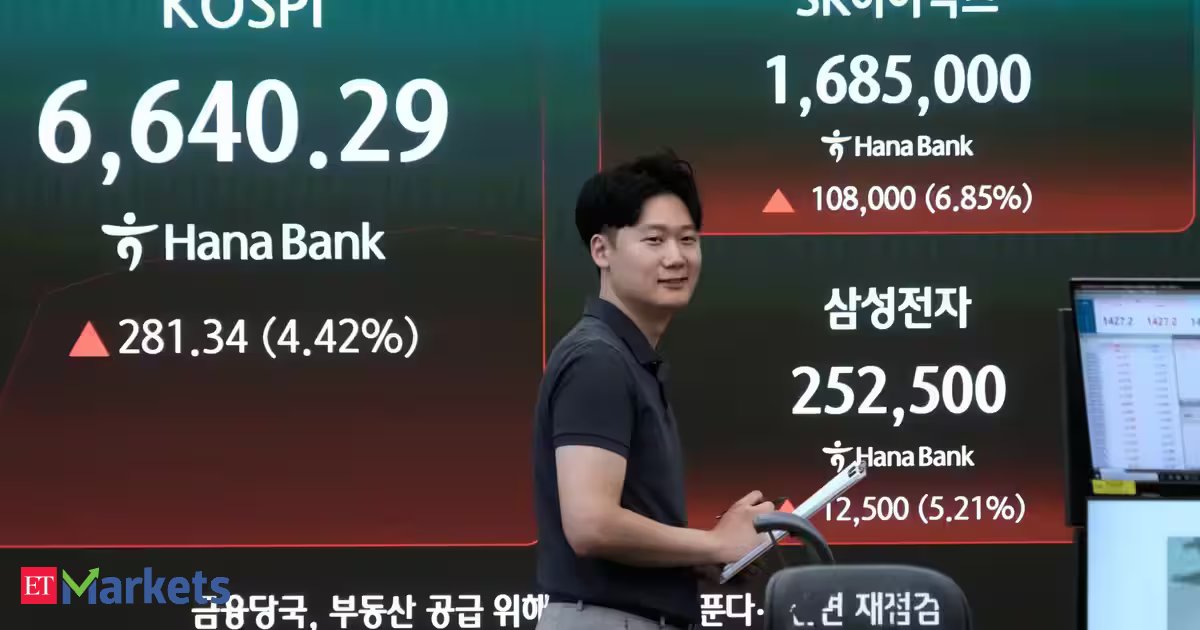
Kospi plunged more than 5% to 6,238 on Thursday, as Samsung shares tumbled over 5% and SK Hynix tanked nearly 7%. The South Korean market is tracking a tech rout on Wall Street, where Nasdaq fell nearly 1% as SpaceX and Advanced Micro Devices slid following their earnings reports. Foreign investors continued to be net sellers in the Korean market, selling shares worth $108.5 million.
Kospi’s skyrocketing rally earlier this year, followed by a massive crash, has been grabbing headlines. The Korean benchmark index rallied over 122% since the beginning of the year to hit a lifetime high of 9,386 in June on the back of a global AI frenzy, taking the position as the world’s best-performing stock market this year so far. However, things soon began to go downhill.
Analysts pointed out the concentration of chipmakers Samsung Electronics and SK Hynix, which make up just over half of the benchmark Kospi. The final nail in the coffin seemed to be the single-stock leveraged ETFs linked to these two chipmakers, which further increased concentration risks, leading to the Kospi spiralling down.
Retail Korean investors vow to never invest in the market again
In the middle of this seesaw market movement, retail investors emerged as the most affected, as they lost massive sums of wealth after these leveraged products wreaked havoc in the country’s financial markets. South Korea’s local investors, including young people, pensioners, parents, and others who borrowed money and piled in late, are hurting the most.

Kim Han-kyung, a Seoul resident in her late 30s, resolved never to invest again, while others are comparing the $3.9 trillion market to a casino, Bloomberg reported. Many blamed the government for its push to invest in the stock market, as well as for the debut of single-stock leveraged ETFs offering the prospect of amplified gains.
“That was the era of the Kospi mania. I got completely swept up in the frenzy. Now, I am honestly scared. I have engraved two rules in my mind now. First: don’t invest in the Korean stock market. Second: follow the first rule,” Kim, who started investing in Korean stocks for the first time in early May, was reported as saying by Bloomberg.
South Korean government apologies
During a parliamentary session last month, South Korea’s Finance Minister Koo Yun-cheol apologised for the introduction of single-stock leveraged ETFs, saying they had not been considered carefully enough. He added that the government is reviewing market stabilisation measures, including adjusting regulations related to the funds, which some analysts have blamed for increasing the amount of leveraged trading in the Seoul bourse.
South Korea’s President Lee Jae Myung recently said, “Our domestic stock market is quite unstable.” He noted that since the country’s stock market experienced a historically unprecedented massive surge in such a short period, it would require time and fluctuation to stabilise.
What lies ahead for South Korea’s stock market?
Nomura believes that the heavy correction in South Korea’s equity market was driven by heavy selling by foreign investors, slowing institutional support and volatility due to the rapid growth in leveraged ETFs and newly launched single-stock leveraged products.
“We believe these factors led to amplified volatility despite resilient corporate fundamentals. As market “deleveraging” progresses and foreign selling pressure eases, the next leg of Korea’s rerating is likely to be supported by corporate share buybacks and treasury-share cancellations, particularly from large-cap companies, in our view,” the international brokerage said, adding that this should become a new structural source of demand and help Kospi re-rate toward a 10,000-11,000 target.
(With inputs from agencies)
(Disclaimer: Recommendations, suggestions, views and opinions given by the experts are their own. These do not represent the views of The Economic Times)